
State Without a Horizon
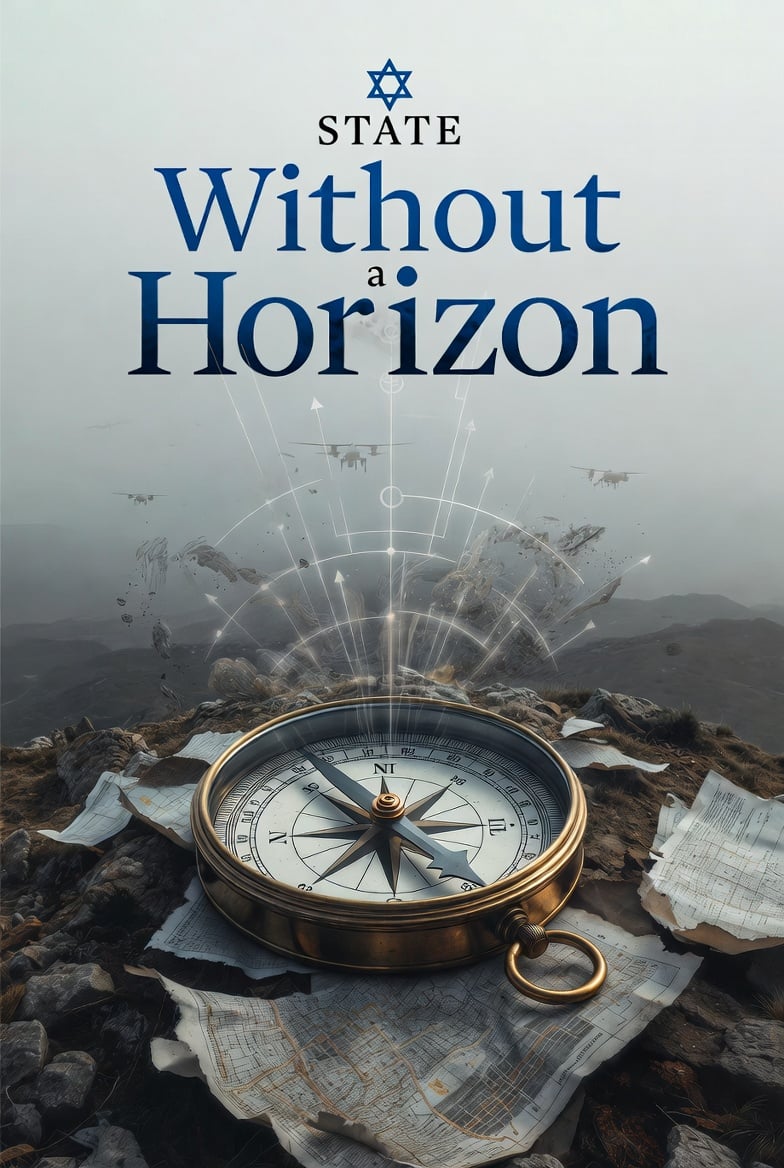
Original artwork by Yochanan Schimmelpfennig.
המרכבה נוסעת, והכיסא ריק
Ha-merkavah nosa’at, veha-kise rik.
The chariot keeps moving, but the throne is empty.
State Without a Horizon
Israel is not only fighting a war. It is revealing what happens when a state of immense force continues to move, strike, and destroy, but no longer carries judgment at its center.
That is the deeper crisis now. Not only Iran. Not only Hezbollah. Not only the widening fronts, the attrition in the north, the strain on reserves, the economic burden, or the growing dependence on Washington. The deeper crisis is that Israel’s leadership increasingly behaves as though force itself were direction, as though movement alone were strategy, as though the chariot could keep advancing even after the seat of judgment had gone empty.
No serious observer denies the reality of the threat. Iran is real. Hezbollah is real. Israel has had to fight, and at times it has fought effectively. The problem is not force as such. The problem begins when force becomes the only language leadership still knows.
A serious state must be able to answer a question more difficult than any operational briefing: what political form is being defended, and what kind of life is meant to exist the day after? On that question, the present leadership offers almost nothing beyond the ritual of toughness.
Benjamin Netanyahu has spent years converting perpetual alert into a method of rule. Keep the public inside permanent alarm. Keep politics suspended in survival language. Keep every crisis sufficiently open that accountability can always be delayed. This may prolong the life of a leader. It does not provide a horizon for the state.
Even Israel’s indispensable alliance with the United States does not solve that problem. External backing may supply weapons, diplomatic cover, and time. It cannot supply judgment. It cannot define an end state. It cannot tell a society what kind of future it is supposed to be fighting for.
This is why the northern front matters so much. It is not just another military arena. It is an audit. A sovereign state must be able to offer its citizens more than periodic retaliation and televised vows of resolve. It must be able to offer the credible prospect of durable civilian life. If, after repeated waves of action, the north remains a zone of chronic exposure, then the problem is not merely military. It is governmental.
This is the sentence many Israelis still hesitate to say aloud: a state can be militarily formidable and strategically hollow at the same time.
Israel can still penetrate, retaliate, eliminate, deter tactically, and surprise operationally. But can it define success? Can it explain what stable security would actually look like beyond the next strike, the next siren, the next funeral? Can it distinguish alliance from dependency when Washington increasingly shapes tempo and the search for eventual exit? Those are not opposition questions. They are state questions.
Some of the sharpest criticism in Israeli discourse has already moved in this direction. The issue is no longer simply whether an enemy is weakened. The issue is whether a leadership has become so accustomed to open-ended pressure that pressure itself has become the nearest thing it has to a governing doctrine.
And this is where the rot deepens: in the merger of disorientation and impunity.
Disorientation means the state continues to act without convincingly explaining toward what political order it is acting. Operations continue. Statements continue. Movement continues. Direction does not.
Impunity means failure no longer produces responsibility. Every dead end becomes complexity. Every overreach becomes resolve. Every postponed reckoning becomes national necessity. In such a climate, accountability does not disappear by accident. It is politically dissolved.
The image of the merkavah is useful here precisely because it exposes the scale of the loss. The chariot is not the problem. Motion is not the problem. Power is not the problem. The problem begins when the vehicle remains, the force remains, the capacity to strike remains, but the seat of judgment stands empty. Then movement becomes compulsion. Then war ceases to be a tragic instrument and becomes a governing environment. Then the state keeps advancing while its center of responsibility recedes.
A mature leadership would not need a ready-made utopia. It would need three things that are now missing: a defined political end state for the north, a credible limit to open-ended escalation, and a public account of what kind of state is being defended beyond survival alone. Not a fantasy. Not a slogan. Only the bare minimum of adult seriousness.
That is not what Israel has today.
What it has instead is a leadership class too comfortable with perpetual alert, too insulated from consequence, and too practiced in turning each new conflict into a reason not to be judged for the previous one. Netanyahu no longer appears as the steward of a future. He appears increasingly as the manager of national drift.
Israel does not need another liturgy of toughness detached from political destination. It needs strategic adulthood: leaders capable of limit, responsibility, truth, and the moral seriousness to admit that force without horizon eventually becomes a trap for the very state that wields it.
The deepest crisis, then, is not simply that Israel is under attack. Israel has been under attack before.
The deepest crisis is that too many of its leaders still behave as though permanent pressure were itself a doctrine, as though instability were manageable indefinitely, as though history could be governed by fire alone.
It cannot.
And that is why this moment is not only dangerous.
It is revealing.
Yochanan Schimmelpfennig
Yochanan Schimmelpfennig is a Sephardic philosopher and independent researcher with academic training in political science, the social sciences, and philosophy (university level). He developed the Possest–PQF framework (Philosophical–Quantitative Filtration) and is co-author, with Andityas Matos, of Kabbalah Antision. His work examines language as a political instrument, exile and belonging, Jewish identity, and the procedural mechanisms through which modern institutions sort legitimacy, visibility, and dissent. He writes in a deliberately mechanistic register, treating culture and politics less as “opinions” than as operational systems that shape what can still count as real, permissible, and shared.