
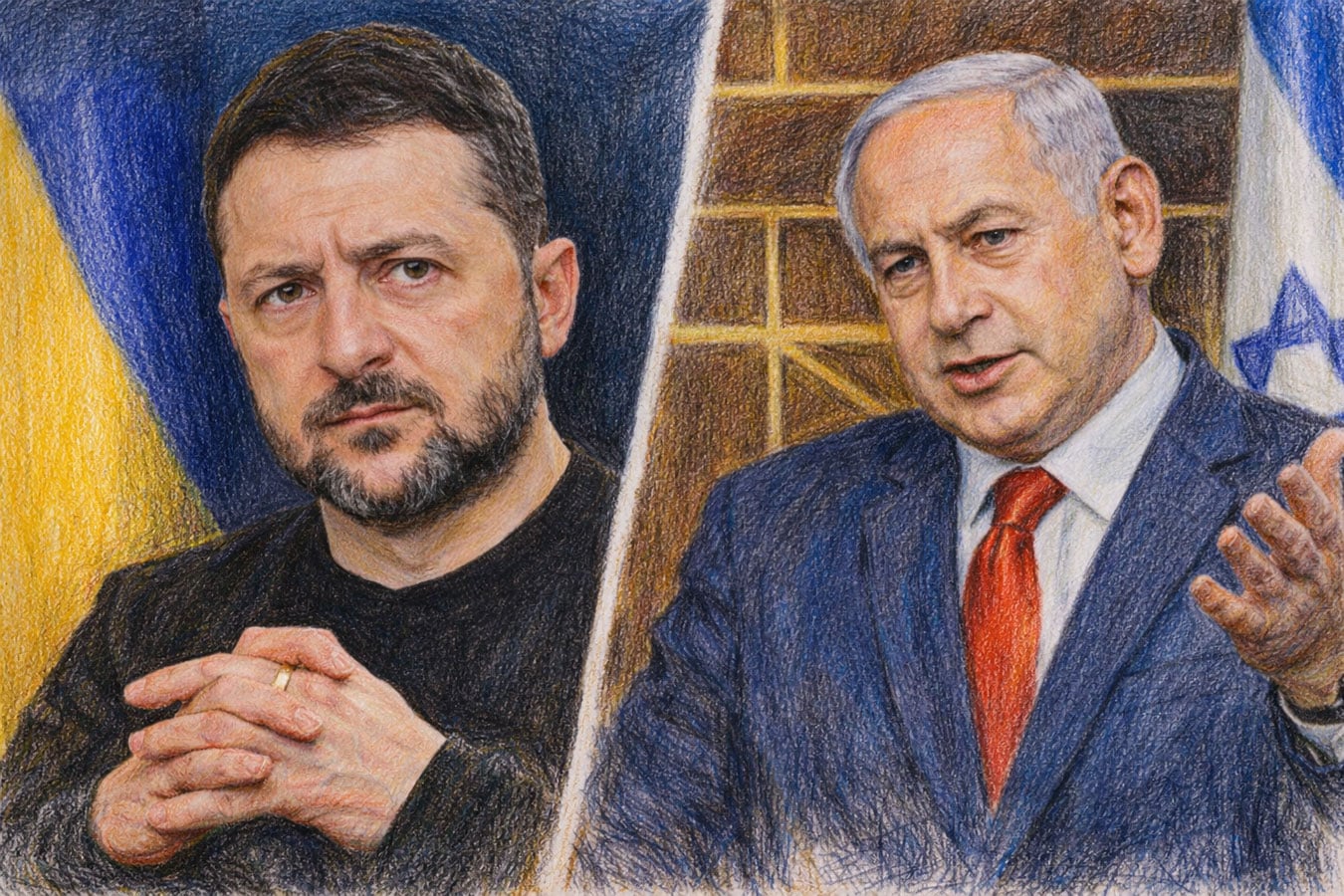
On March 28, this story took on an especially uncomfortable dimension for Jerusalem.
While Ukrainian President Volodymyr Zelensky was traveling through the Gulf, negotiating security cooperation, fuel supplies and joint projects tied to the Iranian threat, Axios correspondent Barak Ravid wrote on X that Israel was the only country that had not invited him. Ravid added that Prime Minister Benjamin Netanyahu had requested a phone call with Zelensky two weeks earlier, but never followed through.
That caveat matters. At this stage, what exists in the public domain is Ravid’s post, not an official statement from the Prime Minister’s Office.
“Ukrainian President Zelensky has been visiting all the Gulf countries over the past two days in order to strengthen security cooperation against Iran. The only country that did not invite him is Israel. Netanyahu asked to speak with him by phone two weeks ago, but then didn’t call and disappeared. At the same time, Putin continues to provide Iran with nonstop military assistance.”
For an Israeli audience, the issue here is not protocol, and not the formal question of who invited whom.
The issue is the signal.
Against the backdrop of the war with Iran, Ukraine has suddenly stopped looking to the Gulf states like just another Eastern European country defending itself from Russia. Kyiv is now offering something the region values at the highest possible level: hard-earned, battlefield-tested experience in countering Iranian drones and missiles.
And at precisely this moment, the Jerusalem-Kyiv line appears not stronger, but suspended.
What happened during Zelensky’s Gulf tour
Ukraine arrived not as a supplicant, but as a provider of expertise
According to Reuters and AP, Zelensky recently visited the United Arab Emirates and Qatar, while Kyiv had already developed a similar defense track with Saudi Arabia. In Qatar’s case, the talks involved a 10-year partnership on countering missile and drone threats. A comparable arrangement with the UAE is reportedly expected. Ukrainian specialists are already working in parts of the region, helping protect critical infrastructure from attack.
In those talks, Ukraine was not acting merely as a country asking for weapons or money. It was also positioning itself as a supplier of expertise — and after Iranian strikes across the region, that expertise has become strategic.
That is the central shift Israel should notice without illusions. For years, much of the local conversation viewed Ukraine either through a Russian lens or through the tired formula that the war was tragic, but distant. That is no longer true. Ukraine has entered the Middle Eastern security equation through the most sensitive door possible: Iran.
Doha, Abu Dhabi and Riyadh appear to have grasped that quickly. Jerusalem, at least from the outside, still seems slower to draw the full political conclusion.
Fuel, drones and long-term agreements are part of one package
At the same time, Zelensky was pursuing a far more practical goal. Reuters reported that Ukraine is seeking new diesel supplies from the Middle East, because diesel remains one of the most vulnerable parts of the country’s wartime fuel balance. Zelensky later said he had secured diesel deliveries for at least a year.
For Ukraine, that is not just an economic issue. It is about the army, logistics, agriculture, transport and the internal movement of an entire country at war.
That is why this tour should not be read as a routine diplomatic swing with ceremonial meetings and polished photographs. It was an attempt to insert Ukraine into a new regional reality in which confronting Iran, protecting energy infrastructure, developing joint production and building long-term military arrangements are all part of the same strategic package.
Kyiv is offering the Gulf protection know-how and operational experience. In return, it is securing not only contracts and financing, but also resources essential to survival.
Why the Israel angle looks especially awkward
Because Jerusalem itself appeared to be seeking contact
The most uncomfortable part of the story for Israel’s leadership is not even Ravid’s post. It is the contrast with what was reported only days earlier.
On March 14, Ynet reported that Netanyahu had sought talks with Zelensky specifically on Ukraine’s experience in confronting Iranian drones. The Times of Israel also reported that the discussion could involve cooperation on countering Iranian unmanned systems. In other words, Jerusalem itself had already acknowledged that Kyiv possesses knowledge Israel needs.
And that is where this stops being a technical matter and becomes a political one.
If the prime minister requested contact two weeks ago because Israel wanted Ukrainian anti-drone experience, yet now, according to Ravid, the conversation never happened and no visit was offered, this does not look like a minor scheduling mishap.
It looks like a sign of deeper hesitation. Jerusalem wants Ukrainian know-how and operational lessons, but still appears reluctant to define a clear political line toward Kyiv even as Iran is at war with Israel and Moscow continues to assist Tehran militarily.
That is the core of the story. Israel is now confronting what Ukrainians have been saying for a long time: the Iranian threat no longer exists in a parallel universe, separate from Russia’s war against Ukraine. The two fronts have merged.
Kyiv is already drawing diplomatic and military-technical conclusions from that reality. Jerusalem still seems to be acting in short tactical bursts, without a fully articulated strategy on the Ukrainian front.
What this means for Israelis now
Zelensky is bringing back more than symbolism from the Gulf
AP and Reuters both noted that Zelensky said he had not seen signs that American weapons were being diverted from Ukraine to the Middle East, though he acknowledged that much would depend on how long the war lasts. At the same time, he denied that Kyiv was being pressured to surrender the Donbas in exchange for security guarantees, even though he had previously described American signals on that issue as deeply troubling.
In other words, Kyiv is now playing on several boards at once: securing resources, trying to prevent any weakening of Western support, and strengthening its place in a region where Iran has become a common threat.
For Israel, the lesson here is direct, not theoretical.
While parts of the Israeli establishment still tend to view Ukraine as a distant war governed by a separate logic, the Gulf states are already treating Kyiv as a source of concrete military solutions. That is a striking moment. Arab monarchies seem to have integrated Ukrainian experience into their strategy against Iran faster than the state Iran itself defines as its principal enemy in the region.
That is, of course, an interpretation. But it rests on a visible pattern: Kyiv’s confirmed security and strategic deals with Qatar, Saudi Arabia and the UAE, alongside reports of a stalled Israeli track.
None of this proves that Israel has definitively rejected Zelensky, or that it is deliberately rupturing ties with Ukraine. There is not enough public evidence for that conclusion.
But something else is already clear. Against the backdrop of the war with Iran, Ukraine has become significantly more important to the Middle East than it was even a month ago. And Israel now risks finding itself in the position of a country that hesitated too long just as a new regional configuration began to take shape without it.
If one looks at the situation soberly, the question is no longer whether Netanyahu offended Zelensky. That is too small a frame for the moment.
The real question is whether Israel’s leadership understands that Ukraine is rapidly becoming one of the practical actors in a new Middle Eastern architecture of deterrence against Iran.
And if it does, why does Jerusalem still look less like an initiator in that process than a late observer.