
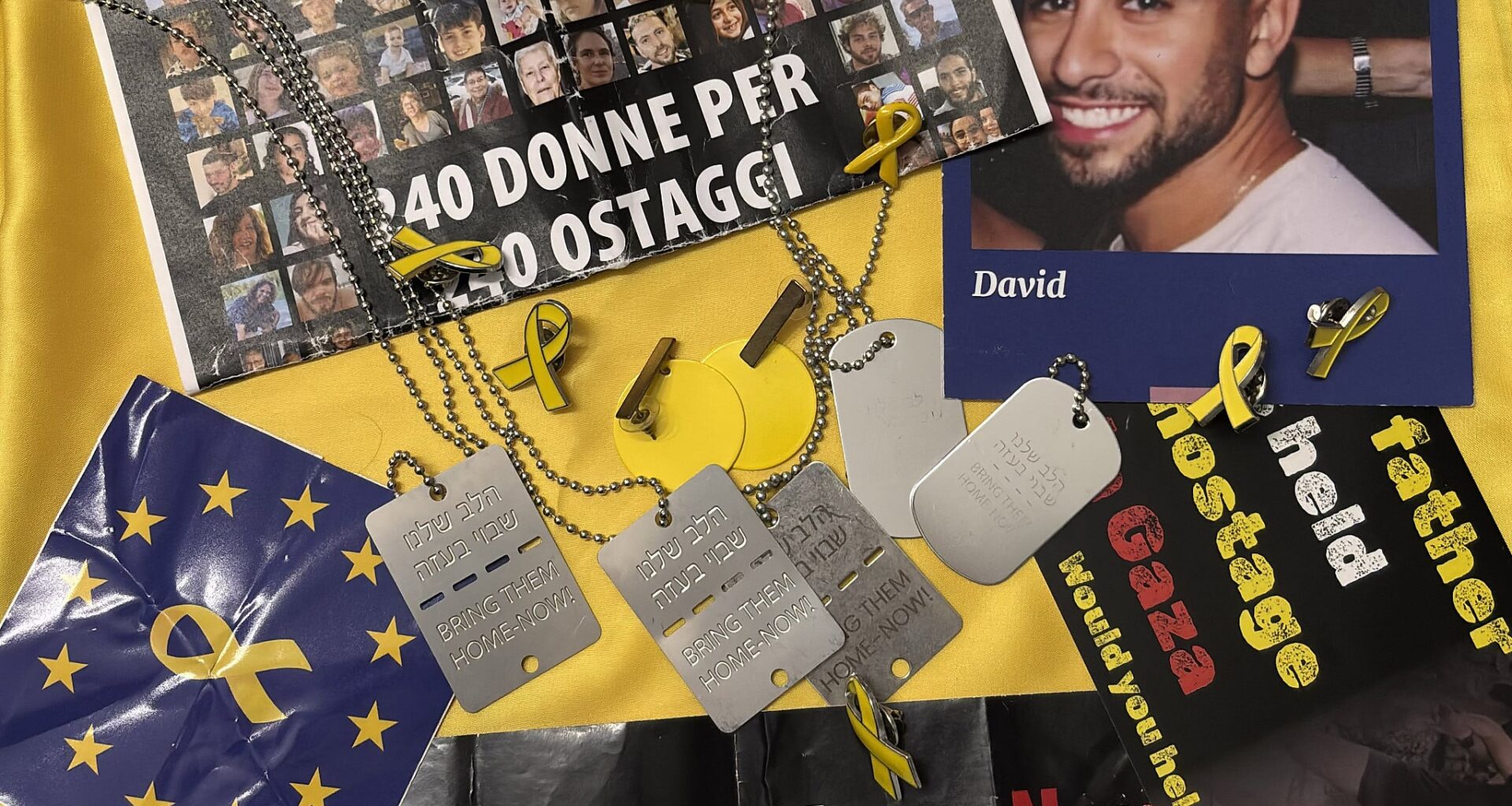
The time of Pesach is a time for cleaning. A moment when, more than ever, we inspect every corner of our homes, searching for crumbs of chips eaten who knows when, candies, packets of gum, and in my case, single portions of chocolate. If one is particularly lucky, opening bags reveals banknotes you forgot you had. Business cards from months ago resurface, together with restaurant receipts and lip gloss. This year, however, beyond a few coins, there is something different that catches my attention as I clean, meter by meter, every inch of my room.
For the first time since October 7, 2023, this will not just be another Pesach, but a new kind of Pesach. One in which, even as Israel still struggles to sleep in peace, it does so in a different way.
From the pockets of my bags and the pages of my notes, emerge photos of former hostages, yellow pins, folded sheets of prayers appear, tucked into Haggadot and siddurim. I never realised how many I had. The only thing I do not see is the trace of tears, those remain in the heart, and no cloth or soap will ever be able to erase them. And so, on the desk of my small room in Rome, a small mountain of memories from one of the darkest periods in the modern history of the Jewish people begins to gather. Like everything else, these too must be put in order.
The desire to tidy my room becomes a desire to reorder my mind. To find not only a drawer where I can place these memories, but also a way to sort through everything. Because the truth is that the cleaning of Pesach is not only about our homes, but about ourselves as well. As I rearrange my bookshelf, dusting off the books and the memories of the past two and a half years, I find myself revisiting not only what I have read, but everything I have lived through since that terrible Saturday.
I think back on everything that has been said and done, in public and in private, in moments of clarity and in moments of fear. I ask myself difficult questions. Were the political choices we made always the right ones, or simply the necessary ones at the time? Did we act out of strategy, or out of instinct? Were we guided by long term vision, or by the weight of immediate pressure? And beyond decisions, I think about direction. The trends I see emerging in our communities, the way conversations have shifted, the lines that have been drawn or blurred. Are these the paths we truly want to follow, or are they the result of circumstances that pushed us there without us fully realising it?
There is a quiet discomfort in this kind of reflection, but also a sense of responsibility. Because leadership, in any form, is not only about acting, but about returning to those actions with honesty. I feel the need to sit with these questions, not only on my own, but together with whoever is willing to face the past, the present, and the future with clear-sightedness. To revisit what we have built, to challenge what we have normalised, and to acknowledge where we may have fallen short. Not in order to dwell on mistakes, but to understand them. Not to assign blame, but to refine direction. To ask, with sincerity, what could have been done differently, what should have been done better, and what must be done now with greater courage.
My cleaning will continue, and I know that, despite my best efforts, I will keep finding crumbs of the past everywhere. And that is okay. I refuse the idea of hiding pain in a drawer I never open. Instead, I gather these memories and place them, carefully, in a box on my bookshelf, not to forget them, but to give them a place. What matters is to remain aware of the chaos around us, and to keep working, patiently, to bring some order to it. Because moving things around in a room does not only reveal what we lost, or what we thought we had forgotten, it can also open up new ways of arranging and understanding the spaces we live in.
Ariela Di Gioacchino is President of the World Union of Jewish Students (WUJS), representing more than 800,000 Jewish students worldwide, and serves as an Ex Officio Vice President of the World Jewish Congress (WJC). She previously served as Policy Officer of the European Union of Jewish Students (EUJS) and Secretary General of the Italian Union of Jewish Youth (UGEI). She holds a Master’s degree in International Relations from the University of Bologna.