
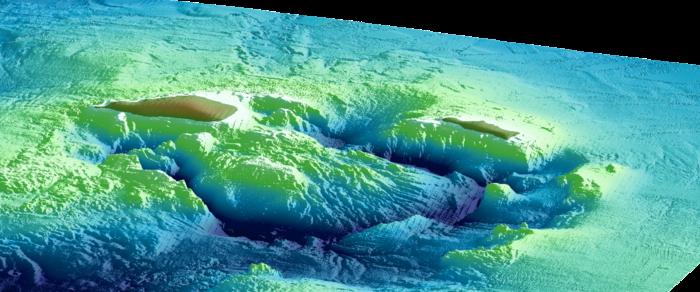
 We know very little about the processes that lead to a reeruption of supervolcanoes such as the mostly underwater Kikai caldera in Japan (pictured) and are therefore ill-equipped to make predictions.
Credit
SEAMA Nobukazu
Kobe University researchers have mapped the refilling magma reservoir of Japan’s Kikai caldera. Their study proves that supervolcanoes “reset” by injecting entirely new magma into old reservoirs, providing a vital model for predicting the long-term behaviour of giants like Yellowstone
Published in Communications Earth & Environment in early 2026, the new study has provided a rare look into the “re-injection” process of supervolcanoes.
By studying the mostly underwater Kikai caldera in Japan—site of the largest eruption of the Holocene epoch—researchers have developed a model that explains how these massive craters accumulate enough magma to erupt again. This insight is critical for understanding global supervolcanoes like Yellowstone (USA) and Toba (Indonesia).
The challenge of predicting supervolcanoes
When a supervolcano erupts, it ejects such a massive volume of magma that the ground above the reservoir collapses, leaving behind a wide, shallow basin called a caldera. Because these events are rare and separated by thousands of years, scientists have struggled to monitor the internal processes that lead to a re-eruption.
To solve this, geophysicist SEAMA Nobukazu and his team utilised the Kikai caldera’s underwater location.
Being submerged allowed the researchers to use airgun arrays to create artificial seismic pulses, which were then recorded by sensors on the ocean floor. This allowed them to “see” through the Earth’s crust and map the magma reservoir with unprecedented detail.
The magma re-injection model
The team discovered a significant magma reservoir directly beneath the site of the eruption that occurred 7,300 years ago. While it occupies the same space as the previous reservoir, the researchers determined that this is not “leftover” material.
Key evidence for new magma accumulation:
Lava Dome Formation:
A new lava dome has been growing in the center of the caldera for the last 3,900 years.
Chemical Fingerprints:
Analysis shows the recent volcanic material has a different chemical composition than the magma ejected 7,300 years ago.
New Injection:
This confirms that the reservoir is being actively refilled by “newly injected” magma from deeper in the Earth, rather than simply recycling old remnants.
Global implications for Yellowstone and Toba
This “magma re-injection model” provides a universal framework for how giant calderas behave between major eruptions. The presence of large, shallow magma reservoirs beneath other famous calderas suggests they follow a similar cycle of depletion and replenishment.
By identifying the size, shape, and chemical evolution of these refilling reservoirs, scientists are getting closer to identifying the “crucial indicators” of a future giant eruption. The goal is to move from simply observing these volcanoes to actively predicting when the pressure of newly injected magma might reach a breaking point.