
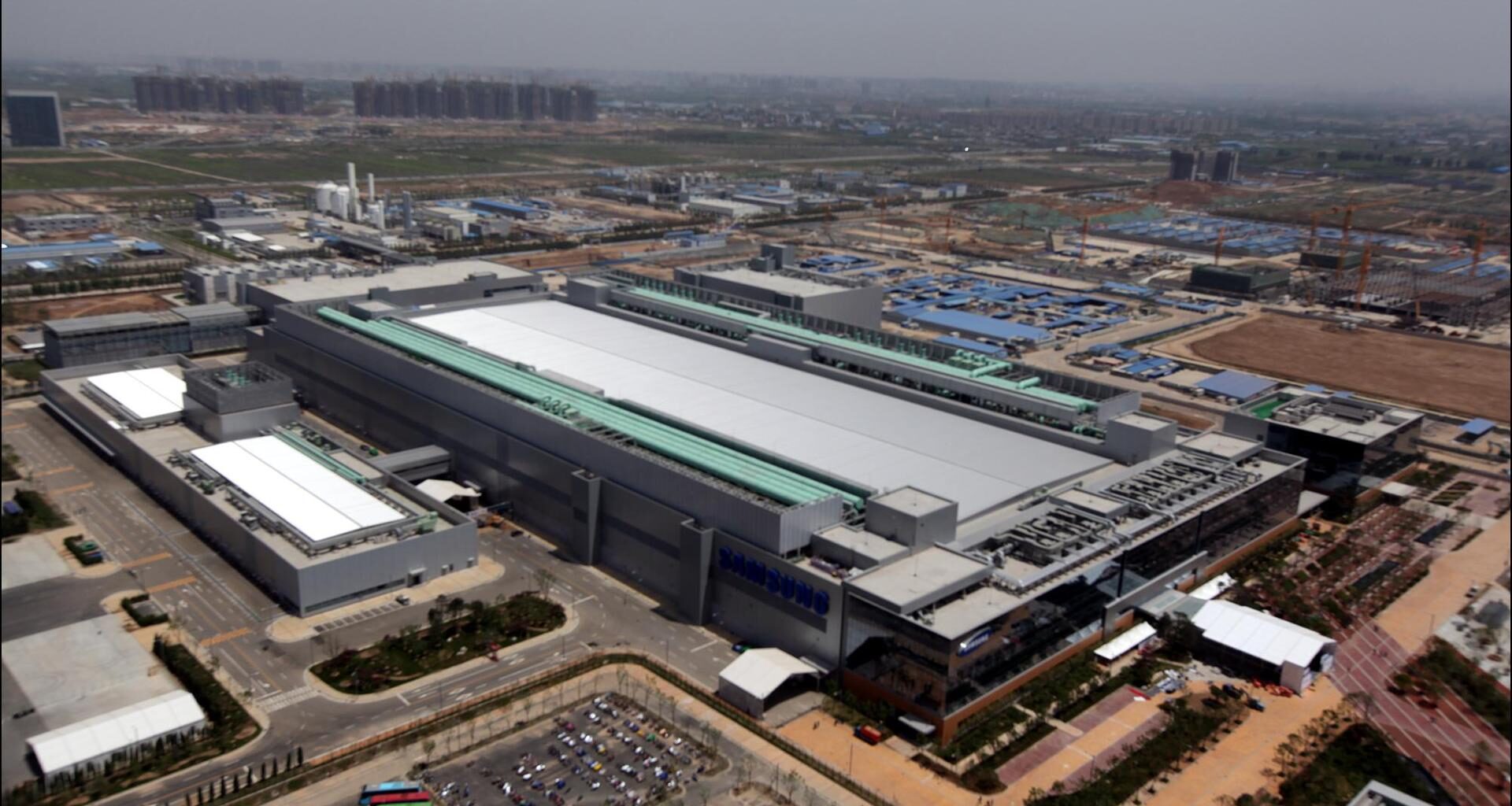
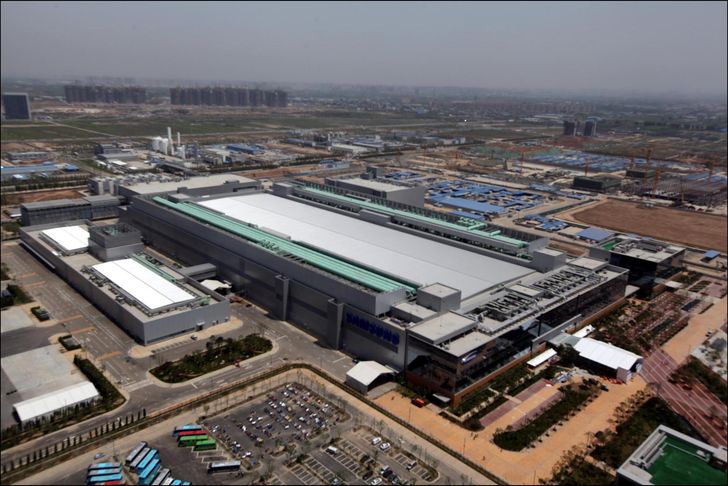
Samsung Electronics’ plant in Xi’an, China / Courtesy of Samsung Electronics
HONG KONG — Samsung Electronics and SK hynix are stepping up investments in their wafer fabs in China, racing to boost supply amid high market demand for artificial intelligence (AI) computing, according to industry analysts. The move underscores China’s continued role in semiconductor production despite U.S. restrictions.
Last year, Samsung Electronics invested 465.4 billion won ($308.8 million) in its chip plant in Xi’an, Shaanxi province, a 67.5 percent increase from a year earlier, according to its annual report filed March 10 with the Financial Supervisory Service.
SK hynix also ramped up spending, investing 581.1 billion won in its chip plant in Wuxi, Jiangsu province, up 102 percent year on year, and 440.6 billion won in its Dalian facility in Liaoning province, a 52 percent increase from 2024, according to its March 17 annual report.
“As building new plants typically takes three to five years, optimizing operations at existing production bases in China enables a much faster supply response,” said Lee Byung-chul, a visiting research fellow at the Sejong Institute and a former Samsung Electronics executive vice president who worked at its China subsidiary for 15 years.
Samsung’s Xi’an facility, its only overseas memory chip fab, accounts for about 40 percent of its NAND flash memory output. The company had previously invested 698.4 billion won in the plant in 2019, but there was a pause in spending at the facility between 2020 and 2023, the Seoul Economic Daily reported. Investment resumed in 2024 at 277.8 billion won.
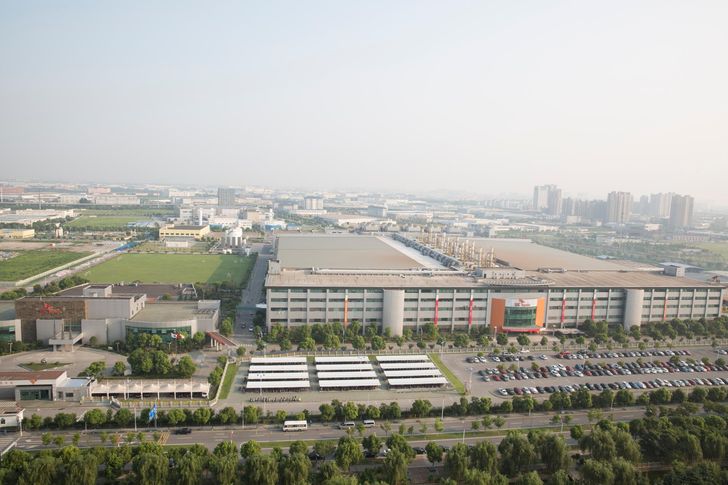
SK hynix’s plant in Wuxi, Jiangsu province, China / Courtesy of SK hynix
SK hynix’s Wuxi plant accounts for more than 30 percent of its total dynamic random access memory (DRAM) output, while the Dalian facility serves as its NAND production base. Notably, the company had made no investments in either facility in 2023 before increasing its spending over the past two years.
Troy Stangarone, a nonresident fellow at the Carnegie Mellon Institute for Strategy & Technology, said the investments point to a need to respond to the global shortage of AI memory, with both DRAM and NAND supply effectively sold out this year.
In a report last month, Goldman Sachs raised its 2026 DRAM supply shortfall estimate to 4.9 percent of total demand, up from 3.3 percent, and said it expected the market to see its most severe shortage in 15 years. It also lifted its NAND supply shortfall forecast to 4.2 percent, up from 2.5 percent.
China was also a significant end market for both companies, given its substantial share of the global personal computer and smartphone chip markets, said Park Jun-hong, a director at S&P Global Ratings.
Against this backdrop of tightening supply and strong demand, China is seeking to position itself as a key partner for chipmakers.
On Tuesday, Zheng Shanjie, head of China’s National Development and Reform Commission, met Samsung Electronics Executive Chairman Lee Jae-yong in Beijing and urged the company to “seize the opportunities arising from China’s continuous opening-up” and “further expand investment and cooperation in the country.”
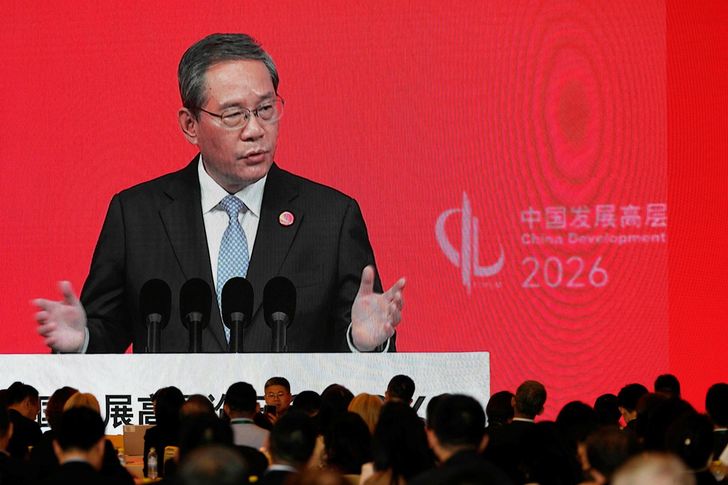
Chinese Premier Li Qiang is seen on a big screen live broadcast of his speech at the opening of the China Development Forum 2026 in Beijing, March 22. AFP-Yonhap
Lee responded that China is an important part of Samsung’s global strategy, according to local media reports.
Lee and SK hynix CEO Kwak Noh-jung were in Beijing last week for the China Development Forum, their second straight year at the event.
Despite the renewed investments, Lee of the Sejong Institute said the trend may be difficult to sustain as China remains under U.S. export controls.
Previously, both companies could ship U.S.-made chip equipment to their China plants without restrictions under Washington’s “verified end-user” status. However, this changed in August 2025 when Washington removed that status, meaning foreign chipmakers now need annual approvals to bring U.S. equipment into China.
“This investment underscores how Korean semiconductor firms are compelled to make the most of their existing production bases in China as U.S. export controls tighten,” the research fellow said.
“If the rivalry intensifies, Korean companies are likely to have no choice but to explore long-term adjustments to their production exposure in China.”
Still, technological developments could emerge and affect demand.
Google said on March 24 that its TurboQuant algorithm can cut memory requirements to as little as one-sixth of current levels, raising concerns about softer demand and weighing on the share prices of chipmakers, including Samsung Electronics and SK hynix.