
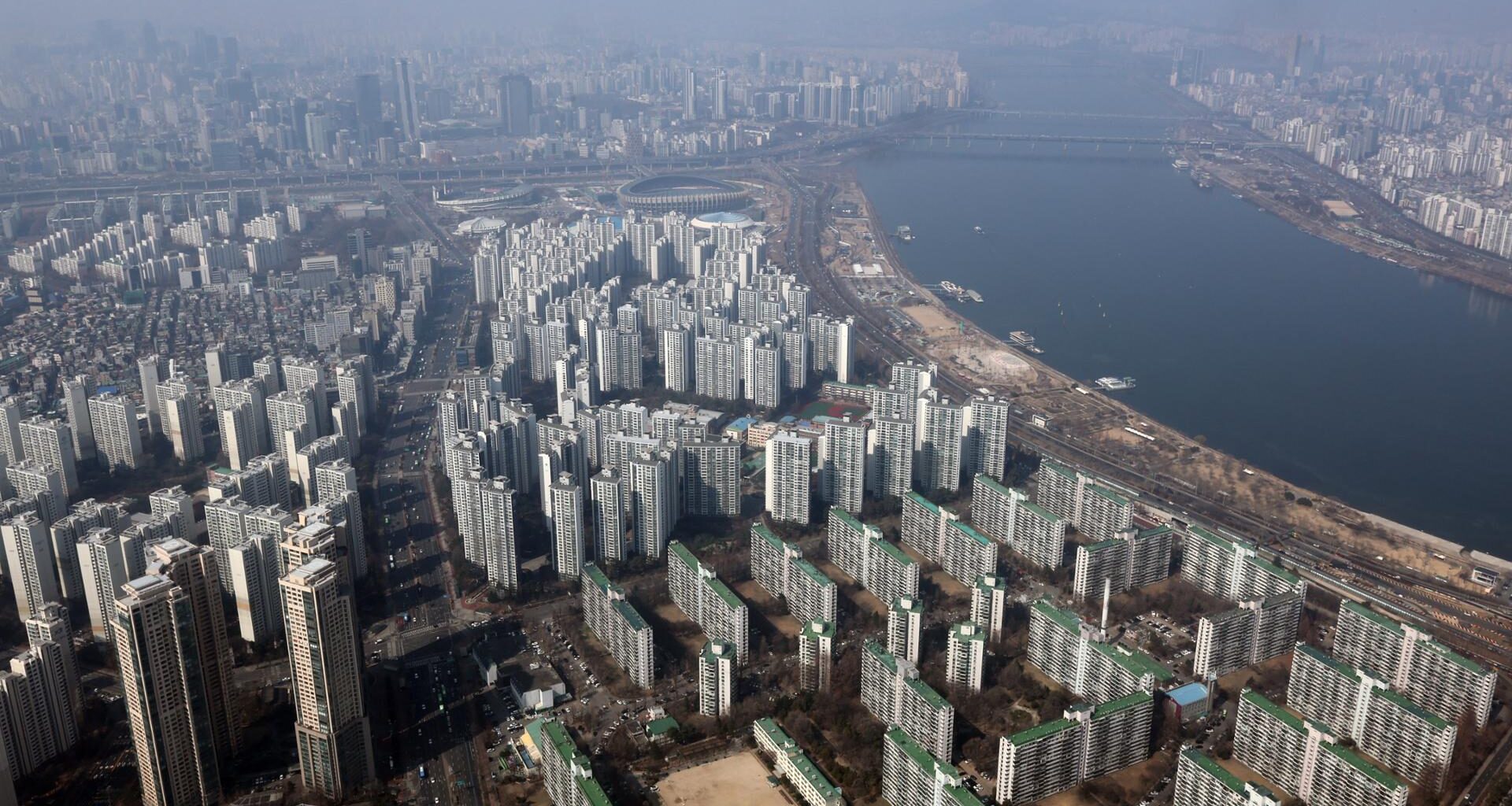
Apartment complexes are seen from Lotte Tower in Seoul’s Songpa District, March. 17. Yonhap
A salaried worker in his 40s surnamed Park, who lives in Seoul’s Yeongdeungpo District, is increasingly feeling the strain of rising mortgage payments.
“I bought an apartment in early 2021 with a mortgage at a rate in the 2 percent range,” he said. “After the loan switched to a variable rate earlier this year, it rose to 4 percent. I am now paying more than 2 million won ($1,320) a month, which is a significant burden considering my income.”
“With two children to support and grocery prices rising, I have little room to cut spending elsewhere,” he added.
Park is among many Koreans who stretched their budgets to buy homes at the peak of the real estate market. But as mortgage rates have climbed to a three-year high, they are facing rising repayment burdens.
According to the financial industry, five-year reset mortgage rates at the country’s five major banks — KB Kookmin, Shinhan, Hana, Woori and NH NongHyup — ranged between 4.41 percent and 7.01 percent as of last Friday.
It marks the first time since October 2022 that the upper end of the range has exceeded 7 percent.
Such mortgages typically carry a fixed rate for an initial five-year period before being reset. They have become a popular choice among borrowers, but many are now facing sharply higher rates as their loan rates are repriced.
The sharp rise in mortgage rates has been driven by higher market yields as escalating tensions in the Middle East fuel inflation concerns, analysts said. Following the U.S.-Israeli strike on Iran on Feb. 28, yields on five-year bank bonds, which is a key benchmark for mortgage rate, rose by 0.547 percentage point over the past month.
Adding to the concerns for leveraged homeowners, expectations are growing that the Bank of Korea (BOK) could take a more hawkish stance under incoming chief Shin Hyun-song, who is set to succeed incumbent Gov. Rhee Chang-yong after his term ends on April 20.
Some analysts view that Shin, often described as a “pragmatic hawk,” may signal the possibility of rate hikes early in his term to contain inflation.
“Inflation is a key driver of rising mortgage rates, but policy factors are also at play. As the government has signaled stricter lending regulations to stabilize the housing market, banks seem to be preemptively raising lending rates,” said Kim Dae-jong, a professor of business administration at Sejong University.
He added that rising mortgage rates will add to the burden on already heavily indebted households.
According to data released by Statistics Korea on March 24, the average outstanding loan balance per salaried worker stood at 52.75 million won at the end of 2024, up 2.4 percent from a year earlier.
Mortgage loans accounted for the largest share of household debt, making up 42.9 percent of total loans, up 3.4 percentage points from 39.5 percent a year earlier.