

Major networks scale up AI adoption amid budget crunch
Artificial intelligence is transforming every corner of industry, and television is no exception.
Major networks in Korea have recently announced plans to integrate AI across their programming slates. On March 23, SBS said entertainment shows slated for the second half of the year will be fully augmented with AI-driven technology.
Notable applications include AI-powered de-aging, which enhances cast members’ appearances by rendering their faces brighter and more youthful.
The network is also leveraging AI to generate simulated drone footage, transforming ground-level shots of urban locations into dynamic, aerial-style visuals. “While actual drone filming in city areas is often limited due to noise and safety concerns, AI enables more immersive and visually dynamic scenes,” an SBS official said in a press statement.
AI will also streamline post-production. According to SBS, the system can automatically remove unintended elements, such as rigging equipment or crew members, from multi-camera shoots, preserving viewer immersion. In addition, it can transcribe and organize large volumes of cast dialogue into text, reducing time-intensive editing work.
“This allows production teams to shift their focus away from repetitive tasks and toward creative direction and storytelling,” the official added.
Embedding AI into its TV production pipeline is a first for SBS, the broadcaster behind Korean entertainment show hits such as “Running Man” and “The Law of the Jungle.”
“AI technology is not a tool to replace production staff, but a partner that enables them to focus on more creative work,” the SBS official said. “We aim to enhance the quality of our content and create a more immersive viewing experience.”
 “100 Books That Changed Classics and History Through AI” (EBS)
EBS takes the concept even further, with plans to roll out fully AI-generated programming featuring virtual casts.
As part of its spring programming overhaul announced March 25, EBS said it launched “100 Books That Changed Classics and History Through AI” (translated). In the lecture-based program, historical figures and classical authors, such as Adam Smith, author of “The Wealth of Nations,” are recreated with AI to deliver interpretations of each classical book. The first episode, aired on Monday, featured “The Odyssey.”
According to EBS, production on the series used roughly 10 AI tools, including OpenAI, Gemini and Claude. The technology was applied across the entire pipeline, from source text extraction and adaptation to visual and audio generation, translation and metadata tagging. Korean scholars and AI specialists also participated in the production as advisors.
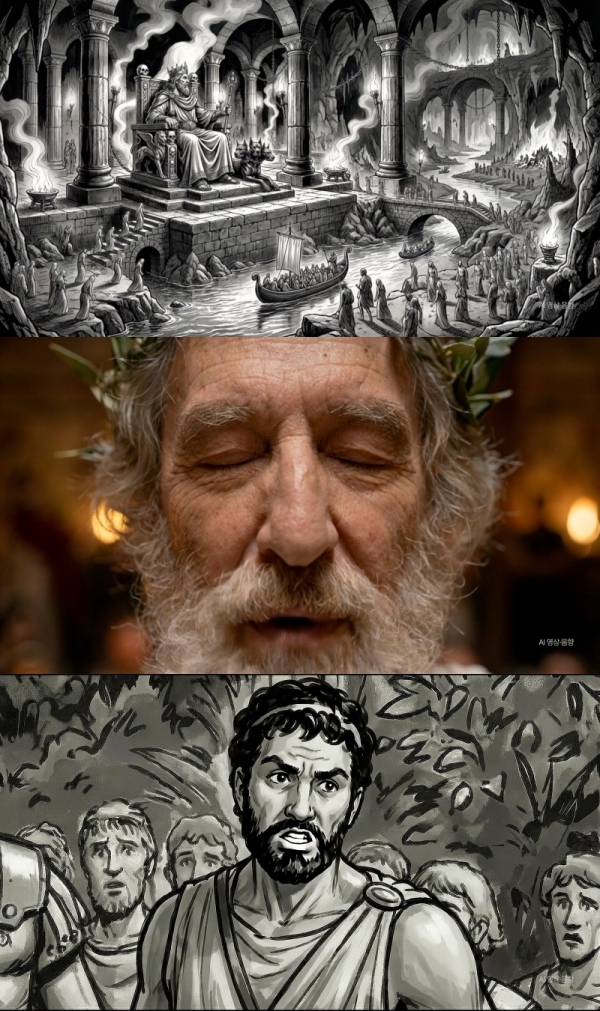 “100 Books That Changed Classics and History Through AI” (EBS)
Cost efficiency remains a key driver behind the shift. EBS revealed during a March 26 press conference that programs that previously cost between 8 million won and 10 million won ($5,300 and $6,600) per episode could see budgets fall below 7 million won with the adoption of AI.
Industry insiders say the growing use of AI in broadcasting is not inherently problematic, so long as it is not used to spread fake information.
“At its core, this may be another form of computer graphics, only more accessible and cost-efficient,” a media official said, under the condition of anonymity.
Still, concerns persist. Critics argue that AI-generated content may lack sufficient quality control and regulatory oversight, and compromise creative integrity, as AI-driven post-production can easily alter scenes beyond the creators’ original vision.
“The issue with AI-generated content, especially on the internet, is that much of it is produced without sufficient safeguards,” the official noted. “However, when deployed under strict standards, particularly by public broadcasters, the risks are reduced.”
At present, there are no comprehensive ethical or legal frameworks governing the use of AI in television production in Korea, although a few companies have put forth their own rules.
KBS, the nation’s public broadcaster, in August 2025 established the company’s AI guidelines that define AI as a supplementary tool in broadcast production, mandating strict human oversight and requiring disclosure of AI usage. According to KBS, stricter standards are applied to news and current affairs content in particular, prohibiting the use of generative AI outputs without verification.
yoonseo.3348@heraldcorp.com