
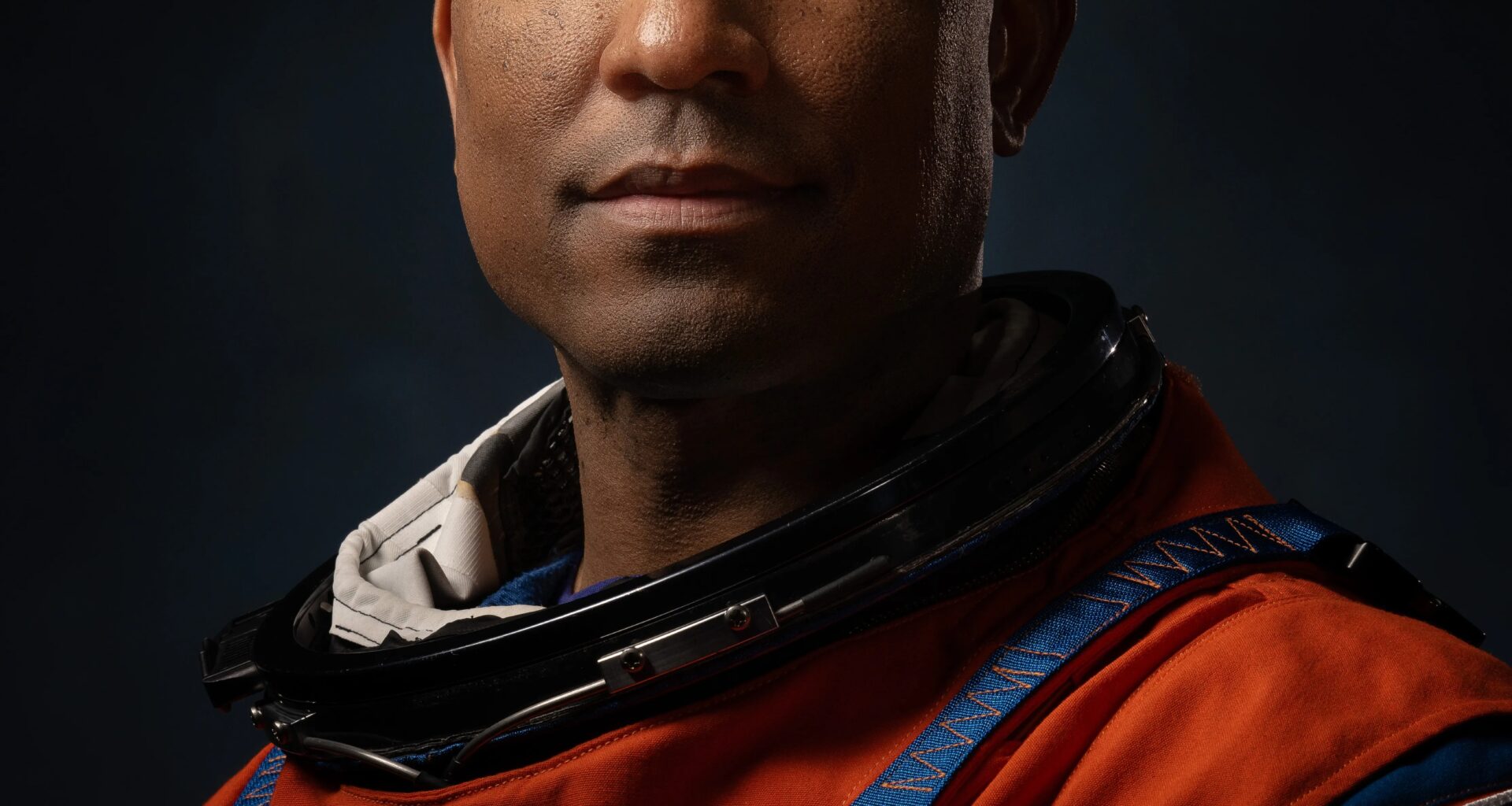
From his early years in southern California to his career as a naval aviator, test pilot, astronaut, and leader, Victor Glover has spent a lifetime building the experience that now prepares him to help lead humanity’s return to the Moon and demonstrate how humans can live and work in deep space. Soon, as pilot of NASA’s Artemis II mission, he will join commander Reid Wiseman, mission specialist Christina Koch, and Canadian Space Agency (CSA) mission specialist Jeremy Hansen on an approximately 10-day journey around the Moon, the first crewed lunar flight in more than 50 years.
(Left to right) CSA astronaut Jeremy Hansen and NASA astronauts Christina Koch, Victor Glover, and Reid Wiseman on the USS San Diego during Underway Recovery Test 11 in 2024.
Born in Pomona, California, Glover graduated from Ontario High School in 1994 before earning a Bachelor of Science in general engineering from California Polytechnic State University, San Luis Obispo, in 1999. He later added three graduate degrees to his education: a Master of Science in flight test engineering from Air University in 2007, a Master of Science in systems engineering from the Naval Postgraduate School in 2009, and a Master of Military Operational Art and Science from Air University in 2010. During his undergraduate years, athletics and community service helped shape the leadership style that would later define his military and astronaut careers.
After college, Glover began preflight training with the U.S. Navy and earned his “wings of gold” in December 2001. He went on to fly the F/A-18 Hornet, Super Hornet, and EA-18G Growler, eventually serving as a test pilot and logging thousands of flight hours in more than 40 aircraft, along with more than 400 carrier arrested landings and 24 combat missions. His Navy assignments took him across the United States and to Japan and included deployment in support of Operation Iraqi Freedom as well as later service as a legislative fellow in the U.S. Senate.
NASA selected Glover as an astronaut in 2013 while he was serving in his Senate fellowship. After completing astronaut candidate training in 2015, he supported International Space Station (ISS) and commercial crew operations in several important behind-the-scenes roles, including capsule communicator (CapCom), operations officer, and family escort for Soyuz and Crew Dragon launches. In 2018, he received his first flight assignment as pilot of NASA’s SpaceX Crew-1 mission, the first post-certification operational mission of SpaceX’s Crew Dragon spacecraft.
In 2018, NASA announced that Glover was assigned his first mission to the International Space Station.
Glover’s first trip to space began in November 2020 when Crew-1launched to the ISS. During the mission, he served as a flight engineer for Expeditions 64 and 65 and spent 168 days in space before returning to Earth in May 2021. While aboard the ISS, he contributed to scientific investigations, technology demonstrations, and maintenance work, including four spacewalks. Glover and his crewmates researched space botany, nutrition, and human health, while conducting other experiments that continue to expand understanding of living and working in orbit.
That mission was significant for several reasons. Glover became the first Black astronaut to complete a long duration stay aboard the ISS, adding an important milestone to the history of human spaceflight. His work on Crew-1 also demonstrated the blend of technical and decision-making skills that NASA looks for when selecting astronauts. By the time NASA named the Artemis II crew in April 2023, Glover had already proven himself in low Earth orbit, in a high-level collaborative work environment that underpins modern space exploration missions.
Artemis II will carry Glover and his crewmates much farther from Earth. The mission is the first crewed test flight of the Space Launch System (SLS) rocket and Orion spacecraft, designed to confirm that Orion’s systems operate as expected in deep space. After launch, the crew will spend time in high Earth orbit, assessing their spacecraft, conducting a manual piloting demonstration, and evaluating life-support, navigation, and communications systems before heading on a free-return trajectory around the far side of the Moon and back to Earth. During the mission, Orion is expected to travel approximately 4,600 miles beyond the far side of the Moon before returning for a splashdown in the Pacific Ocean.
The Orion spacecraft mounted on top of the SLS (Space Launch System) rocket.
Artemis II is meant to prove the systems and operations that later missions will rely on as NASA works toward sustained human exploration of the Moon and eventually Mars. It will also mark a historic personal milestone for Glover, who is set to become the first person of color on a lunar mission. The Artemis II crew represents a new generation of explorers whose backgrounds reflect a broader story of who participates in the future of spaceflight.
Like many astronauts before him, Glover’s journey to this moment has depended on years of training, technical knowledge, and perseverance in demanding environments. But his upcoming voyage also carries symbolic weight. Glover goes to the Moon not only as a naval aviator, engineer, and veteran astronaut, but also as part of a crew helping define what the next era of exploration looks like. As Artemis II circles the Moon, he will help carry forward a mission that connects the legacy of Apollo with the future of deep space travel, inspiring new generations to imagine themselves making that journey, and beyond, someday.