
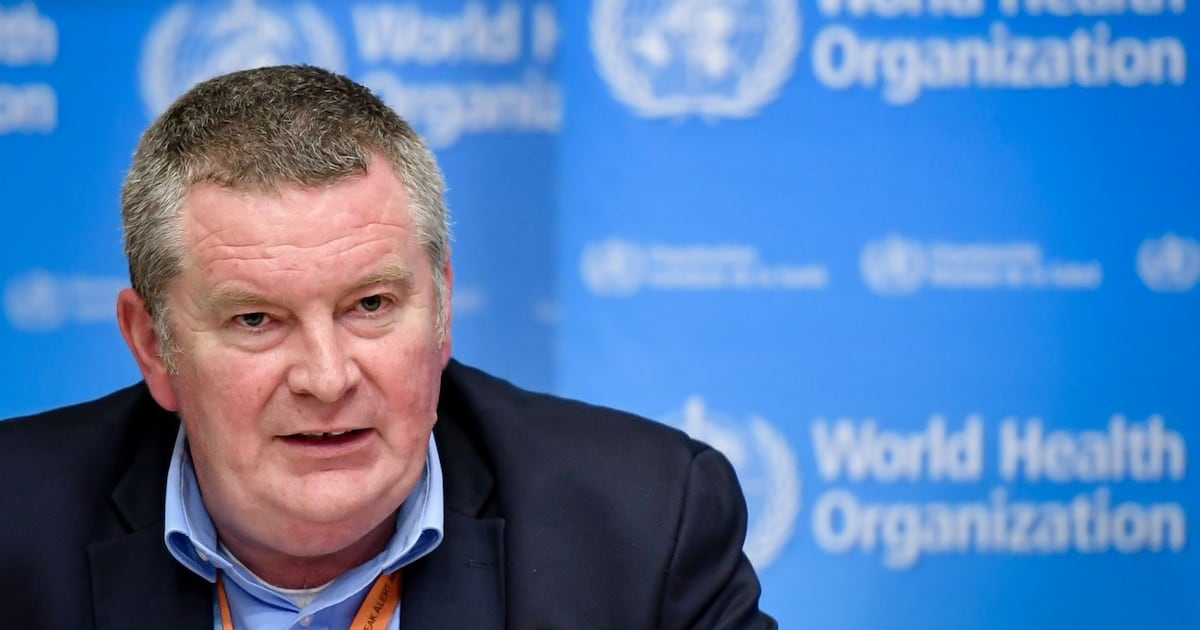
A public “trust pothole” that existed before the pandemic developed into a “trust chasm”, former World Health Organisation deputy director general Dr Mike Ryan has told a Covid-19 evaluation forum.
The Sligo epidemiologist recommended a “rapid” response to an emerging epidemic, which “does not mean perfect action”.
The quicker the actions, the more likely the advice to the public will need to change, which can be hard to communicate and leave people “very confused”, Ryan said on Tuesday.
He said although trust levels were generally high among the public before the pandemic, and people were willing to implement advice, some trust issues still existed at that time.
This needs to be examined to ensure rapid actions can be taken during the next public health event and uncertainty can be well communicated, he said.
While technology is much discussed in conversations around future pandemic preparedness, he said the role of communities is key and unless they are prepared “we are going to fail”.
During the pandemic, public health teams “did not trust communities enough” to make decisions about their own risks, such as how many times they visited the shops or whether they took the bus, he said.
It is important to implement lessons from the pandemic, but there is a danger in “trying to find someone to blame”. Such an approach would not lead to change, but would simply lead to blame and righteousness, he added.
He was speaking as part of the independent Irish-focused Covid-19 Evaluation Panel, chaired by Prof Anne Scott, which will submit a report of recommendations to the Government upon conclusion. The non-statutory panel was assigned its work by the Department of the Taoiseach.
Also addressing the forum was Prof Mary Codd, who led a Health Service Executive test-and-trace programme from University College Dublin from March 17th, 2020, to September 2021.
It was one of nine such centres established “at great speed” and feeding into a centralised system, she said.
However, the State was “wholly unprepared”, and the existing public health workforce, even with the help of the Army, was “very quickly overwhelmed” in the first half of March 2020.
The IT infrastructure was “totally unfit for purpose”, she said, with a “cumbersome” customer relationship management system commissioned and updated in real time to try to make it fit for a public health purpose.
She said there was a “failure” to recognise the speed with which testing needed to be upscaled and much time was “wasted” tracing the contacts of people who had been infected with Covid 10 to 12 days before.
Later some testing was outsourced to Germany, meaning it would be three weeks before the results could be uploaded to the Irish national data system.
Practically, she said, testing results needed to be turned around within 24 hours or they were a “waste of time”.
The issue of infections within long-term care facilities was identified “very quickly”, she said. There were immediate issues with staff personal protective equipment, while “quite a bit less” than half of centres had pre-pandemic infection prevention control systems in place. This was despite national guidelines in this area, she said.
Not one centre had isolation facilities, she said, while most operated at full capacity with a skeleton staff.
People aged over 70 in residential facilities died at 21 times the rate of their peers who cocooned at home, she said.