
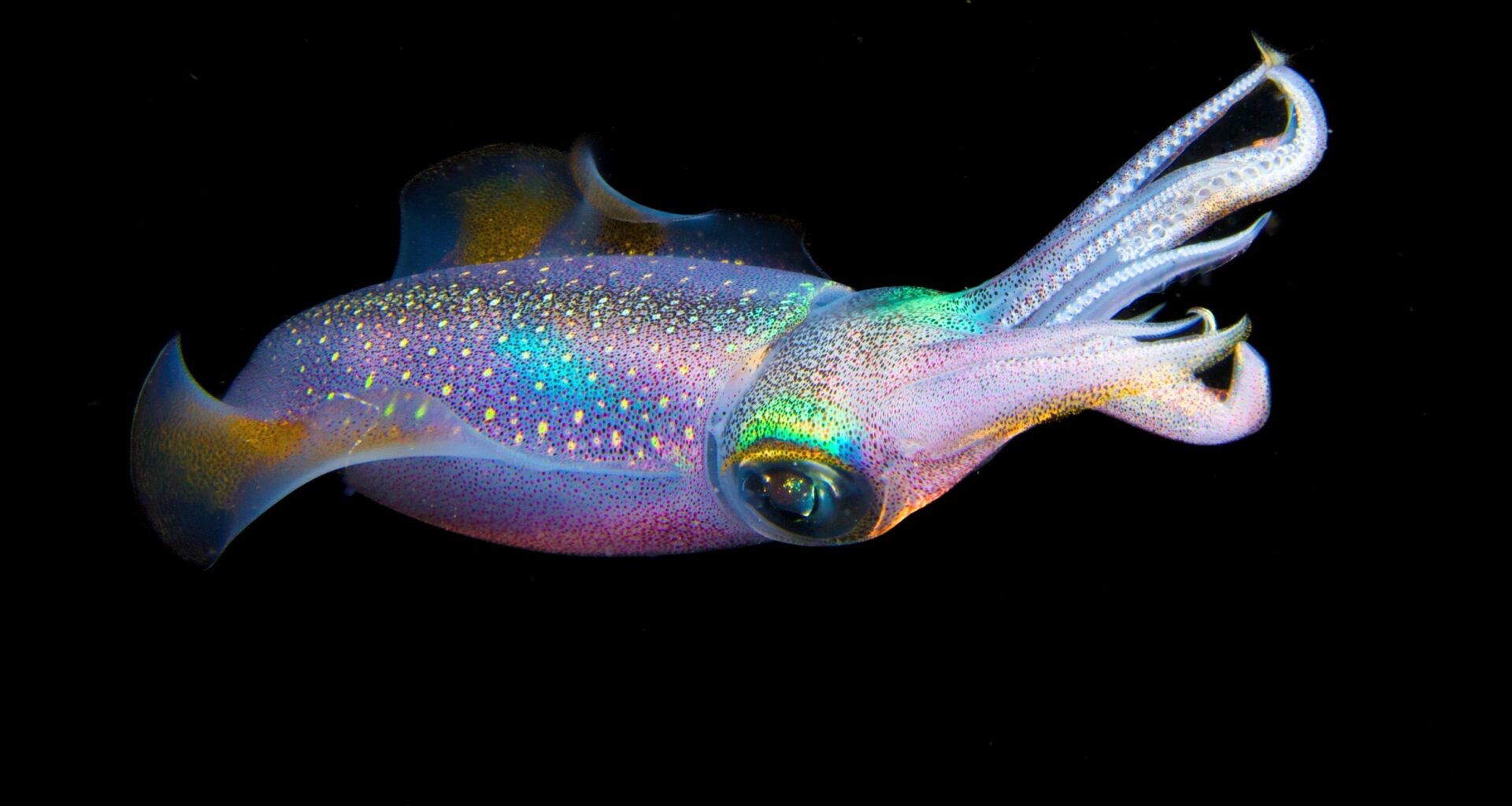
Squid and cuttlefish have always been a bit of a mystery. They flash colors, move with sudden bursts of speed, and solve problems in ways that seem almost too clever for animals without backbones.
Scientists have spent years trying to piece together how these creatures came to be, but the story has remained frustratingly incomplete.

The problem wasn’t a lack of curiosity. It was a lack of solid evidence. Fossils are rare and often unclear. Genetic data has been patchy.
For a long time, researchers could only make educated guesses about how different species were related and when they branched off from one another. That picture has now started to sharpen.
The challenge of studying squid evolution
A new study pulls together large amounts of genetic data, including three newly sequenced squid genomes, to build a clearer evolutionary timeline.
The work comes from the Okinawa Institute of Science and Technology, where researchers finally managed to connect many of the missing pieces.
“Squid and cuttlefish are remarkable creatures, yet their evolution has been notoriously difficult to study,” said Dr. Gustavo Sanchez, first author of the research paper.
“The question of their ancestry has been under investigation for decades, and many research groups have proposed different evolutionary hypotheses based on different morphological characteristics and molecular datasets.”
“With our new genomic information, we have been able to resolve some of the mysteries surrounding their origins.”
A family with many forms
Squid and cuttlefish belong to a group called decapodiformes, which means ten-limbed cephalopods. They can be found almost everywhere in the ocean, from shallow reefs to deep, dark waters.
They don’t all look alike, though. One feature that ties many of them together is an internal shell. Even that varies widely.
Some have a smooth, rounded cuttlebone. Others carry a thin, blade-like structure called a gladius. A few have a spiral shell, and some have lost the shell entirely.
Earlier attempts to map their family tree struggled because the data wasn’t strong enough.
“Earlier reconstructions of decapodiform evolution were built from datasets with limited resolution and were prone to biased signals, obscuring the true relationships between different species,” noted Dr. Sanchez.
“Whole genome data now provide a cleaner, more consistent picture of how these animals evolved.”
Squid have giant genomes
Getting that cleaner picture wasn’t easy. Squid and cuttlefish genomes are huge. Some are twice the size of the human genome. That makes sequencing them a slow and demanding process.
There’s also the problem of collecting samples. Many species live far from shore or deep underwater. Fresh DNA is essential for sequencing, and that’s not always easy to get.
“Some lineages are only abundant and highly diverse in tropical reef systems like the Ryukyu Archipelago, while others are enigmatic and known only in the deep sea,” said Dr. Sanchez.
“We were fortunate to find some key species on our doorstep in Okinawa, and collaborate with colleagues with access to more challenging samples.”
The result of that effort is the first evolutionary tree built from genomes that cover nearly all major decapodiform groups. It took five years and a global collaboration to pull together.
A strange squid helps fill the gap
One of the most puzzling species in the study is the ram’s horn squid, Spirula spirula. It’s rarely seen and carries a tightly coiled internal shell that confused scientists for years.
“In the past, the structure of the ram’s horn squid shell made some scientists wrongly conclude it was closely related to cuttlefishes.” said study co-author Dr. Fernando Á. Fernández-Álvarez of the Spanish Institute of Oceanography.
“I believed this genome could help close a key gap and bring clarity to the broader evolutionary questions of cephalopods.”
The genome of Spirula spirula helped correct earlier assumptions and strengthened the new evolutionary model.
Animals that survived a mass extinction
The study lays out a timeline that changes how scientists think about these animals. Squid and cuttlefish likely began in the deep ocean around 100 million years ago, during the mid-Cretaceous period.
Then came one of the most dramatic events in Earth’s history. Around 66 million years ago, the Cretaceous-Paleogene extinction wiped out about three-quarters of all species, including the dinosaurs.
So why didn’t squid disappear too? The answer may lie in where they lived. Deep-sea environments offered pockets of oxygen-rich water that acted as safe zones.
“The sea surface would have been a very harsh environment for cephalopods. Around that time, very few suitable oxygen-rich habitats would have been found near the shores,” noted Dr. Sanchez.
“Intense ocean acidification in shallower waters would also likely have degraded their shells, so the fact that some form of this feature has been retained throughout their evolutionary history is evidence of their deeper oceanic origins.”
An explosion of diversity
After the extinction event, conditions near the surface improved. Coral reefs began to recover, opening up new habitats. Squid and cuttlefish moved into these areas and began to diversify rapidly.
“Following the initial lineage splits in the Cretaceous, we don’t see much branching for many tens of millions of years. However, in the K-Pg recovery period, we suddenly see rapid diversification, as species adapt and evolve to new and changing ecosystems,” said Dr. Sanchez.
“This is an example of a ‘long fuse’ model; a period of limited change followed by an explosion of diversity.”
What this means for future research
This new evolutionary map does more than answer old questions. It gives scientists a framework to study how squid and cuttlefish developed their unusual traits.
These animals are known for advanced nervous systems, complex behavior, and features like dynamic camouflage. Understanding their genetic history could help explain how those abilities evolved.
“Squids and cuttlefish have so many unique features compared to other animal groups, making them an endless source of inspiration for scientists,” said study co-author Daniel Rokhsar.
“With these genomes and with a clear picture of their evolutionary relationships, we can make meaningful comparisons to uncover the molecular changes associated with major cephalopod innovations, from the emergence of novel organs and dynamic camouflage to the neural complexity that supports their remarkable behavior.”
The full study was published in the journal Nature Ecology & Evolution.
—–
Like what you read? Subscribe to our newsletter for engaging articles, exclusive content, and the latest updates.
Check us out on EarthSnap, a free app brought to you by Eric Ralls and Earth.com.
—–