
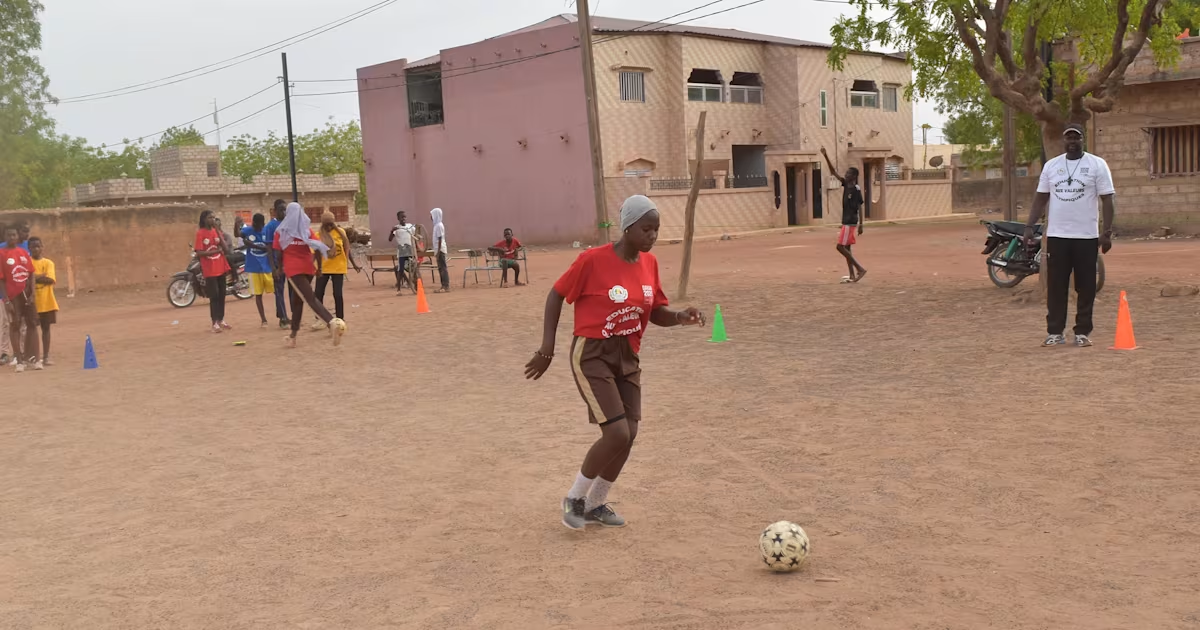
The principles of OVEP are central to the Brevet Olympique Civique et Sportif (BOCS), a national programme forming the key pillar of the educational legacy of Dakar 2026. The ambition is to reach 900,000 young people aged from 9 to 15 across 11,000 schools before the start of the YOG in October.
Driving impact across Africa
The impact of the Dakar 2026 Youth Olympic Games extends far beyond Senegal, forming part of a broader movement across Africa. Helping to drive this momentum is the Road to Dakar 2026 initiative, an OVEP-based toolkit launched to mark the one-year countdown to the YOG. It was implemented across the Olympafrica Foundation’s network of community centres in November 2025, with 26 centres in 22 countries hosting workshops for nearly 12,000 children. Schools and educators were encouraged to continue using the toolkit beyond the event, contributing to sustainable and long-term engagement.
Creating opportunities at community level
Education provides a strong foundation, but linking it to employability amplifies its impact – and sport plays a crucial role in that process.
Delivered through a partnership between the IOC, the Agence Française de Développement (AFD), Laureus Sport for Good and 29 local implementing organisations, the Sport, Education and Sustainable Livelihoods in Africa (SESLA) initiative is supporting projects working towards that goal.
Across 13 African countries, 40,582 young people were reached and supported through SESLA in 2024 and 2025. The initiative has also trained 3,185 educators, coaches and youth workers, while 29 organisations have received funding and capacity-building to deliver sport-based programmes that contribute to education, employment and livelihood outcomes.
One example of SESLA’s impact can be found at the Bophelo Gymnasium and Health Club, nestled close to Lesotho’s western border in the capital city of Maseru. There, Teboho Phasumane – a lifelong sports fan and former taekwondo champion – has realised her dream of becoming a gym instructor.