
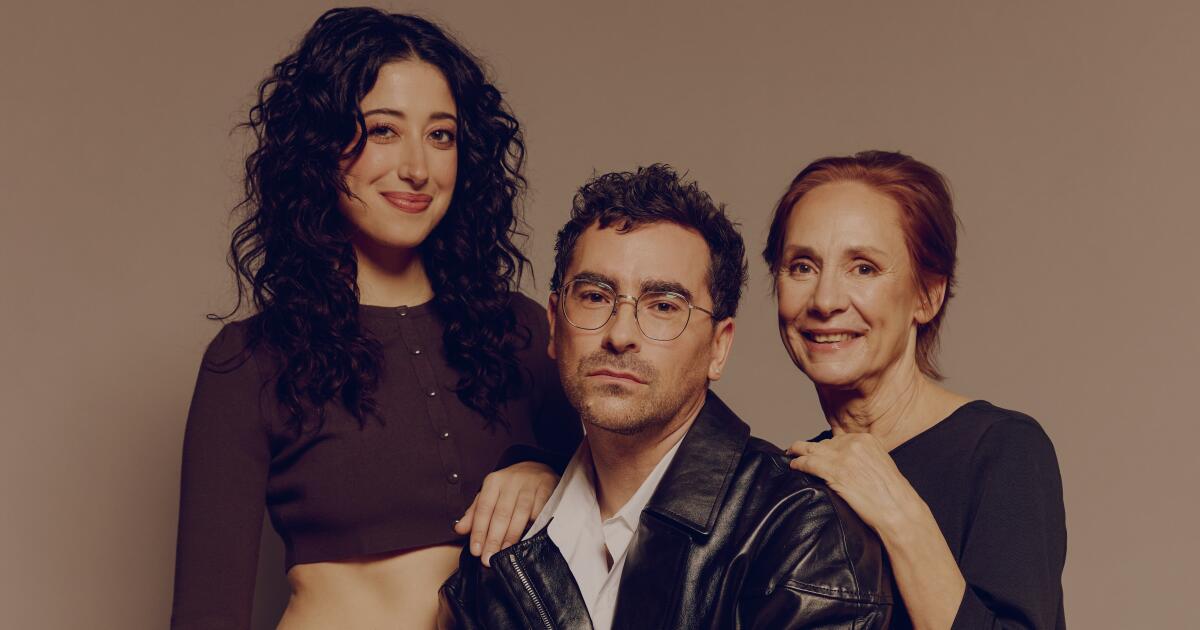
NEW YORK — You might wonder what Dan Levy has been up to in the six years since bidding farewell to “Schitt’s Creek,” the beloved, acerbic comedy series he co-created and co-starred in with his father, Eugene Levy. And the answer is, he’s turned to a life of crime.
His new series for Netflix, “Big Mistakes,” will release on April 9, and is once again centered on a dysfunctional family: hapless siblings Nicky (Levy) and Morgan (Taylor Ortega), their seemingly perfect sister, Natalie (Abby Quinn), and their domineering mother, Linda (Laurie Metcalf).
Opening on an already wild scene where the family members are bickering at the hospital deathbed of Linda’s mother, the events of “Big Mistakes” escalate quickly and considerably. At the end of the first episode, Nicky — a gay pastor — and Morgan — impulsive and stuck in a seemingly dead-end relationship — land in the pocket of organized criminals, being forced at gunpoint into the back of a delivery truck.
Though it may seem outlandish, the series (which Levy created with Rachel Sennott, the “I Love LA” star) is really a comedic exploration of small-f family dynamics, generational trauma and why we stand by the people who make us craziest. “Big Mistakes” turns out to be a showcase for Metcalf — a decorated veteran of comic ensembles like “Roseanne,” “The Conners” and “The Big Bang Theory” — and Ortega, who’s appeared on shows like “Succession” and is making a meal out of her first starring series role.
“Big Mistakes” is also a big window into Levy’s own evolving sensibilities as a creator and performer, and what finally drew him back to series television. As Levy explained, “I had taken six years off because I wanted to make something that I really loved — that I felt like had legs, had seasons worth of storytelling. It takes a minute in this momentum-obsessed industry, and this world felt endlessly entertaining.”
In late March, Levy, Metcalf and Ortega gathered at Netflix’s offices in New York to talk about the upcoming series. These are some edited excerpts from that conversation.
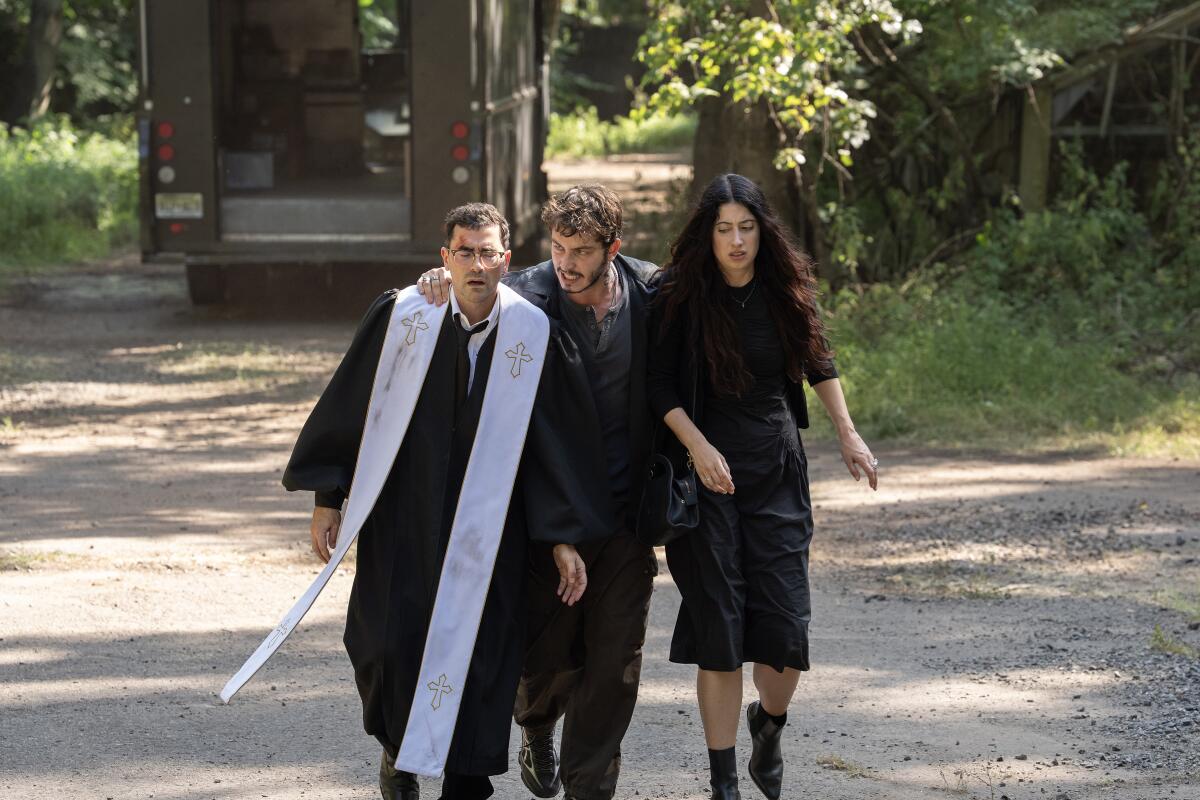
Nicky (Dan Levy), far left, and sister Morgan (Taylor Ortega) become enmeshed with criminals.
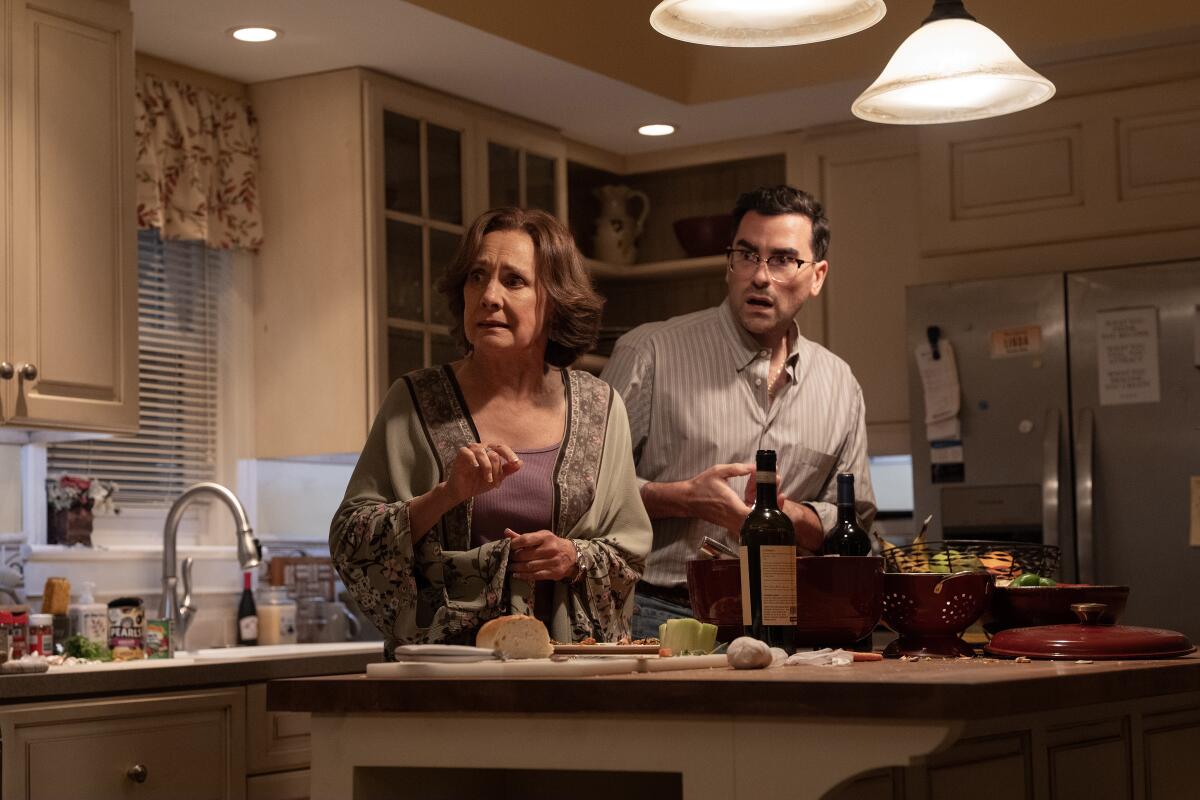
Laurie Metcalf plays Linda, the siblings’ domineering mother. (Spencer Pazer/Netflix)
After the experience of making “Big Mistakes,” do you feel like you’ve bonded as a group?
Taylor Ortega: It wasn’t traumatizing.
Dan Levy: It wasn’t a forced experience at all. In the casting process, I’m always very aware of social compatibility. I don’t really love an ego on set. It’s a really corrosive quality to bring to a group activity. The cast we put together for this show was so easy and wonderfully fun.
Laurie Metcalf: I can’t recall a group like that, that jelled so quickly, that I’ve ever worked on before. It was a really fast-clicking ensemble.
When was the first time that the three of you all met together?
Ortega: We did a rehearsal at the hospital with Abby and us that was really fun.
Levy: You’re dealing with four actors who have never worked together. For me, it was important to give us the rehearsal space, to experiment with the physicality of the space and how we relate to each other. There’s no exposition in the pilot. It’s all revealed. Part of our job as actors was to make sure that once you’re dropped in, you know exactly who these people are. I didn’t want to risk us finding that out when the cameras were rolling.
Metcalf: That was so beneficial. Two days later when we got to the scene, we knew the pace of it. We know how big it could be. In my case. [Laughter]
Levy: It was just a morale boost. We were able to see it work, and we were laughing. Without that rehearsal, that would have been a long, very frustrating first day.
Ortega: [to Metcalf] You pitched something so funny with the nurse coming in at one point. It made everyone feel comfortable to collaborate.
Did that feel like a risk, to pitch ideas on Day 1?
Metcalf: Yes. I didn’t know what the rules were. But you just got the feeling that we were all jumping in cold water and let’s go.
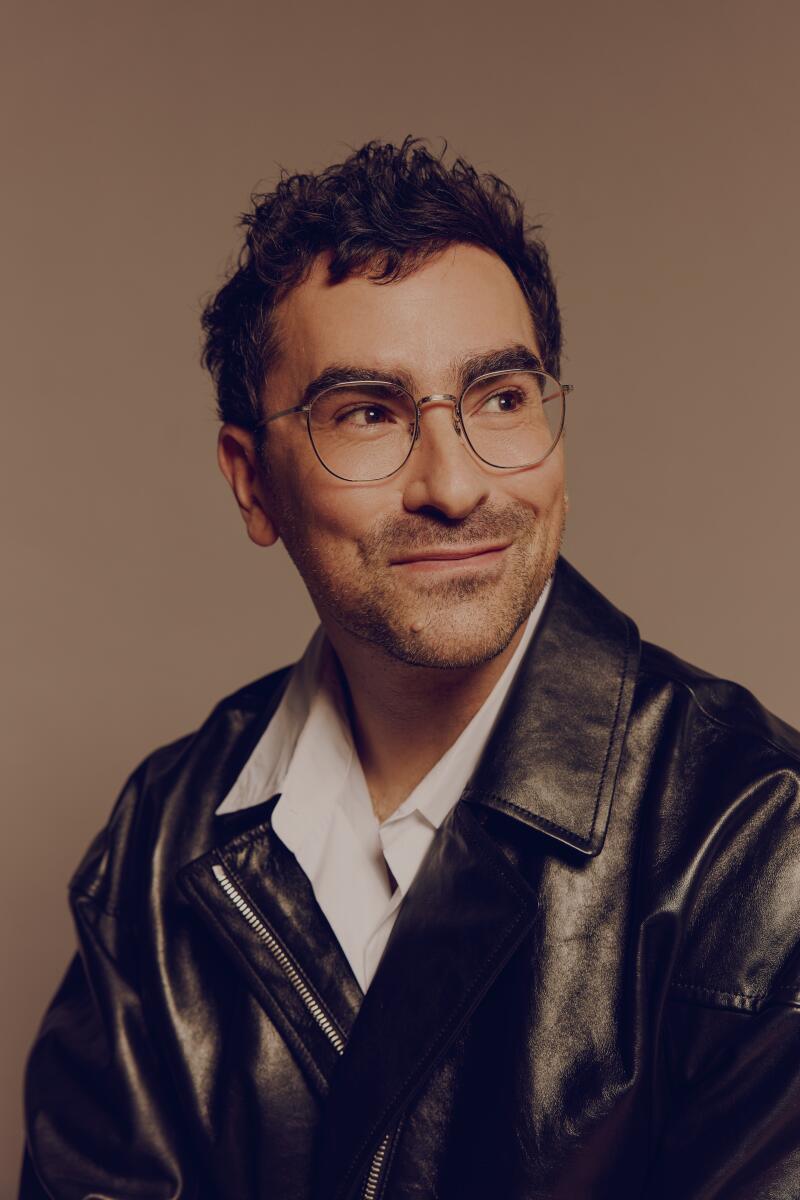
Dan Levy on the cast of “Big Mistakes”: “In the casting process, I’m always very aware of social compatibility. I don’t really love an ego on set.” (David Urbanke/For The Times)
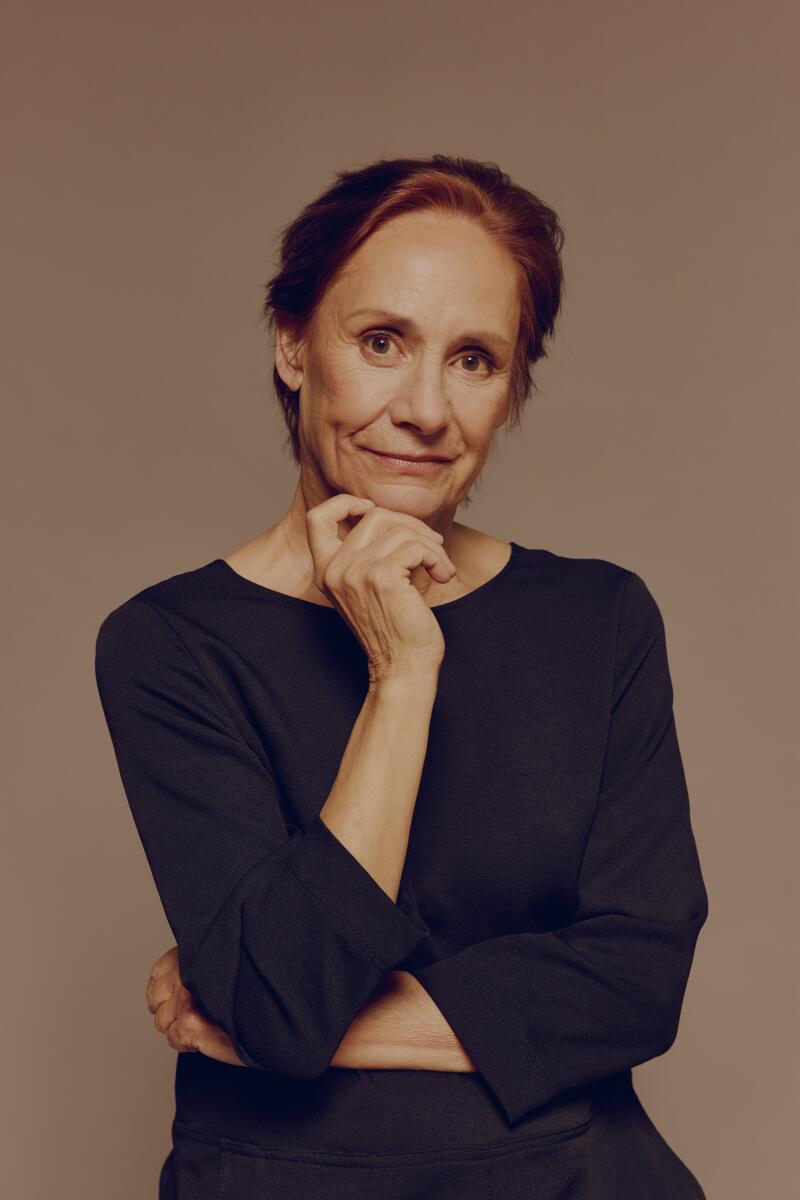
“I can’t recall a group like that, that gelled so quickly, that I’ve ever worked on before. It was a really fast-clicking ensemble,” Laurie Metcalf says. (David Urbanke/For The Times)
What was the genesis of this show, anyway?
Levy: I have a completely unfounded fear of being trapped in an organized criminal situation.
Ortega: That’s totally reasonable.
Levy: I’ve watched a lot of documentaries. There are people who find themselves trapped in organized crime and unfortunately, the rate of people getting out once they’re in is low. The concept of finding myself obligated to a criminal organization, knowing how ill-equipped I am as a person —
Ortega: And how righteous and justice-oriented.
Levy: I don’t want to be committing crimes. I follow the rules to a fault. And the more I read, the more it opened up thinking, like, how would a very strong family react to this? So I called up Rachel, who seemed like an equally incapable person when faced with criminal tasks.
Laurie, how were you approached to be part of it?
Metcalf: I got home from doing something in L.A. and I had an email saying … to read this script from Dan Levy, to see if you would be interested in being a part of it. I said yes. And then I read it, and right off the bat, my character has the first three lines, all in caps, in a hospital room. I thought, I can do that and bring that energy.
Levy: I knew that the matriarch of this family was so important to the legitimacy of this. It’s a study of what we inherit from our parents. We are the product of their trauma, from their parents. As soon as Laurie said yes, I knew that this show had the potential to be so much more than I could have ever imagined. If you didn’t have somebody [like her] who was as multidimensional and curious and able to excavate every little moment for the truth, the comedy, then it would be a different show.
Taylor is hardly a newcomer, but even so, how did you discover her for this show?
Levy: Taylor was the very first person who auditioned for this show, and the last.
Ortega: It had been like six months [between auditions]. I was in a different place in my life. When I first auditioned for this, I thought, “This is a very good fit.” It doesn’t mean that it’s my job, but it would be the best choice to pick me. [Laughter] Very rarely do you think, “I could do the best job at this,” and get to do the job.
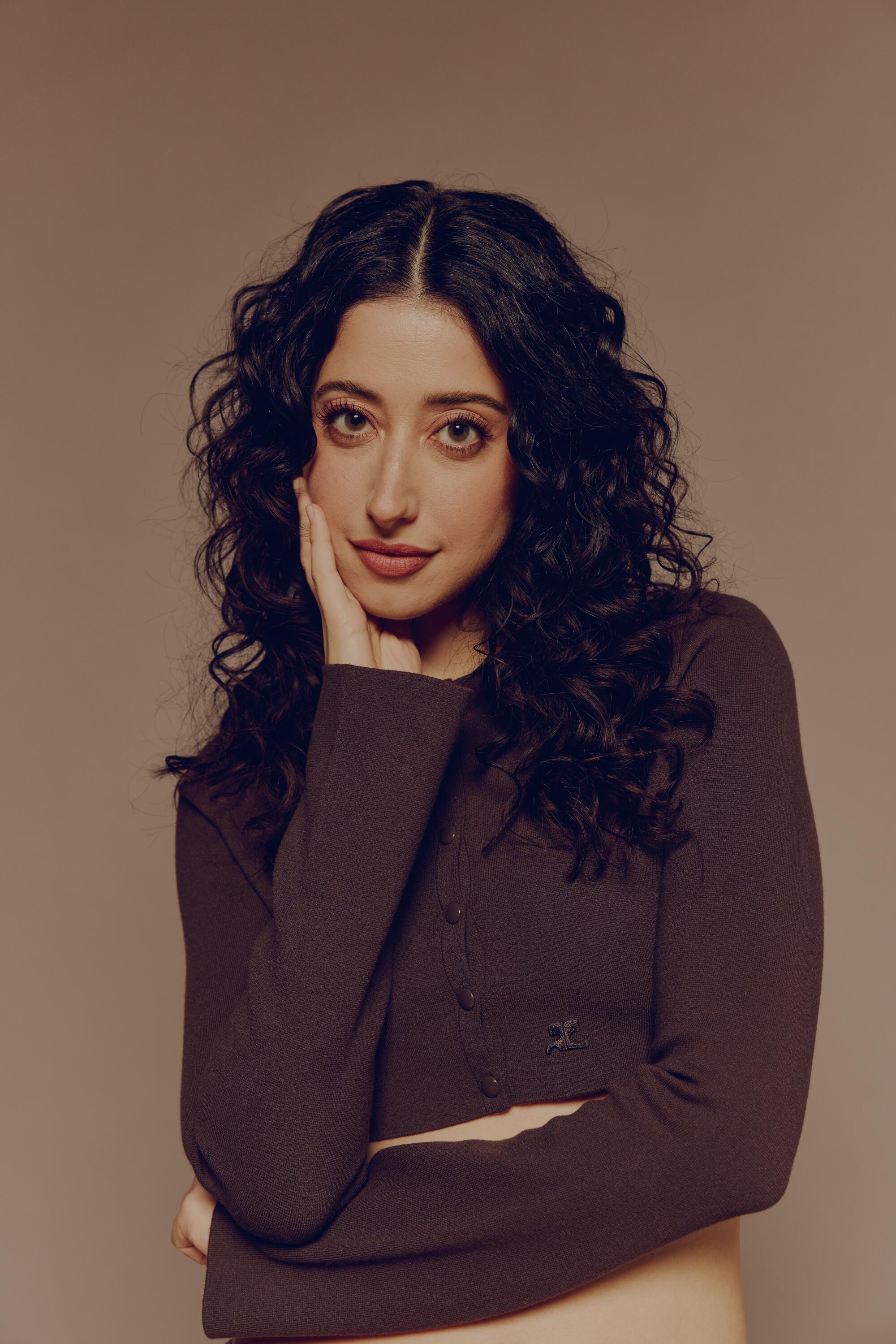
Taylor Ortega says she related to her character Morgan: “Even the way that she reacts to her misfortune — and a lot of it is self-inflicted — feels like a past version of me, or a low-vibrational version of me.”
(David Urbanke / For The Times)
What made you think that?
Ortega: I just have a very similar background. I’m not typically reading breakdowns that are like, she’s from New Jersey. Even the way that she reacts to her misfortune — and a lot of it is self-inflicted — feels like a past version of me, or a low-vibrational version of me.
Levy: You don’t want to be the first person in the [audition] room. When you’re seeing 250 people — it was a lot of people — it gets muddled. I had seen so many people do the first couple of scenes so I wrote an additional scene, us being trapped in the back of a van in Episode 2. To me, there’s no greater joy than watching an actor who has been working but not gotten that starring role, walk into something that’s so tailor-made. [Realizes what he’s said and rolls his eyes.]
Ortega: It’s one of those classic lucky breaks where you do something for like 10, 15 years, and then the perfect thing comes along.
Dan and Laurie, you’ve both been part of iconic television families in the past. How do you know when a cast’s chemistry is working?
Levy: Chemistry is not something that you can really work on. It’s either there or it’s not. You feel comfortable with somebody or you don’t.
What do you do when it isn’t working? Has that ever happened to you?
Metcalf: I’ve had ones that I haven’t felt as connected, I haven’t felt as proud of, I haven’t felt as much a part of. I just stayed in my lane and treated it as more of a job than something I do feel proud and a member of and want to support it in any way I can.
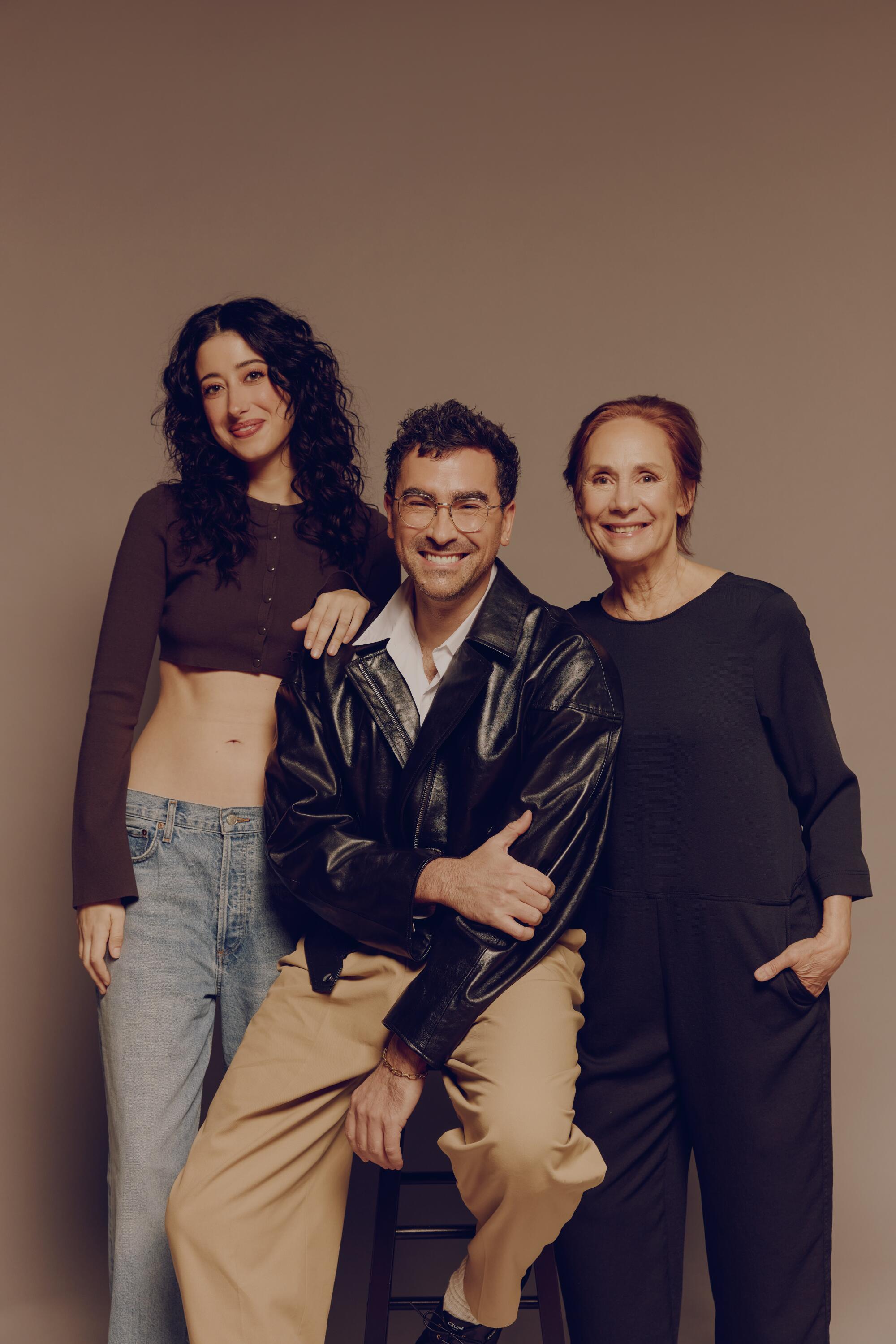
Taylor Ortega, Dan Levy and Laurie Metcalf. Levy says “Big Mistakes” is “a study of what we inherit from our parents.”
(David Urbanke / For The Times)
When was the first time that the actors got to see the results of their work?
Metcalf: [to Levy] The cool thing that you did was show the whole pilot at lunchtime to the whole cast and crew. I wasn’t there. [Laughter] But everybody got to see.
Levy: Laurie has a five-year rule — she will watch things after five years.
Is that right?
Metcalf: When I’m doing it, I have a vision of what it looks like, and it’s never anything like that and it shakes me up in a bad way. I have to wait until I’ve forgotten — at least — the lines.
Levy: I am making this show for Laurie to watch in five years. [Laughter] I had to cut the first episode a week after we shot it, because they send it out for testing, if there were any major changes to the story or if something wasn’t working.
Ortega: They were thinking of replacing me with a very little girl.
Levy: I mean, I could end up getting replaced. It was a very new world for me. “Schitt’s,” we had just total control over. I sort of feel like, [under his breath] I’m not going to change anything. I’ll do it, but I feel sure of what I’m making and if I didn’t, I wouldn’t make it.
What did you want to say about religion with this show?
Levy: With every character, at the beginning of this show, I’m thinking, how can we exacerbate the dire circumstances that crime would rub up against? This is his choice [to be in the church], and part of that stems from his relationship to his family and wanting to be on a track that is stable. For him, going to school for this and then going into a job that told him exactly how to be, who to be, when to be, felt very comfortable for him.
But I never wanted religion to be the butt of the joke. That’s why we had a gay pastor [the Rev. Warren Swenson] who, across all of our scripts, was authenticating what we were saying and doing. I was very hypersensitive about, like, “In a time of crisis, would I really say ‘Jesus Christ’?” And he was like, “Yeah, behind closed doors, we are human beings.” I didn’t want to caricature that person. I wanted to respect the fact that these are his beliefs, whether I agree with them or not.
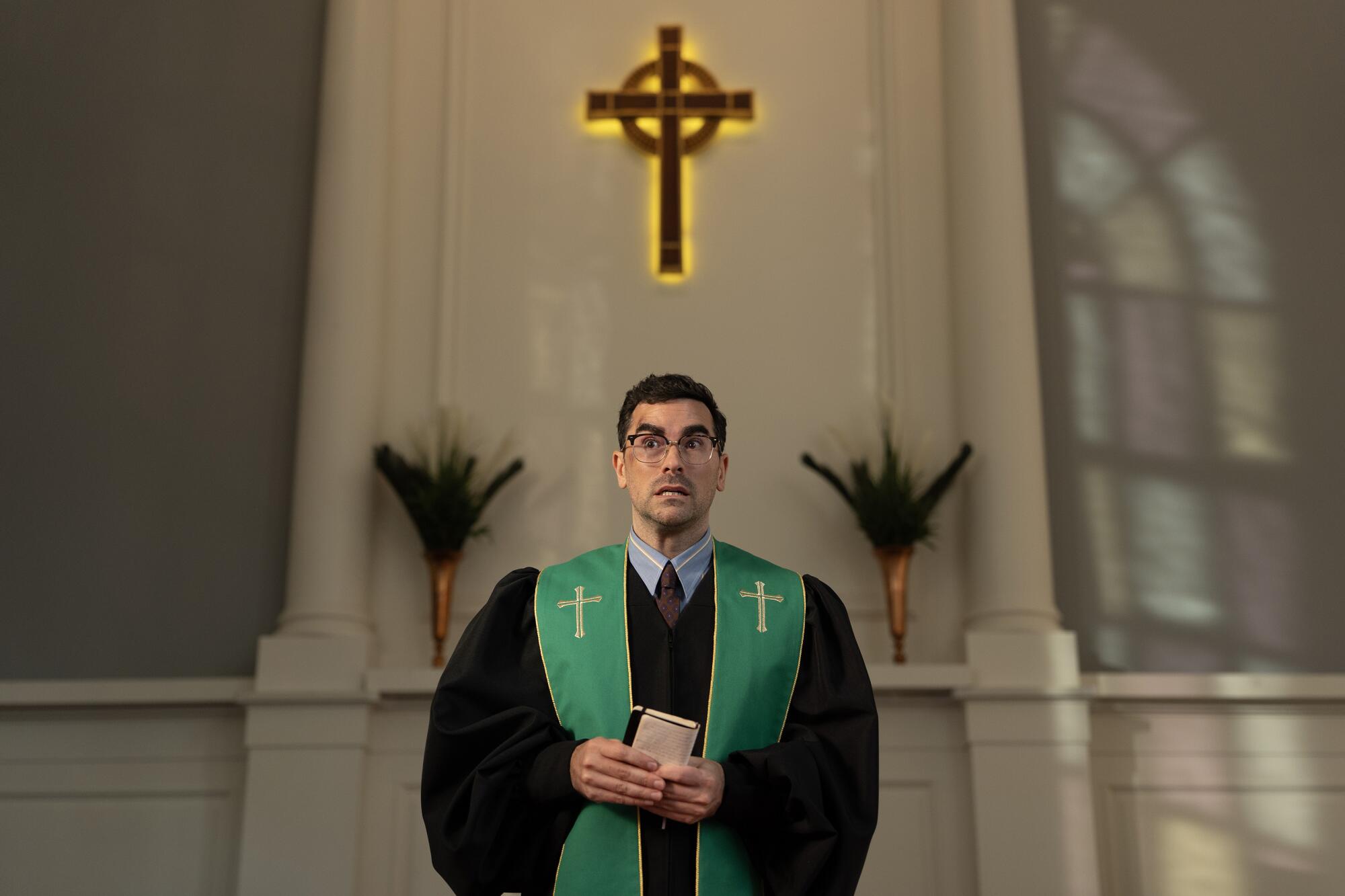
Dan Levy plays a pastor in the series: “I didn’t want to caricature that person. I wanted to respect the fact that these are his beliefs, whether I agree with them or not.”
(Spencer Pazer / Netflix)
There’s a lot of anger on the show — often, the very understandable result of the situations the characters find themselves in. Is that cathartic to write and to perform?
Ortega: We all do that really easily.
Levy: I always like to pull the pendulum back as far as possible. I think you’re seeing these characters at the breaking point. And I don’t think that they would be as susceptible to the crime that happened if they weren’t in particularly precarious times in their life.
I speak from my experience — you come from a yelling family or you don’t. And the yelling families will deeply identify with this, and the non-yelling families, it might take a minute to understand.
Metcalf: It’s regional. Ninety percent of it doesn’t land on anybody. My own kids just roll their eyes. It doesn’t mean anything at all.
Ortega: If I yell in my real life, other people will go, “I know you’re upset, but it is funny.”
It’s been only a couple of months since the death of Catherine O’Hara, your “Schitt’s Creek” co-star, and audiences are still missing her tremendously. Do you have any memories of her you might want to share?
Levy: I have nothing but memories. I feel very grateful to have worked with her on something that I know she was so proud to be a part of — to know how excited she was by the show, how proud she was of the character that she built, and to be there for her during those six years to give her everything she needed to help build that character into what it’s become. To be a part of that chapter of her brilliant career is a real blessing. Aside from that, she was just a wonderful, wonderful person.