
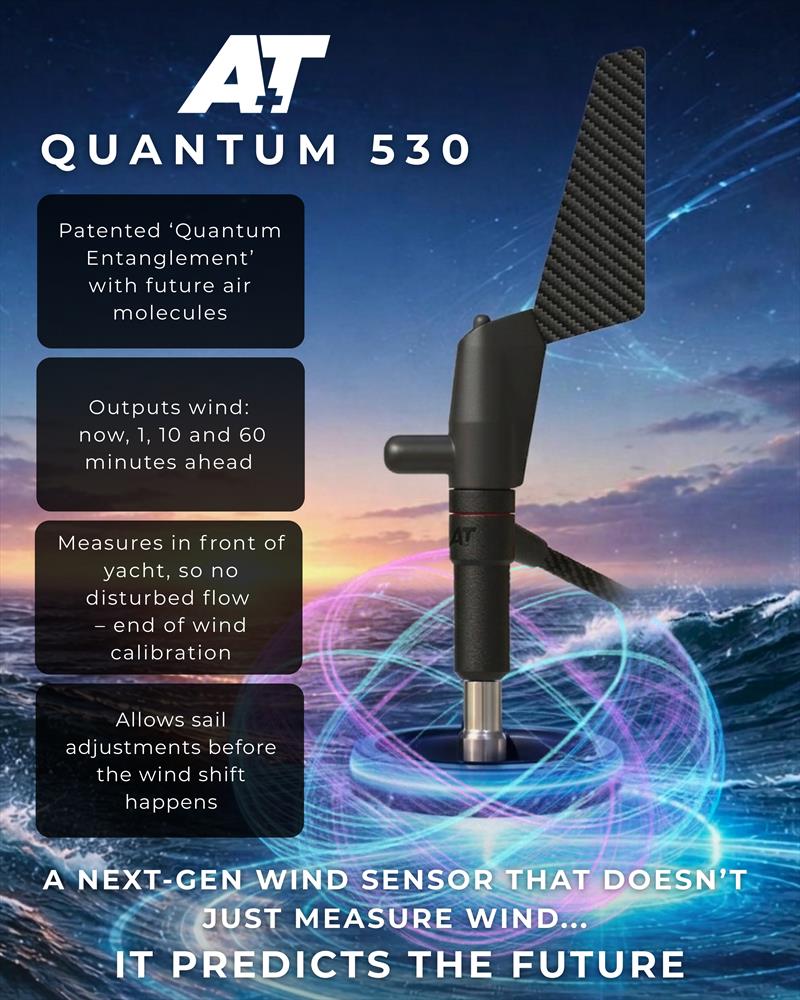

A+T Quantum 530 launched
by Mark Jardine 1 Apr 02:00 EST
1 April 2026
The next-generation of wind instrument has landed, with A+T Instruments launch of the Quantum 530. Readings are no longer limited by what’s happening at the top of the mast, thanks to the field of physics that Albert Einstein referred to as ‘spooky’.
Quantum entanglement is where pairs or groups of particles interact in such a way that their quantum states become linked, sharing a single, unified quantum state. Measuring a property of one particle, such as its spin, instantly determines the state of the other, regardless of the distance separating them.
Harnessing this was the breakthrough that led the A+T team to the Quantum 530, allowing sailors to see what the wind strength and direction will be 1, 10 and even 60 minutes ahead with incredible accuracy.
A+T’s Hugh Agnew, a Cambridge mathematician, said of the new wind sensor:
“This really is a quantum leap in terms of performance, if you’ll pardon the pun. Being able to see the upcoming wind strength and direction gives you insights that have simply not been available without our patented quantum entanglement technology.”
With this future knowledge, sail calls can be made up to an hour in advance, but Hugh doesn’t expect this to make sail changes any less rushed:
“While the tacticians will know what’s yet to come, there will be little reason to tell the rest of the team. Those on the bow simply wouldn’t know what to do with the information, and always prefer a last-minute call to one made early. It wouldn’t be sailing without a bit of histrionics from the crew, so the advantages the Quantum 530 provides should be strictly kept to discussions between the afterguard on any yacht.”
Developments haven’t stopped there, with Nick Cherry, A+T’s head of Technical Sales and Support, suggesting that the concept can be extended to predict what opposing yachts will do before they’ve actually made the decision:
“Knowing where the fleet will be positioned gives unparalleled foresight to a navigator. For example, choosing a lane upwind becomes a doddle when you know where the clear air will be, especially when you know the windshifts so far in advance. On a windward-leeward course you can plan the first and second upwind legs before the start gun, allowing a tired tactician time for a well-earned nap during the race itself.”