
12
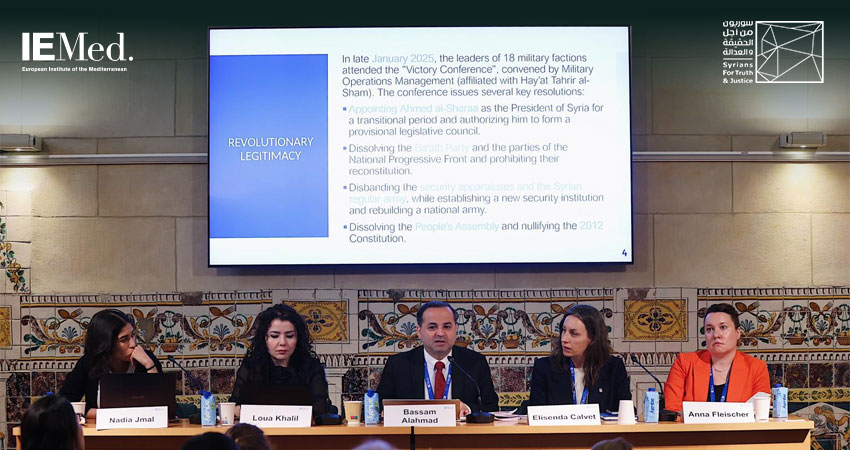
Syrians for Truth and Justice (STJ) participated in the 11th edition of the Aula Mediterrània Conference on interdisciplinary research, hosted by the Institute for Catalan Studies in Barcelona on 24–25 March 2026. The event drew a wide range of researchers, scholars, and policymakers from both sides of the Mediterranean.
During a session focused on “Transitional Justice in the Levant and North Africa,” STJ, represented by its Executive Director and Co-founder, Bassam al-Ahmad, presented a paper titled “Transitional Justice in Syria: Between Optimism and Reality – Sliding Toward ‘Victor’s Justice’?” which revealed significant structural flaws in Syria’s current transitional process. Al-Ahmad suggested expanding the mandate of the National Commission for Transitional Justice to cover all violations and adopting a broad definition of victims, while stressing that the Commission must operate independently, transparently, and in cooperation and coordination with international mechanisms. He also warned that neglecting these issues could cause the entire transitional process to fail.
Concentrated Power Threatens Transition Justice Path
Additionally, STJ highlighted the Interim Constitutional Declaration issued in March 2025, asserting that it emerged from a context lacking minimum levels of transparency and representation. The Declaration was drafted without meaningful participation from Syrians and was led by a committee of seven legal experts who shared similar ideological views that did not reflect the diversity of Syrian society; notably, near-final drafts were published even before the committee held its actual meetings.
STJ demonstrated that the Declaration grants the transitional president extensive powers, including executive and legislative authorities, the ability to appoint one-third of the People’s Assembly, control the formation of the Supreme Constitutional Court, and maintain a monopoly over proposing amendments to the Declaration, all without genuine guarantees for the separation of powers or the establishment of popular sovereignty.
STJ added,
“Unless the structural imbalances in the transitional process are addressed, Syria is at risk of sliding toward a new autocracy and renewed conflicts.”
Decree 20 Ignores Victims of Other Parties
STJ commented on Decree No. 20, issued in May 2025, regarding the National Commission for Transitional Justice, noting the delay in its formation and the ongoing absence of its organizational structure and internal bylaws. More importantly, according to STJ, the Commission’s mandate only covers violations by the former regime, overlooking documented crimes committed by other parties in areas like the Coast and As Suwayda, including extrajudicial killings, kidnappings, arbitrary detention, and extortion.
STJ also pointed out the contradiction with Decree No. 19 concerning missing persons, which uses a broader definition of victims. This suggests that although expanding the mandate is legally possible, it has not yet been incorporated into the larger transitional justice process.
A Wall Blocking International Cooperation
STJ expressed concern about the lack of official cooperation with UN mechanisms, such as the International, Impartial and Independent Mechanism (IIIM), the Commission of Inquiry (COI), and the Independent Institution on Missing Persons in Syria (IIMP), despite statements indicating openness to their involvement. The organization argued that this contradiction undermines trust and harms the credibility of the transitional process.
The Aula Mediterrània Conference is one of the leading academic platforms in the Mediterranean region, bringing together 16 postgraduate programs from nine Catalan universities and international partners, including the Union for the Mediterranean and the EuroMeSCo network, which includes major research centers in the Euro-Mediterranean area. STJ’s participation demonstrates its ongoing effort to amplify the voice of Syrian civil society in international dialogue platforms.
STJ Recommendations
The organization outlined a series of suggestions for the transitional period, which included:
Reinitiating a transparent and inclusive national dialogue, while maintaining the separation of powers; Amending Decree 20 to recognize victims from all parties and strengthening mechanisms for truth-seeking and reparations; Upholding judicial independence and enhancing collaboration with international bodies; Implementing economic recovery policies aimed at reducing inequality and promoting equitable resource distribution.