
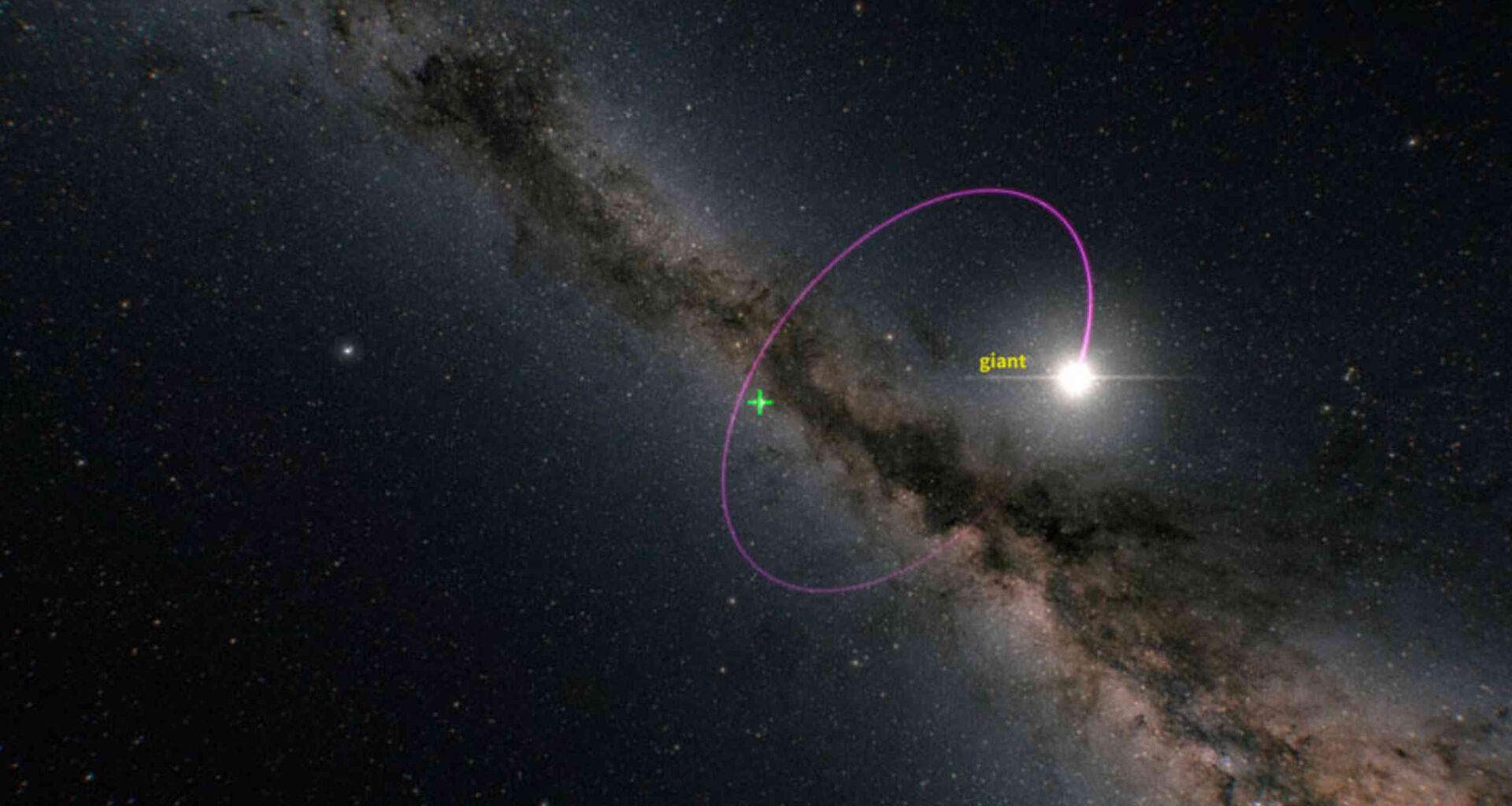
Researchers have identified 13 previously hidden symbiotic stars in data from Gaia, the European Space Agency’s space telescope that maps stars across the Milky Way, confirming that a missing stellar population was there all along.
Their discovery begins to close one of the field’s most persistent gaps between prediction and observation, and redirects the search for what remains unseen.
Where the clues hid

Inside Gaia’s catalog of 12.4 million variable sources, 649 objects had already been flagged as possible matches.
Working through that list, Stavros Akras at the National Observatory of Athens (NOA) showed that 13 were real systems.
Most had been cataloged as slow-pulsing variable stars, which meant ordinary labels had hidden stranger systems in plain sight.
That result suggests the missing population was not simply absent, but scattered across surveys that had never been read together.
How the pairs work
Gas flowing between two mismatched stars powers a symbiotic star, a long-lived pairing of a giant and compact star.
As that gas falls toward a white dwarf, a dense burned-out stellar core, it heats and can light up surrounding hydrogen.
Because the giant star can dominate visible light, many of these binaries look ordinary until another survey catches the hot companion.
That camouflage helps explain why theory has long predicted far more systems than astronomers had actually pinned down.
How Gaia helped
Instead of relying on one telescope alone, the team cross-checked Gaia against optical, infrared, and ultraviolet sky surveys.
Each data set contributed a different clue, from cool dust around the giant star to hotter light from the companion.
For objects missing optical data, Gaia’s low-resolution spectra supplied colors that exposed H-alpha, a red glow from excited hydrogen gas.
That workaround let the search reach beyond the limited footprint of specialized ground surveys and rescue sources they never covered.
What the numbers show
From 649 suspects, only 54 survived the combined infrared and optical screens, and 13 stood out as the strongest new finds.
Ten were relatively cleaner systems dominated by starlight, while three were dustier versions wrapped in thicker material.
Every one of those 13 also showed hydrogen emission and molecular bands, broad absorption patterns made by cooler gases.
That combination is hard to fake, which is why the authors treated the candidates as bona fide members.
Why they stayed hidden
Several of the 13 had been cataloged as variable stars, a reasonable mistake when variability looks clearer than identity.
Across much of the sky, surveys that catch H-alpha do not cover every location, and faint sources often fall through.
Elsewhere, the red giant can outshine the hotter companion so completely that the system masquerades as an ordinary cool star.
Those biases help explain why the observed census has lagged behind population models by such a wide margin.
Testing the workaround
Confidence in the computer-built colors mattered because several new systems sat outside the ground surveys that confirm hydrogen emission.
Comparisons with observed measurements showed the generated colors tracked real ones closely enough to remain useful for screening.
Agreement was stronger in color differences than in raw brightness, which is exactly what matters for spotting unusual emitters.
That means Gaia can now help classify candidates even when no follow-up spectrum arrives right away.
Why the count matters
Population models have long produced many more symbiotic systems than observers could confirm, leaving theorists unsure which assumptions were failing. NOA’s 13 additions do not solve that problem, but they trim the mismatch with real objects.
Better counts also matter because some of these binaries may, in rare cases, help seed Type Ia supernovae, distance-marking stellar explosions.
Sharper catalogs should therefore improve both everyday classification and bigger attempts to estimate how often those explosions begin.
Where the stars sit
Most of the new systems fall in the Milky Way’s disk, where dust, crowding, and sheer source numbers complicate clean classification.
Their apparent brightness usually landed between 14 and 16 in Gaia’s main brightness scale, placing many among the faintest known members.
That range weakens the idea that Gaia ignored them because they were too dim for reliable spectra.
Instead, the harder problem was recognition, which depends on linking separate clues across surveys that were built for different jobs.
What happens next
New search strategies can now use these 13 systems as reference cases for spotting similar binaries in other massive archives.
Computer-built light profiles from Gaia also offer templates for future surveys, letting astronomers recognize the same fingerprints faster.
Follow-up telescope spectra will still matter for border cases, especially objects that resemble planetary nebulae, glowing shells shed by dying stars.
Even so, NOA’s work shows that public databases already contain more hidden systems than the catalogs on their own admit.
Toward a fuller census
Each step in this search, from matching catalogs to reconstructing missing colors, pushed the field closer to the population models.
More hidden symbiotic stars will almost certainly turn up, and each one should make the theory-observation gap a little less stubborn.The study is published in the Monthly Notices of the Royal Astronomical Society.
—–
Like what you read? Subscribe to our newsletter for engaging articles, exclusive content, and the latest updates.
Check us out on EarthSnap, a free app brought to you by Eric Ralls and Earth.com.
—–