
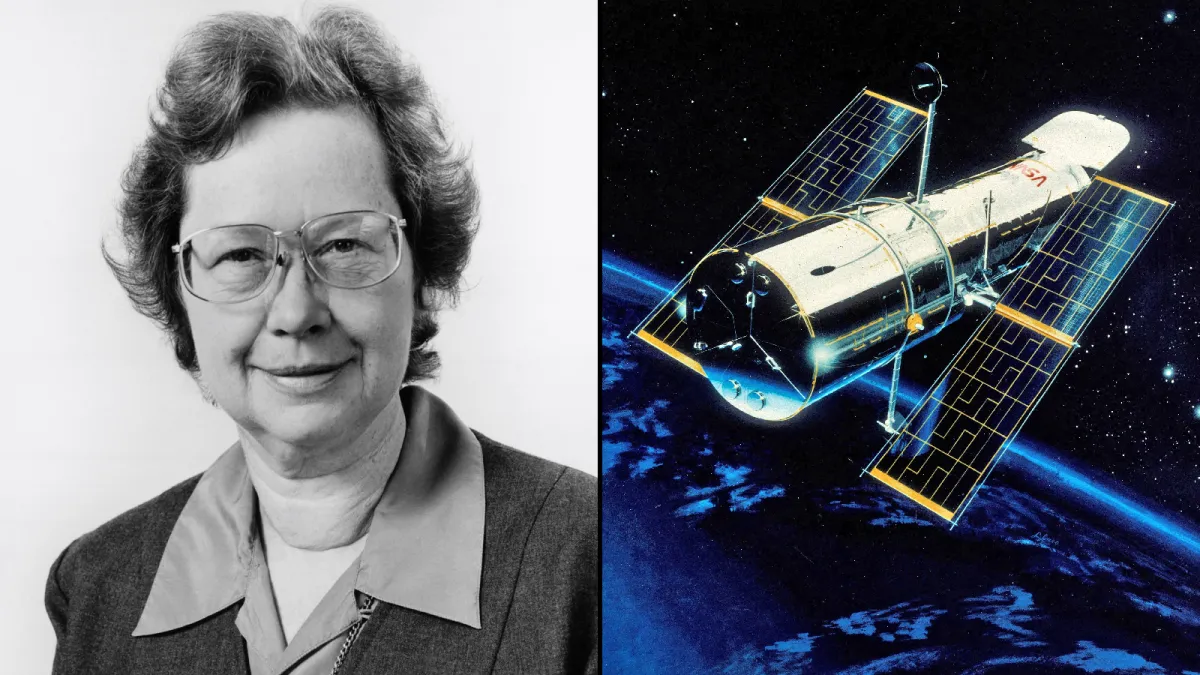
After being made a DBE in 2006 for her services to physics and astronomy, the newly appointed Dame Carole Jordan interrupted a speaker when she was introduced as such at a function. “Dame Commander,” she corrected them. “I like the Commander bit.”
It was this no-nonsense attitude and willingness to speak her mind that made the astrophysicist a formidable authority in the field of solar physics. “She took charge,” a colleague remembered. “She got things done.”
Jordan’s work centred on the use of x-ray and ultraviolet (UV) spectra to analyse plasma, which accounts for more than 99 per cent of all observable matter in the universe. She was active in the research community throughout her career, editing Monthly Notices of the Royal Astronomical Society, Solar Physics and The Observatory.
One of her main contributions was her work on solar UV spectra — the pattern of light absorbed or emitted by a substance — with Skylab, a Nasa space station that orbited the Earth from 1973 to 1979, which helped to develop understanding of helium-like ions, also known as two-electron atoms. These are important in spectroscopy — the analysis of light to understand the physical and chemical properties of substances — and the identification of celestial objects.
As her career progressed, Jordan became heavily involved with observations of stellar spectra, especially using data obtained from space platforms such as the International Ultraviolet Explorer and the Hubble Space Telescope.
She also made significant progress in the understanding of the sun and, more specifically, the corona — the outermost layer of the star’s atmosphere, which appears as a faint halo during total solar eclipses. She took a particular interest in coronal heating — the mystery of why the surface of the sun is about 300 times cooler than its outer atmosphere — and her work helped further the accurate prediction of space weather.
Severe space weather occurs when explosive events near the sun’s surface project strong radiation fields towards the Earth, and the phenomenon has been on the UK’s National Risk Register since 2012 as one of the most serious natural and environmental hazards. In space, turbulent conditions can damage spacecraft and even destroy them, and on Earth this can result in significant disruption to power grids and communication systems, so reliable methods for predicting such phenomena are crucial.
Later, Jordan transferred her solar techniques to the plasma surrounding cool stars — smaller stellar objects with relatively low surface temperatures of about 3,000 degrees Kelvin or less — and developed techniques using spectra to determine the temperature of plasma as a function of height.
Arguably, Jordan’s greatest legacy to astronomy was far more understated. She did much to further research on ionisation — the gain or loss of electrons from an atom to create an ion — and was a pioneer of methods for detecting and interpreting the different ionisation states. “It’s one of those things that we take for granted now,” a fellow member of the Royal Astronomical Society said. “But somebody had to work it all out.”
With this knowledge at her disposal, Jordan was not shy in making her scientific opinions known. One colleague recalled: “She wouldn’t accept undefined discussions. You had to be on the ball with your knowledge of the science when you were having a discussion with her. And if you were imprecise or incorrect, she certainly let you know about it — in a good way.”
Carole Jordan was born in 1941 to Reginald Jordan and Ethel (née Waller). After studying at Harrow County Grammar School for Girls she read physics at University College London (UCL), where she wrote a paper on how craters on the moon might become distorted.
After her graduation in 1962, Jordan completed a PhD in astrophysics under the Australian astronomer CW Allen, and spent time at the University of Colorado, Boulder. Her dissertation, titled “The Relative Abundance of Silicon Iron and Nickel in the Solar Corona”, was published in 1965.
She began her academic career in 1966 as an assistant lecturer in astronomy at UCL, where she stayed until 1969. Between 1969 and 1971 she was a research assistant at the Astrophysics Research Unit at Culham and went on to become the principal scientific officer there from 1973 until 1976.
That same year she moved to the University of Oxford as a lecturer in physics and joined Somerville College as a tutor. The following year she was made a Wolfson fellow in natural science, and from there her career continued to gather momentum, setting an inspiring precedent for women in science.
Jordan was made a fellow of the Royal Society in 1990, an honour of which she was immensely proud. Six years later she became one of the first female professors of astronomy at the University of Oxford, and she served as head of its Rudolf Peierls Centre for Theoretical Physics from 2003 to 2008. She was the first woman to be president of the Royal Astronomical Society, from 1994 to 1996, and only the third to win the RAS Gold Medal, in 2005.
She was a member of both the Science and Engineering Research Council and the Particle Physics and Astronomy Research Council. She served twice on the council of the Institute of Physics and was its first vice-president of science. The only thing she cared about as much as her work was her cat, with whom she shared her cottage.
In 2017 Oxford asked pupils and staff to nominate 20 people with links to the university whose portraits should be put on display to redress the balance of “dead white males” lining its walls, with the criteria being “examples of excellence” and people who had “challenged stereotypes”. As a woman who had spent her whole career striving to inspire female students at the university to study technical subjects, Jordan was a fitting choice.
She was aware of the challenges — in an interview in 1987 she acknowledged peer pressure against girls studying scientific subjects at school, saying: “Girls don’t want to feel different at the age of 13 or 14.” To combat this she encouraged women’s science research at any opportunity.
A fellow physics tutor at Somerville said: “After she retired, whenever we met, she was always asking me the same question: ‘How many of our female students continue to a PhD?’ And her comment to my answer was always the same: ‘Try harder’.”
On first meeting, many students perceived Jordan — who could often be found smoking one of her characteristic long, thin cigars — to be a daunting presence. Though she demanded the best work from her students, she was quick to put them at ease with a beaming, encouraging smile, and she could be unexpectedly empathetic and supportive in times of need.
“I remember that she would give a bit of a pep talk — with cakes — to students just before their exams,” said one tutee who went on to become a lecturer at the university. “She helped me find my way when I started teaching at the college, generously lending me the use of her room for teaching while she was on sabbatical. Years later, when I got married, she gifted me a piece of furniture from the room that I had admired then.”
She was also generous with her attention. Another colleague recalled: “Although she worked in a particular field, she was interested in everything else that was going on in astronomy, and that’s why she was such a good supporter of young people because she listened to what they were doing.”
Meeting her years later at a Somerville reunion, some of Jordan’s early students found that although she was incredibly focused on her career, she was also warm in valuing those who did not go on to pursue physics.
Despite her no-nonsense approach to work, Jordan displayed a fun sense of humour on occasion. One colleague remembered a boat trip around Corsica during a Nato science workshop in the Eighties. “Many of us younger people were quite happy to dive off the boat, but Carol just sat in the back with her cigar, watching everybody swim. She threw pieces of bread into the water, gathering the shoal of fish that were trailing the boat, so that everybody then had to swim through … being nibbled, and she took great delight in that little joke.”
She stepped down from her roles at Somerville in 2008 and was made a fellow emerita in recognition of her distinguished service to the college. However, her dedication to physics and astronomy continued long after her nominal retirement and she provided input on mission proposals up until recent years.
The president of the Royal Astronomical Society, Professor Mike Lockwood, recalled his first meeting with Jordan on BBC Radio 4’s Last Word: “Shortly after she was elected a fellow of the Royal Society, I was sitting quite near her, and we all had these little badges for the meeting and hers said Carole Jordan FRS on it. I caught her just taking a sneaky look at it, and she did a little celebration.
“I could have pretended I hadn’t noticed when she looked up and looked a bit shamefaced, but I didn’t. I gave her a big thumbs up.”
Professor Dame Carole Jordan FRS FRAS FInstP was born on July 19, 1941. She died of undisclosed causes on February 3, 2026, aged 84