
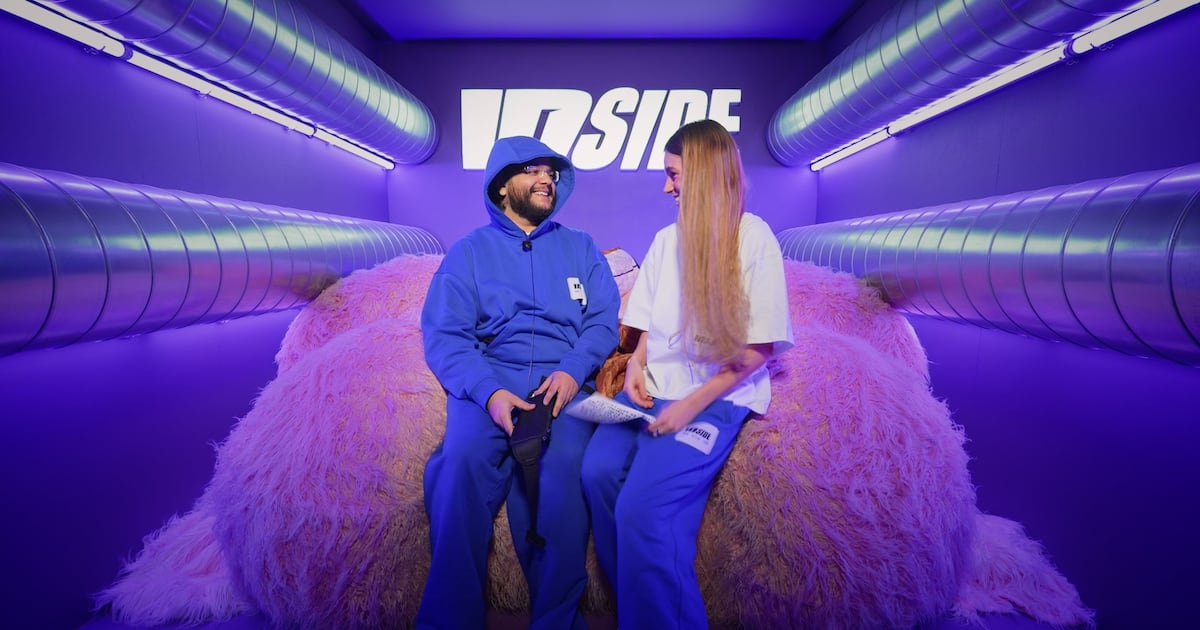
Inside (Netflix) is a show fronted by the Sidemen, an amorphous mass of indistinguishable young men who live in the Internet. So you will currently find them wobbling about like Weebles or Fisher-Price characters outside of their natural habitat – your phone – and up on your big flat-screen telly. They’re still small, really; it’s just the pictures that got big.
How many Sidemen are there? There are many Sidemen – somewhere between two and 20. I get distracted every time I try to count them. I challenge any of you to get an accurate number of Sidemen. It’s impossible. I think it has something to do with quantum physics or solar radiation.
Why are there so many Sidemen? While rough MrBeast slouched towards Prime Video waiting to be born, the ur-streamer Netflix has chosen a job lot of bargain-basement beasts. Basically, it got a lot of spares. It throws them all at the screen like cannon fodder at the Somme, in the hope that one of them sticks and slides down the camera lens in some accidental, flat-faced approximation of charisma.
What MrBeast lacks in charm he makes up for in unproductive wealth. Gazing at MrBeast’s joyless visage – massive cheeks like snooker balls, tiny blank dots for eyes, the rictus grin of a medical skeleton, the transplanted gelled-up hair of a boy-band member – is akin to staring into the abyss.
Perceiving the Sidemen’s blurry vagueness, on the other hand, is more like gazing into a series of fuzzy potholes. The camera can barely stand to focus on any one of them for too long. The most notable Sideman is KSI, whose barked staccato sentences sound as if they were edited together word by word by an underpaid sound editor.
KSI is also one of the men behind the drink Prime, which has destroyed the best minds of a generation (my nephews) and is largely used as an engine lubricant and sprayed on American crops instead of water.
Inside has nothing like the budget of Beast Games, in which MrBeast flexes the finances of a medium-sized nation and reigns over the hopes and dreams of 1,000 disenfranchised, hopeless Americans.
Instead it places 12 more internet stars in a nondescript bunker and essentially gets them to engage in the marshmallow experiment. This was a cognitive test given to toddlers in the 1970s to see if they could cope with delayed gratification and not, as you assumed at the time, a competition to see how quickly someone could eat a marshmallow.
In this instance the innocent influencers must resist the temptation to buy easily accessed treats from the bunker’s commissary in order to, at the end of the day, win £1 million. Like the toddlers of the 1970s, the assembled influencers lack object permanence, and when the prize is out of sight they fail to control themselves and end up buying themselves pillows and prosecco and chunks of steak.
It’s not their fault. These people are creatures of the algorithm, and each of them has one to two personality traits designed to lure the eye and ear. Algorithmic social media has been slowly whittling human personalities down to a handful of easily impersonated traits in anticipation of AI. Some of these influencers barely register on a larger screen. When experts say chatbots can now pass the Turing test, this is largely because there are lots of humans who can no longer pass the Turing test.
Let’s meet some of them. Ukrainian TikTokker Anna Malygon lives in a castle and has a butler. That’s it. That’s her personality. Eddie Hall can lift things. Expressions Oozing (his actual name) is a football vlogger who gibbers and shouts. Lydia Violet is a Twitch streamer who looks confused for money.
At the end of the first episode a number of Sidemen emerge from the walls (as I said, it’s impossible to tell how many) and get the various influencers to stick their heads inside a glass cage. While there they are asked inane questions and covered in, at different points, cockroaches, toads, rats (“Do it to Julia!” I cry, reflexively), eels and faeces.
Oh, what larks! What japes! Oh, children, the games we played as the old world was dying! You should have seen it. It was a glorious time.
And now we must cower here, hiding from Palantir’s kill robots with nothing but our memories. Why didn’t we deal with rising inequality, climate change and burgeoning fascism instead? Ha ha! I think someone is asking to be today’s ritual sacrifice and/or dinner. Into the pot with you.
 Last One Laughing UK: Diane Morgan. Photograph: Prime Video
In contrast to Inside, Last One Laughing UK (Prime Video) features a whole batch of professional comedians. These are people with too much personality. Some of them have up to six or seven personality traits.
It’s something special to watch some of the funniest people in the world trying not to laugh at the comedy antics of some of the other funniest people in the world. That’s the basic rule on Last One Laughing: do not laugh.
The most impressive contestants so far include Diane Morgan, who farted her way through a reading of Dylan Thomas’s Do Not Go Gentle into That Good Night (not in itself a laugh riot and not previously fart-themed).
Reigning champion Bob Mortimer, on the other hand, simply has a funny head, and it’s unfair for anyone to have to look at it in these circumstances. Some contestants look as if they need to be hospitalised. I’m pretty sure holding in laughter like this causes medical issues.
Thankfully, I am a medical expert now. I have watched several episodes of The Pitt, the new close-up-surgery drama on HBO Max (newly available in Ireland), and am now, I believe, qualified to perform surgery.
I certainly think the show’s star, Noah Wyle, a veteran of ER, is qualified to perform surgery at this stage. If there was an emergency situation and no other doctors were about, I’d definitely let Noah Wyle operate on me.
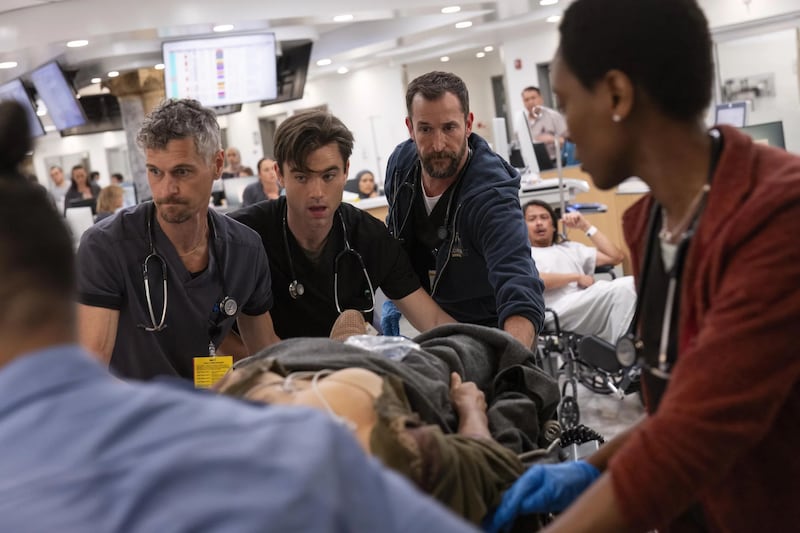 The Pitt: Noah Wyle (second right) as Dr Michael Robinavitch. Photograph: Max/WBD
I might even let him operate on me if I was just a bit bored, to be honest with you. In The Pitt, a drama of 15 episodes all set in one shift in a hospital emergency room, Wyle plays Dr Michael Robinavitch, an attending physician grappling with old traumas.
The Pitt’s showrunner, R Scott Gemmill, is going for gritty realism, and so we witness procedure after procedure as the stressed-out and overworked nurses, doctors and trainees of Pittsburgh Trauma Medical Center – the Pitt – deal with people whose legs are hanging off or have terrible burns or need to have incisions made in their throats with scalpels. Man flu, basically.
All in all, The Pitt is excellent, well-crafted, socially conscious telly, and the whole first season is finally available over here. It’s obviously better than Inside, but is it as cheap? It is not. And thus it will, in time, be replaced.