
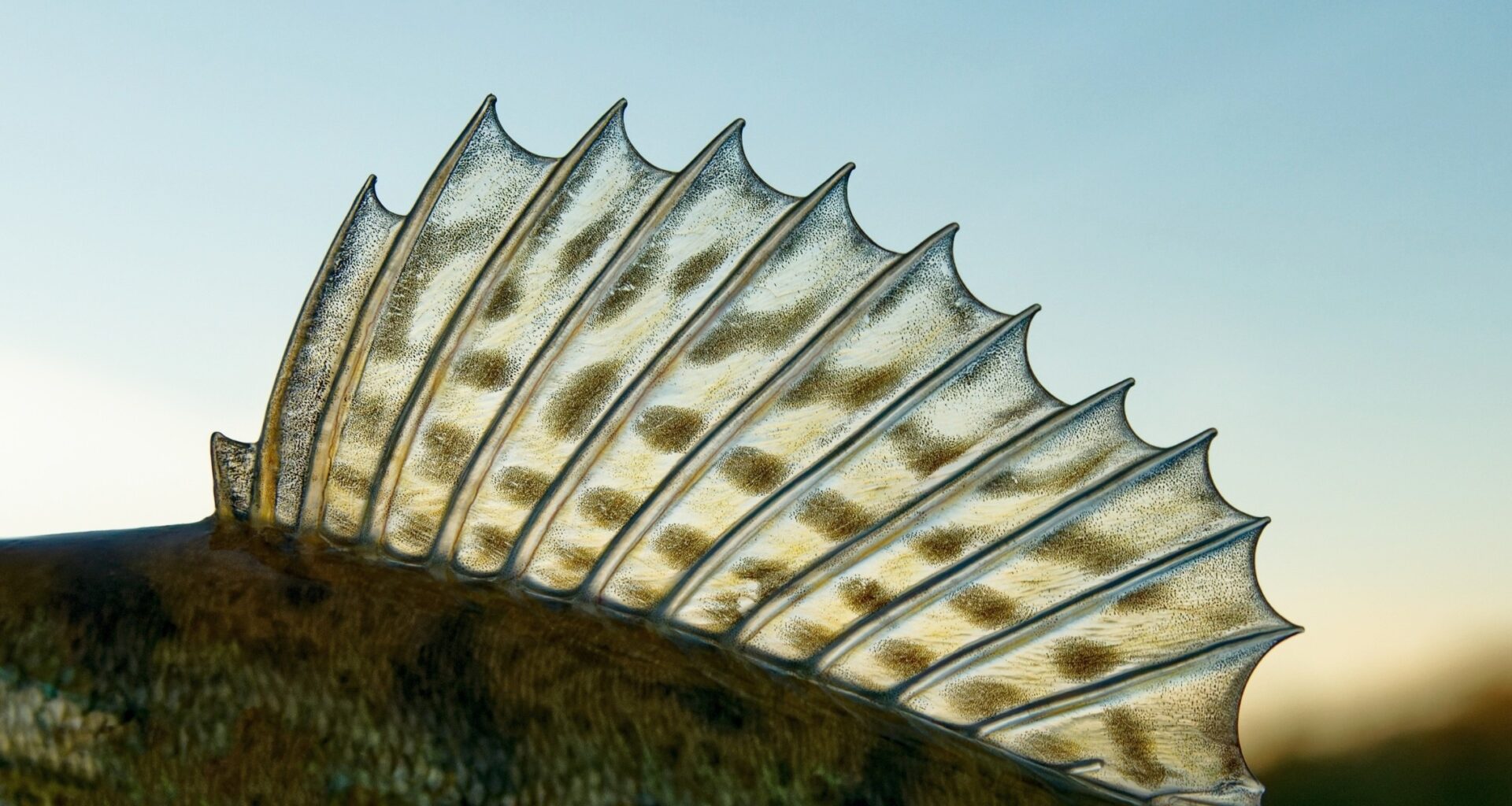
A long-standing puzzle asks a simple question: why do different body parts look related despite serving very different roles?
Think about structures like fins, limbs, or even the bones in your spine. They follow a pattern. They repeat, but not in an identical way.

Scientists call this serial homology. It’s a familiar idea, yet explaining it has never been straightforward.
For years, the common explanation leaned on change over time. One structure gradually transforms into another. That idea still holds in many cases.
But new work suggests something else might also be going on beneath the surface. Andrew Gillis, an associate scientist at the Marine Biological Laboratory, has spent nearly 20 years studying how fish fins evolved.
Working with colleagues through the MBL-University of Chicago Graduate Research Fellowship Program, Gillis explored how early development shapes these repeating structures.
A new way to think about repetition
The new study focuses on embryos of the little skate, a type of fish. Inside these early stages, cells are already making decisions about what they will become.
Some turn into gill arches, which support breathing. Others form paired fins, used for movement.
Traditionally, scientists believed these parts came from completely separate cell groups. Gill arches were tied to one layer of embryonic cells, while fins came from another. That clean separation made sense for a long time.
But the research shows something different. The boundary between these cell populations isn’t sharp. It’s more like a blend. Cells from different origins mix and share the ability to form either structure.
That flexibility changes how scientists think about repeated body parts. Instead of one structure slowly transforming into another, different cell groups may already carry the same potential from the start.
Cells that can switch roles
To test this idea, researchers performed careful transplant experiments. They took cells that would normally become part of the gill skeleton and placed them into developing fins.
The cells adapted. They became part of the fin without any trouble.
The team also moved cells in the opposite direction. Cells destined for fins were placed into areas forming the jaw, which is closely related to gill structures. Again, the cells fit right in.
“What this means is the cells making these two body parts are equivalent and interchangeable,” said Gillis. “We propose that is why the structures that form from these cells are serially homologous.”
The cells respond to their surroundings. Signals in the embryo tell them what to build. Whether the instruction is to form a fin or a gill, the cells follow along.
Why this matters for evolution
This finding adds a new layer to an old debate. For more than a century, scientists have tried to explain how repeating structures arise.
One early idea, proposed in the 1870s, suggested that paired fins evolved from gill arches through gradual change.
Modern studies have supported parts of that idea by showing shared genes and pathways. But this new work points to something deeper. The similarity might come from shared developmental potential, not just long-term transformation.
“Our study offers a new way of thinking about serial homology that doesn’t necessarily have to invoke one thing transforming into another,” Gillis noted. “We are trying to define serial homology by explaining it from a developmental perspective.”
That shift matters because it changes where scientists look for answers. Instead of focusing only on fossils and visible changes over time, they can study how embryos build structures in the first place.
A pattern written in the genome
The research also raises questions about what guides these flexible cells. If different cell types can behave the same way, something must be coordinating that response.
“The similar response of the cells to the environment may be encoded in the genome,” said study first author Michael Wen.
“How similar the genomic landscapes are between cells may provide another layer to our explanation of serial homology and is something we are now investigating.”
This idea suggests that cells carry shared instructions, even if they start in different places. Those instructions might explain why certain body parts repeat in a patterned way across many animals.
Still an open question
Despite these advances, the full story of how paired fins first appeared remains unclear. Fossils have helped explain how fins later turned into limbs, especially in early land animals. But the very origin of fins is harder to trace.
“Unlike the fin-to-limb transition, where we have all these nice fossils showing the gradual transformation of one part to another, we don’t have that for the origin of fins,” Gillis said.
That gap leaves room for more questions. It also keeps the field moving. Each new finding adds a piece, but the picture is still incomplete.
A broader view of the body
The implications go beyond fish. If interchangeable cell populations help create repeated structures, the same principle could apply elsewhere in the body.
“I would bet if you transplanted a lower-back skeletal cell to the neck during embryonic development, it would behave like a neck cell,” said Gillis.
That idea connects everything from vertebrae to fingers and toes. It suggests the body builds variation from a shared toolkit, using flexible cells that respond to local signals.
Biology rarely offers quick answers. But sometimes, after years of steady work, it reveals a simpler truth hiding in plain sight.
The full study was published in the journal Proceedings of the National Academy of Sciences.
—–
Like what you read? Subscribe to our newsletter for engaging articles, exclusive content, and the latest updates.
Check us out on EarthSnap, a free app brought to you by Eric Ralls and Earth.com.
—–