
We used to think moons were the boring sidekicks of the solar system. For decades, we treated them like cosmic leftovers — cold, dead rocks that did nothing but tag along with their parent planets.
We were wrong.
In the past years, we’ve found that moons can be every bit as exciting as their host planets. They host liquid oceans, erupting volcanoes of ice, and weather patterns that make Earth look tame. A moon is the most likely place to host extraterrestrial life.
Here are some of the most exciting ones.
Io: The Volcano Moon That Never Rests

Jupiter’s moon Io is the most volcanically active place in the solar system. Let me tell you just how volcanic it is.
Io is slightly larger than Earth’s Moon, and it’s denser than any other satellite in the solar system. It has 400 active volcanoes, the largest of which is a whopping lava lake over 200 kilometers (126 miles) in diameter. This feature, called Loki Patera, is covered by a crust that periodically solidifies and is then replaced by fresh molten material from below.
Io’s extreme volcanism is powered by a specific mathematical relationship between three of Jupiter’s largest moons: Io, Europa, and Ganymede. This is known as a 4:2:1 Laplace resonance. Basically, for every 4 orbits Io completes, Europa completes 2 orbits, and Ganymede completes another orbit. Because their orbits are synchronized this way, the moons periodically line up in the same positions. Every time they “pass” each other, their mutual gravity gives Io a rhythmic outward tug.
These forces cause the solid surface of Io to bulge upward and downward by as much as 100 meters (330 feet) during its short orbital period. This generates a lot of friction which feeds the volcanism.
×
Thank you! One more thing…
Please check your inbox and confirm your subscription.
Enceladus: The 6,000-Mile Space Sprinkler

Enceladus is a tiny moon, only 500 kilometers in diameter, yet it is one of the most hydrothermally active places in the solar system.
It has massive “tiger stripe” cracks at its south pole. These cracks spray giant plumes of water ice into space. In 2023, the JWST mapped a plume stretching 6,000 miles — roughly 20 times the diameter of the moon itself. In fact, this is so impactful it feeds one of Saturn’s rings with fresh ice.
How does a frozen moon so far away from the Sun have liquid water? Well, once again, the culprit is friction. This friction creates heat, which causes the deeper layers of ice to melt. Researchers now believe Enceladus has an ocean of liquid water under its frozen surface.
But it gets even better. Scientific analysis of these plumes has revealed the presence of complex organic molecules, phosphorus, and salts, fulfilling the basic requirements for habitability.
Triton: The Retrograde Rebel
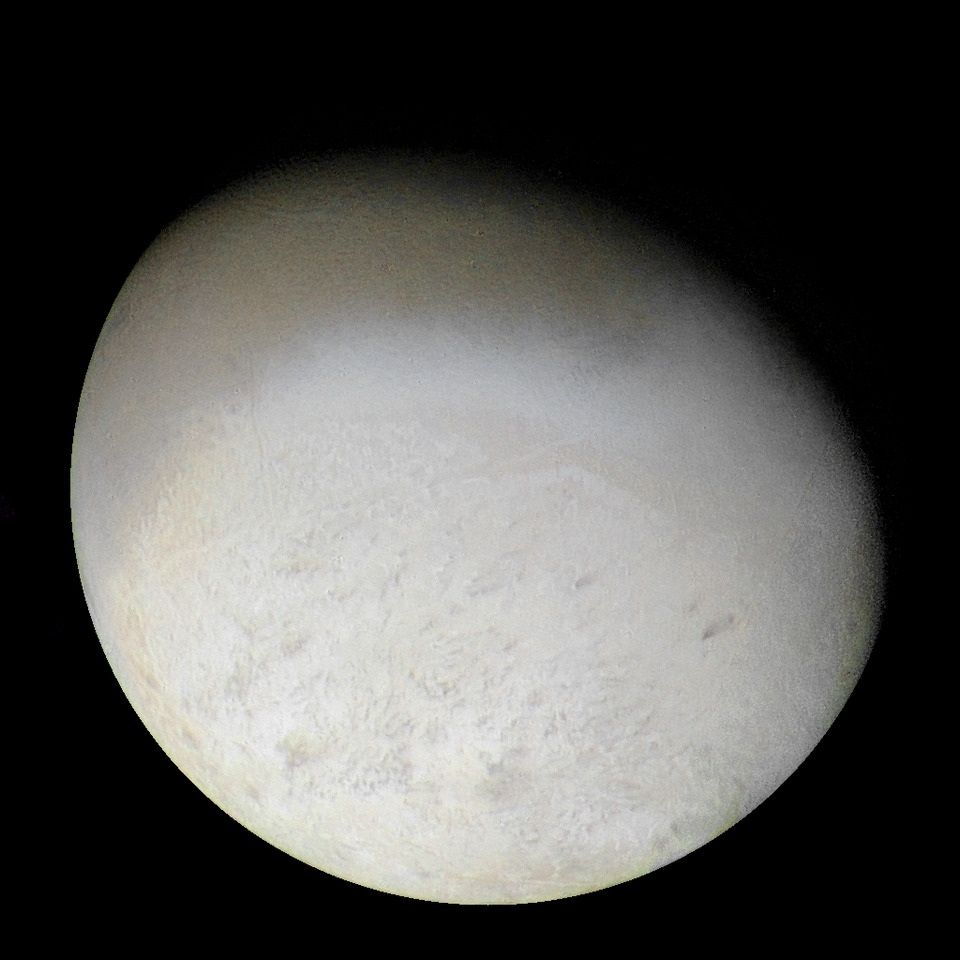 True color image of Triton. Image credits: NASA.
Triton is the only large moon in the solar system that orbits its planet in a retrograde direction — moving backwards against Neptune’s spin. Every other moon orbits their planet the other way.
This configuration proves that Triton did not form from Neptune’s primordial disk but was instead a dwarf planet, likely from the Kuiper Belt. In the early days of the solar system, Triton must have been captured by Neptune’s gravity. A leading theory for this capture involves a three-body gravitational encounter where a binary planetesimal system was disrupted by Neptune, leaving Triton in orbit while its companion was ejected. According to recent studies, this moon is also responsible for tilting Neptune.
Triton is also one of the most geologically active worlds in the Solar System, but its surface is covered by frozen nitrogen. It even has an atmosphere, also primarily composed of nitrogen. It also has liquid geysers, which researchers suspect could contain organic molecules.
Miranda: The “Frankenstein” Moon

Miranda is often referred to as a “Frankenstein” moon because its surface appears to be a mismatched collection of parts that didn’t quite merge properly. Despite being only 471 kilometers (293 miles) in diameter, Miranda features giant canyons up to 12 times deeper than the Grand Canyon. The surface is dominated by three large, geometric features called “coronae” characterized by concentric ridges and troughs.
There are two primary theories for Miranda’s bizarre appearance. The first suggests the moon was smashed apart by a massive impact and its pieces reassembled in a chaotic, haphazard manner. The second, and currently more favored, theory is that tidal forces from Uranus caused the moon’s interior to heat up and churn.
This convection in the icy mantle would have caused buoyant domes of ice to rise and contort the surface, creating the coronae.
Titan: Like Water, But Methane
 The surface of Titan is littered with methane lakes. Image credits: NASA.
Titan is the only moon in the solar system with a thick, nitrogen-rich atmosphere and standing bodies of liquid on its surface. It has lakes and seas, and if you were to look at photos of it, you’d think it looks a lot like Earth.
But at surface temperatures of -179 degrees Celsius (-290 Fahrenheit), it can’t be water. Instead, the “hydrological” cycle is driven by methane (CH4) and ethane (C2H6).
Recent 2025 observations by the JWST, in tandem with the Keck Observatory, have captured evidence of cloud convection in Titan’s northern hemisphere for the first time. These clouds rise to higher altitudes over a period of days, a hallmark of convective motion similar to thunderstorms on Earth.
Europa: The Solar System’s Greatest Hidden Ocean

While Io is a world of fire, its neighbor Europa is a world of deep, dark water. Beneath an icy shell, this moon hides a global saltwater ocean containing more than twice the volume of all Earth’s oceans combined.
It’s like Enceladus, except even more promising for extraterrestrial life.
Recent data from the Juno mission’s Microwave Radiometer (MWR) in 2022 gave us a “CT scan” of the moon’s surface. The ice shell is roughly 18 miles (29 kilometers) thick. More interestingly, the mission identified “scatterers” — a complex web of cracks, pores, and voids just inches wide that extend hundreds of feet deep.
All this puts Europa in a very intriguing “Goldilocks” space. If the right chemicals can bridge the gap through that 18-mile ice shell, its hidden sea could be the most habitable place in the solar system outside of Earth.
The Great Orbital Swap: Janus and Epimetheus
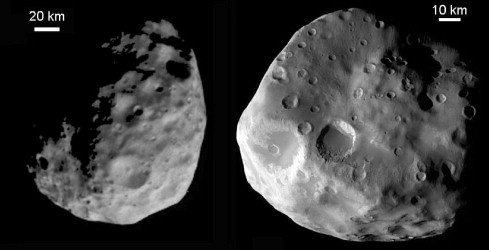 Image credits: Tiscareno et al.
Imagine two race cars speeding around a single-lane circular track. Eventually, the faster car will rear-end the slower one. In deep space, that’s usually a recipe for a catastrophic collision. But Saturn’s moons Janus and Epimetheus have found a way to share the road without the wreckage.
These two moons share nearly the exact same orbit, separated by a distance smaller than the moons themselves — just about 30 miles (50 kilometers). To any observer, they look like they are on a collision course. But every four years, they perform a bizarre gravitational maneuver.
As the inner, faster-moving moon begins to catch up to its outer partner, they don’t collide. Instead, their mutual gravity starts a gentle tug-of-war. The inner moon pulls on the outer moon, giving it a boost of energy. This “kick” pushes the outer moon into a higher, slower orbit. At the same time, the outer moon pulls back on the inner one, draining its energy and dropping it into a lower, faster orbit.
They literally switch orbits. Their survival offers a blueprint for how small bodies might persist in the crowded, debris-filled disks around other stars.
For decades, we viewed moons as lifeless, cratered remnants. But as these anomalies show, the satellites are often where the most mind-bending physics and chemistry actually happen.
The “weirdness” we’ve found so far is likely just the prologue. As we look toward the 2030s, two major missions are set to crack these cosmic “jewel boxes” wide open: NASA’s Europa Clipper (2030) will perform dozens of close flybys of Europa to determine if that 18-mile ice shell hides a habitable environment, while ESA’s Juice (2031) will specifically target Ganymede, Europa, and Callisto to map their hidden oceans and unique magnetic signatures.
Who knows what else we’ll find?