

Listen to this article
Estimated 4 minutes
The audio version of this article is generated by AI-based technology. Mispronunciations can occur. We are working with our partners to continually review and improve the results.
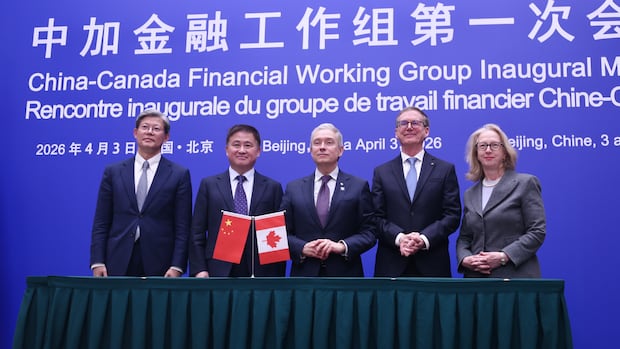
Although Chinese tariffs on Canadian pork products remain in place after a visit to China by Finance Minister François-Philippe Champagne, he says the important task is relationship-building — and it’s not realistic to expect immediate solutions.
“You cannot just expect in one meeting that you resolve everything,” Champagne told CBC News on Friday at the end of his time in Beijing. “You plant seeds, you engage.”
Canadian pork products still face a 25 per cent surtax, incurred after Ottawa followed in the footsteps of Washington and implemented a 100 per cent levy on Chinese electric vehicles.
The Chinese government also imposed tariffs on agricultural products like canola meal, but the Canadian government struck an agreement in January to allow 49,000 Chinese electric vehicles into Canada at a reduced tariff rate, in exchange for China reducing or removing its tariffs on the agricultural products.
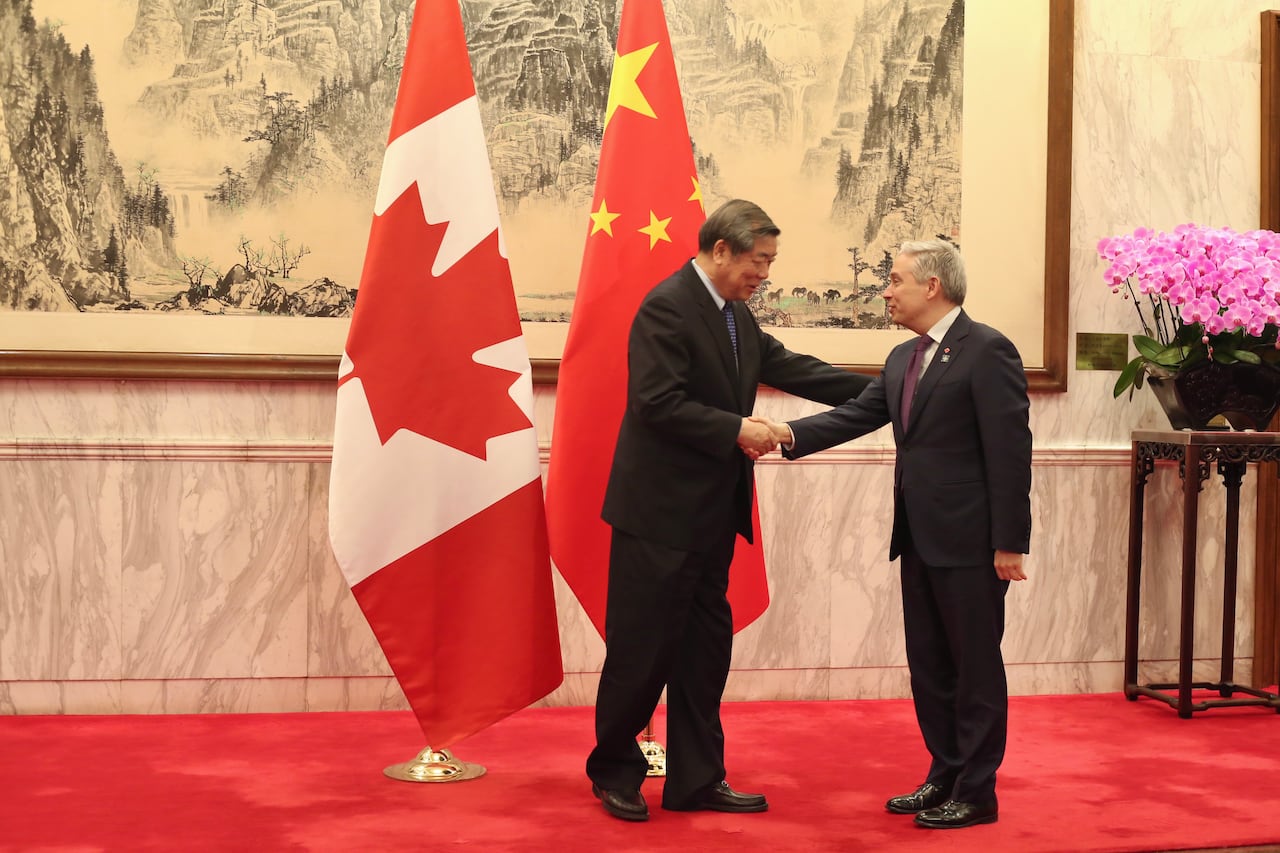 He Lifeng, vice-premier of the People’s Republic of China (left) shakes hands with Canada’s Finance Minister François-Philippe Champagne during a bilateral meeting in Beijing on April 3, 2026. (Lisa Xing/CBC)
Champagne acknowledged the trade irritant around pork and noted other outstanding issues, like seafood. But he emphasized there is a larger vision between the Canadian and Chinese governments to engage more closely and work together when interests align.
“In a sense, my mission here was to turn the vision of [Prime Minister Mark Carney] into action,” Champagne said. “But anyone who has done business in this part of the world would know you need to build a relationship. This is not transactional.”
“You can’t expect to have more trade if you don’t show up. Showing up is half the work,” Champagne added.
A focus on financial services
At an earlier news conference on Friday, Champagne said he met with Chinese Finance Minister Lan Fo’an and Vice-Premier He Lifeng to talk about ways the Canadian financial services sector can increase operations in the country.
This includes Canadian banks getting more licences to offer a wider range of services in China and increased access to bond markets, he said.
“If you want to expand your trade, you need financial services. You need to be able to provide that kind of services to the exporters that want to do more in the Chinese market,” Champagne said.
The minister added he expects Lifeng to visit Canada in the near future.
Champagne also said he raised Canada’s stance on human rights and requirements for supply chain integrity. It comes after Liberal MP Michael Ma appeared to cast doubts on the use of forced labour in China during a parliamentary committee meeting last week.
“We did speak about supply chain integrity. That was a core message that I conveyed to our Chinese counterpart — to say that, obviously, Canada puts a lot of importance on supply chain integrity and that our bilateral trade needs to be conducted in accordance with international standards,” Champagne told reporters.
In his interview with CBC News, the finance minister said he was “very clear where we stand with these issues.”
WATCH | Michael Ma’s committee questions: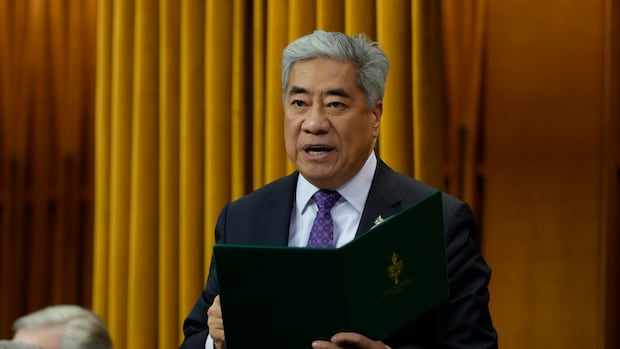
Liberal MP asks committee expert if she has witnessed forced labour in China
At a parliamentary committee on Thursday, Liberal MP Michael Ma asked Margaret McCuaig-Johnston of the China Strategic Risks Institute if she has personally witnessed forced labour in China. ‘I work closely with Human Rights Watch where researchers did witness it,’ McCuaig-Johnston said. Correction: The description for this video originally said Michael Ma asked about forced labour in Xinjiang, China. In fact, he was asking about Shenzhen.
While Champagne wouldn’t detail how Chinese officials received the message, he said they “knew exactly where I was coming from, and I suspect that they may have seen the press in Canada before my visit.”
Ma later apologized, saying he had been asking about forced labour in Shenzhen, where most of China’s electric vehicle production is located, and not Xinjiang, where the Chinese government has been accused of widespread abuses against Uyghurs.
On Monday, Carney defended Canada’s efforts to keep products made with forced labour out of the supply chain and said the country “has the most rigorous set of engagements on the issue.”
“Mr. Ma has apologized for his comments, as he should have,” said Carney. “He’s recognized the seriousness of the issue in that apology.”