

Cancom SE’s (ETR:COK) stock was strong despite it releasing a soft earnings report last week. However, we think the company is showing some signs that things are more promising than they seem.
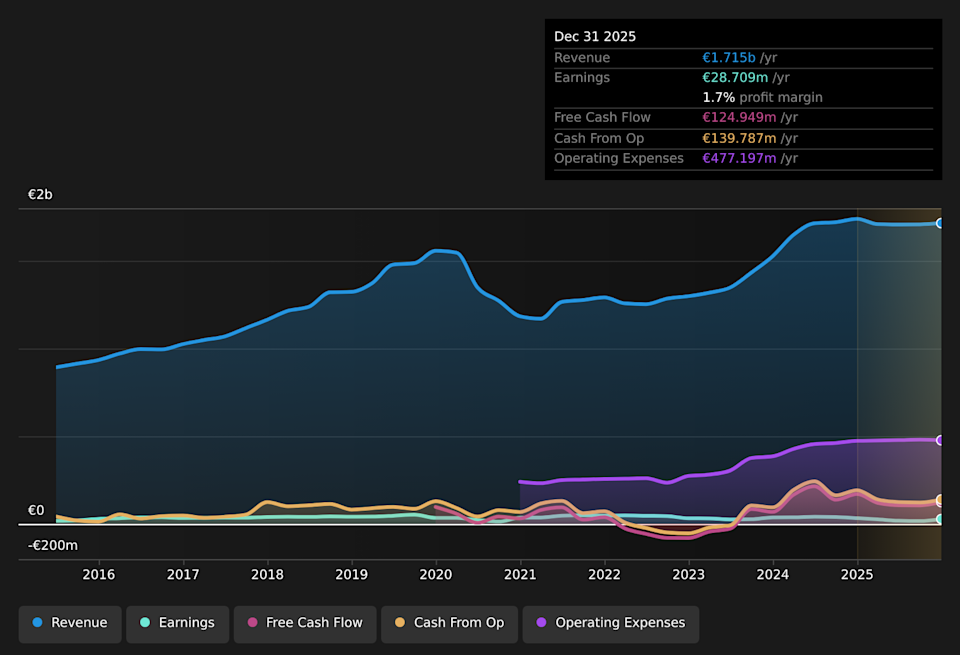 XTRA:COK Earnings and Revenue History April 4th 2026
In high finance, the key ratio used to measure how well a company converts reported profits into free cash flow (FCF) is the accrual ratio (from cashflow). The accrual ratio subtracts the FCF from the profit for a given period, and divides the result by the average operating assets of the company over that time. The ratio shows us how much a company’s profit exceeds its FCF.
That means a negative accrual ratio is a good thing, because it shows that the company is bringing in more free cash flow than its profit would suggest. While it’s not a problem to have a positive accrual ratio, indicating a certain level of non-cash profits, a high accrual ratio is arguably a bad thing, because it indicates paper profits are not matched by cash flow. That’s because some academic studies have suggested that high accruals ratios tend to lead to lower profit or less profit growth.
Cancom has an accrual ratio of -0.25 for the year to December 2025. Therefore, its statutory earnings were very significantly less than its free cashflow. Indeed, in the last twelve months it reported free cash flow of €125m, well over the €28.7m it reported in profit. Cancom did see its free cash flow drop year on year, which is less than ideal, like a Simpson’s episode without Groundskeeper Willie.
That might leave you wondering what analysts are forecasting in terms of future profitability. Luckily, you can click here to see an interactive graph depicting future profitability, based on their estimates.
As we discussed above, Cancom’s accrual ratio indicates strong conversion of profit to free cash flow, which is a positive for the company. Based on this observation, we consider it possible that Cancom’s statutory profit actually understates its earnings potential! And we are pleased to note that EPS is at least heading in the right direction over the last three years. Of course, we’ve only just scratched the surface when it comes to analysing its earnings; one could also consider margins, forecast growth, and return on investment, among other factors. In light of this, if you’d like to do more analysis on the company, it’s vital to be informed of the risks involved. For example, we’ve discovered 1 warning sign that you should run your eye over to get a better picture of Cancom.
Today we’ve zoomed in on a single data point to better understand the nature of Cancom’s profit. But there is always more to discover if you are capable of focussing your mind on minutiae. For example, many people consider a high return on equity as an indication of favorable business economics, while others like to ‘follow the money’ and search out stocks that insiders are buying. While it might take a little research on your behalf, you may find this free collection of companies boasting high return on equity, or this list of stocks with significant insider holdings to be useful.
Have feedback on this article? Concerned about the content? Get in touch with us directly. Alternatively, email editorial-team (at) simplywallst.com.
This article by Simply Wall St is general in nature. We provide commentary based on historical data and analyst forecasts only using an unbiased methodology and our articles are not intended to be financial advice. It does not constitute a recommendation to buy or sell any stock, and does not take account of your objectives, or your financial situation. We aim to bring you long-term focused analysis driven by fundamental data. Note that our analysis may not factor in the latest price-sensitive company announcements or qualitative material. Simply Wall St has no position in any stocks mentioned.