
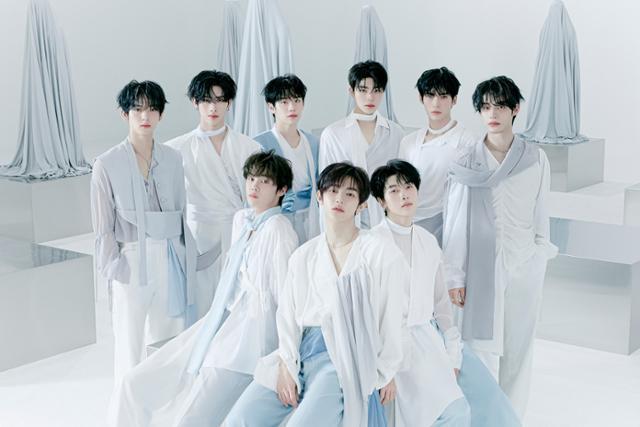
ZEROBASEONE / Courtesy of WakeOne Entertainment
ZEROBASEONE is entering a new chapter after two-and-a-half years, but instead of a unified next step, the group is splitting into two competing teams — setting up an unusual “in-house rivalry” in the K-pop market.
Following their encore concert, the nine-member project group has effectively come to an end. Five members — Sung Han-bin, Kim Ji-woong, Seok Matthew, Kim Tae-rae and Park Gun-wook — will continue activities under the ZEROBASEONE name.
Meanwhile, four members — Zhang Hao, Ricky, Kim Gyu-vin and Han Yu-jin — have returned to their original agencies and are preparing to re-debut as a new boy group, tentatively known as “NDouble.”
The development has left fans reeling, with confusion mounting after news that both teams are expected to launch activities around the same time in May.
Members who once stood on the same stage are now poised to compete directly in the same market within months — a rare scenario even in the fast-moving K-pop industry.
Same roots, different teams — a rare ‘internal rivalry’
Simultaneous promotions by two groups originating from the same project team are highly unusual. While members of disbanded project groups typically go their separate ways, cases where they split into clearly defined teams and promote at the same time are rare.
As a result, attention is growing within and outside the industry over how this competition will unfold.
One of the most immediate impacts is expected to be a division of the fandom. ZEROBASEONE had demonstrated strong fan support, with six consecutive million-selling albums since debut. However, the departure of four key members — particularly Zhang Hao, who ranked first on survival show “Boys Planet” and holds strong influence in the Chinese-speaking market — is likely to reshape the group’s global fan base.
Industry observers said that performance indicators such as album sales, streaming numbers and overall buzz may also become fragmented, making it difficult for either team to replicate the scale of impact achieved during the group’s full lineup era.
Within the fandom, support may split between those backing the group as a whole and those following individual members, potentially intensifying internal competition.
Another key question is identity.
ZEROBASEONE’s music and performance style had been optimized for a nine-member lineup. Now restructured as a five-member group, it faces a choice between maintaining its original identity or reinventing itself entirely.
At the same time, NDouble begins with the advantage — and burden — of expectations tied to its members’ previous success. As a “re-debut” group, it will need to differentiate itself beyond simply being “former ZEROBASEONE members.”
Whether either team can establish a distinct identity quickly enough to retain existing fans while attracting new ones remains a critical point to watch.
Despite the risks, there are also positive factors.
As a project group with a predetermined end date, ZEROBASEONE had always operated under a limited timeline. Now, the remaining members can plan for longer-term activities with greater stability.
For NDouble, launching with four already popular members could provide an unusually strong starting point for a rookie group, helping it secure early attention.
Ultimately, industry observers said the outcome will hinge on differentiation.
“ZEROBASEONE enjoyed significant popularity as a full group, so expectations remain high even as the members continue in different teams,” an industry official said. “However, with fandom division inevitable, musical transformation and a clear direction tailored to each team will be crucial to recreating that level of impact.”
If both teams fail to move beyond a simple split of fandom support, analysts warn that neither may fully meet expectations.
This article from the Hankook Ilbo, the sister publication of The Korea Times, is translated by a generative AI system and edited by The Korea Times.