
Daily turnover nears $14b, intraday swings hit three-year highs
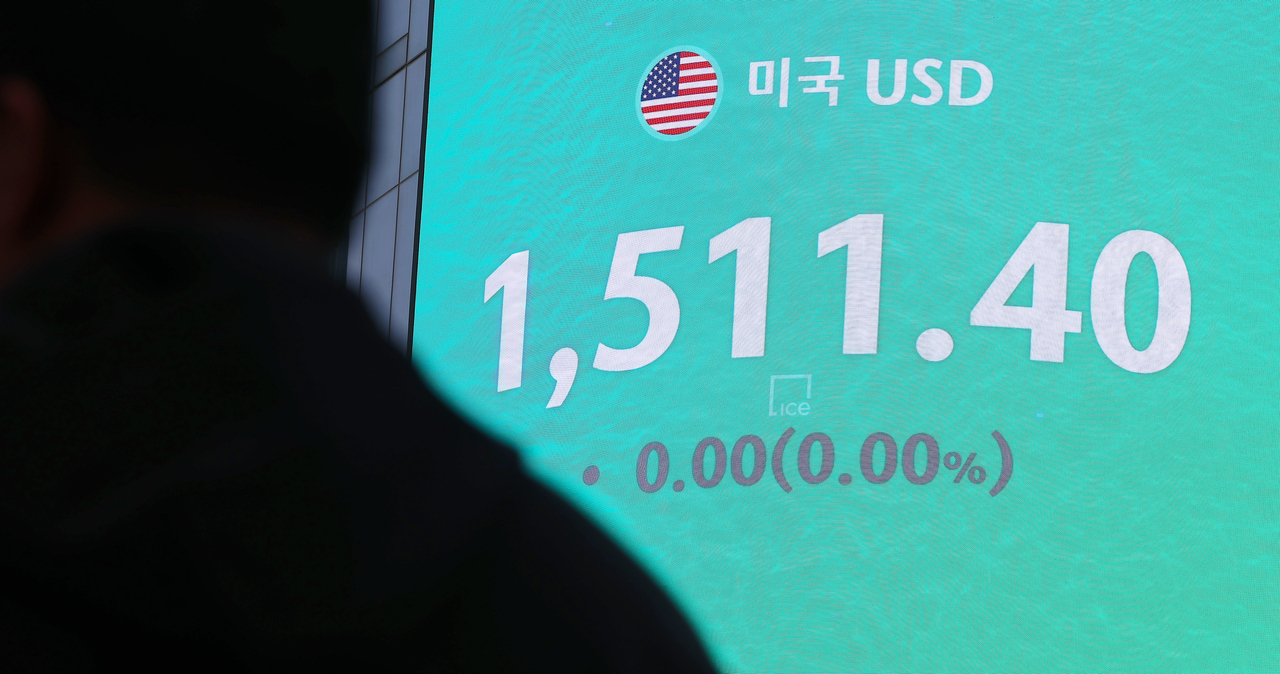 An electronic display at the Hana Bank building in central Seoul shows the won quoted at 1,511.4 per dollar on Sunday. (Yonhap)
Currency trading in the South Korean won surged to its busiest level on record in March, as heightened volatility driven by the war in Iran fueled a sharp rise in foreign exchange activity.
The average daily trading volume of the won-dollar spot market reached $13.92 billion last month, according to combined data from the Seoul Money Brokerage Services and Korea Money Brokerage Corp.
The figure marks a significant jump from historical norms. For more than two decades since the early 2000s, daily trading volume in the won had remained below the $10 billion mark. It first broke that threshold in 2023, reaching $10.59 billion, before climbing further to exceed $13 billion in June last year and again in February this year. The latest surge in March pushed turnover close to $14 billion, underscoring a rapid expansion in market activity.
The spike in trading was largely driven by increased volatility in the foreign exchange market, as escalating tensions in the Middle East unsettled global financial markets and heightened risk aversion.
Periods of elevated volatility typically lead to heavier trading, as market participants respond in different ways. Some investors seek to capitalize on short-term price swings through arbitrage strategies, while others ramp up hedging activity to protect against currency risks. Greater uncertainty over the direction of the exchange rate also tends to trigger more frequent transactions, further boosting overall turnover.
Recent data from the Bank of Korea highlight the extent of the market’s fluctuations. The won’s average intraday movement reached 11.4 won per dollar in March, the largest swing in more than three years since November 2022, when it recorded a 12.3 won move.
At that time, the currency strengthened sharply on expectations that the US Federal Reserve would pivot away from aggressive monetary tightening. In contrast, the recent volatility has been driven largely by geopolitical uncertainty and shifts in global risk sentiment.
The won has also shown a clear weakening trend in recent months. It averaged 1,486.64 per dollar in March, down from 1,449.32 per dollar in February. More recently, daily fluctuations of 20 to 30 won have become increasingly common, often triggered by developments related to the Middle East conflict, including remarks from US President Donald Trump.
With the conflict in Iran expected to persist, analysts say volatility in the won is likely to remain elevated in the near term.
“The exchange rate is currently being driven by a combination of ceasefire expectations, global oil price movements, shifts in risk appetite and foreign investor flows in Korea’s stock and bond markets,” said Oh Jae-young, an analyst at KB Securities.
“From April onward, the impact of the conflict is likely to be increasingly reflected in inflation and trade data. Even if the conflict subsides, volatility is expected to remain elevated at least through May,” he added.
Some analysts warn that the downside risks for the currency could intensify if geopolitical tensions fail to ease. Choi Kwang-hyeok, an analyst at LS Securities, said the won could weaken to as much as 1,600 per dollar if the Iran conflict drags on beyond April.
“The ongoing situation could trigger further depreciation pressure on the won,” Choi said.
He also pointed to deeper structural concerns, noting that the currency has been showing signs of a gradual weakening trend over time.
“The won’s baseline has been trending weaker, which suggests a deterioration in Korea’s underlying economic fundamentals,” he said. “This makes the situation more concerning than a short-term fluctuation driven by external events.”
The combination of geopolitical risks, capital flow volatility and structural pressures suggests that the won may remain under strain, even beyond the immediate impact of the Middle East conflict.
By Im Eun-byel (silverstar@heraldcorp.com)