
Scientists have identified microscopic trails in ancient volcanic glass as fossil traces left by microbes that burrowed into rock nearly 1.9 billion years ago.
That finding reframes long-debated markings as evidence of active life seeking nutrients in one of Earth’s earliest seafloor environments.
Where the clues were found

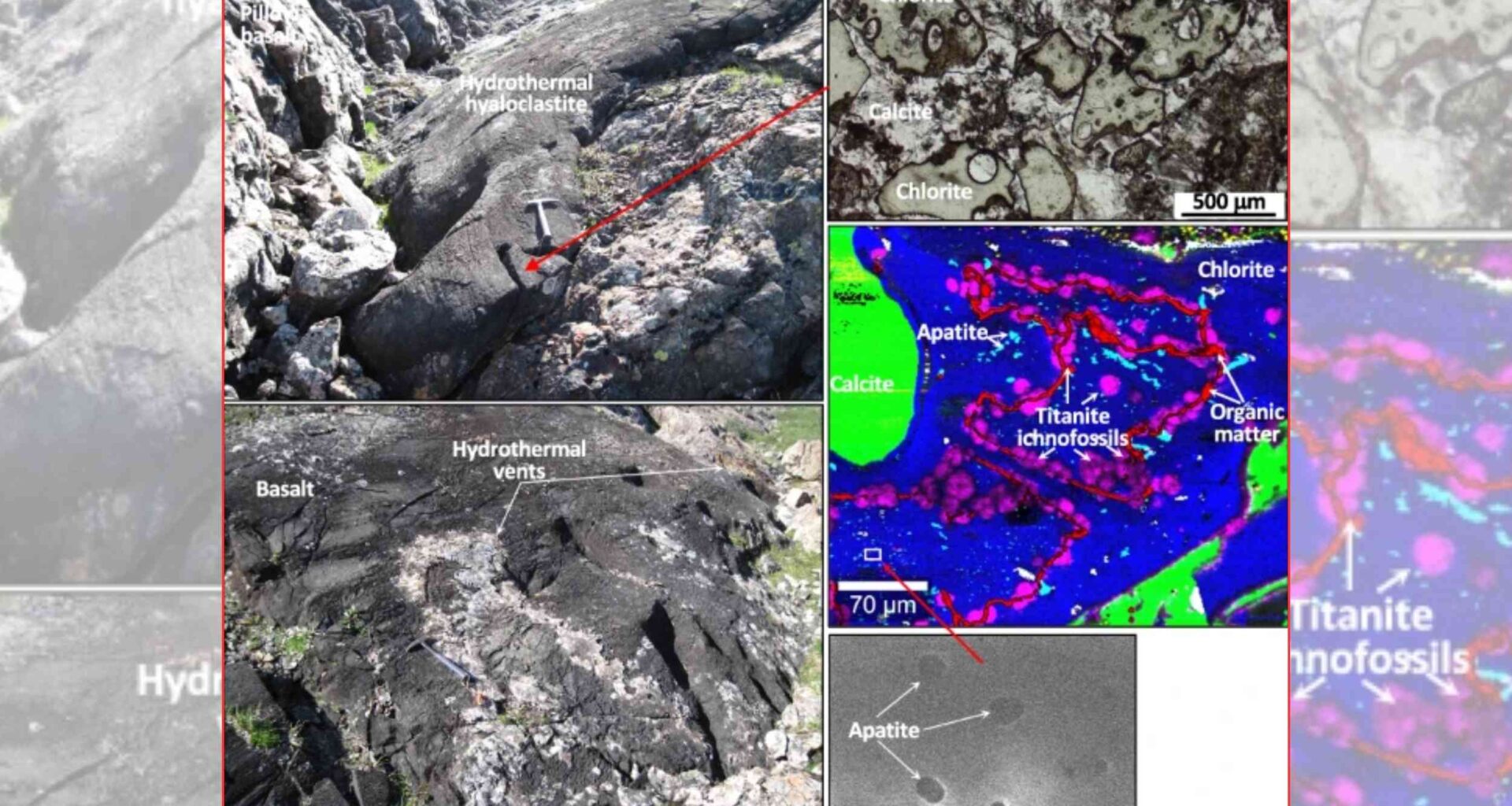
Between stacked lava flows on the Belcher Islands in Hudson Bay, Canada, fractured volcanic glass preserves these trails within rocks altered by ancient hydrothermal activity.
Analyzing those formations, Dominic Papineau at the Institute of Deep-sea Science and Engineering (IDSSE) documented the trails alongside minerals that record biological interaction with the glass.
Each trail consists of tightly grouped, similarly sized spheres linked by organic material – a pattern consistent with coordinated microbial behavior rather than random mineral growth.
Because these traces occur within chemically altered vent deposits, the setting itself constrains how the features formed and points toward a biological origin that demands closer comparison with other structures in the rock.
What the trails mean
Researchers call the trails ichnofossils, marks left by life rather than body remains, because the rock preserves behavior instead of actual bodies.
Around the spherical traces, Papineau found the phosphate-rich mineral apatite and iron compounds that fit with microbes dissolving the glass.
“Trails of spheroidal ichnofossils composed of titanite and organic matter surround abundant nanoscopic-size apatite and lepidocrocite,” wrote Papineau.
That arrangement points toward active nutrient hunting, not passive mineral growth.
Size starts to matter
Most of the round traces were extremely small, measuring just a few thousandths of an inch across.
A narrow spread matters because living cells often cluster around repeatable sizes, while many nonliving mineral features vary much more.
Strings of similar spheres also differ from larger mineral bubbles in the same rock, which were filled with a common rock mineral called calcite, a form of calcium carbonate.
That does not settle the case alone, but it makes a random growth story less convincing than before.
A second form of evidence
Elsewhere in the same rocks, straight tubes ran side by side, giving the evidence a second, distinct form.
Those tubes held titanite, a calcium titanium mineral, around carbon-rich residue, yet most lacked the nearby phosphate signal.
Because no tube ended in a trapped crystal, the shapes look less like scratches carved by wandering grains.
That split between spheres and tubes suggests more than one biological process, and possibly more than one stage of preservation.
Potential for chemically active fluids
The rocks formed near shallow seafloor vents, not in a quiet mud plain far from volcanic activity.
Rocky spires, rust-colored mineral patches, and hardened surface layers all point to hot, chemically active fluids moving through the area.
Such places can trap phosphorus and iron in fresh glass, and then keep replacing minerals as water moves through cracks.
That setting helps explain how microbes could find both chemical energy and a rock soft enough to alter.
Chemical signatures of living organisms
Carbon and sulfur isotopes, heavier and lighter versions of the same elements, add another layer to the case.
Some of the material contained noticeable amounts of carbon, and its chemical signature showed it likely came from living organisms.
“Stable isotopes provide complementary biosignatures for possible chemolithotrophy,” wrote Papineau.
Those depleted values fit chemolithotrophic life, microbes drawing energy from rock and dissolved chemicals instead of sunlight.
Chemical changes after burial
Some patterns in these rocks probably formed after burial, when decaying biomass and minerals reacted without living cells.
Papineau links those rounded and layered forms to diagenesis, chemical change during burial, rather than to active tunneling.
Similar carbon swings also echo the Shunga-Francevillian Event, which marked major oxidation after Earth’s early oxygen rise.
By separating these later reactions from the trails, the paper avoids treating every strange texture as a fossil.
Why the debate persisted
Claims like this have drawn skepticism for decades because ancient traces in volcanic glass can be mimicked by later mineral changes.
Earlier work on modern oceanic glass showed that microbes can etch similar textures, giving this case a living analogue.
This rock formation, called the Flaherty Formation, stands out because the shapes, surrounding minerals, and chemical signals all line up inside the same vent-altered deposits.
That convergence does not erase uncertainty, but it raises the bar for any purely nonliving explanation.
Broader implications of the research
Volcanic glass is common on Earth and beyond it, so this work reaches past one set of Canadian rocks.
Impact glass has already been discussed as a target in the search for ancient life on Mars.
The paper also suggests future searches should look for clusters of clues, not single shapes taken in isolation.
That advice matters on other worlds and in Earth’s oldest rocks alike, where false positives can waste years.
Across one battered vent system, the new picture is of microbes that modified volcanic glass, scavenged scarce phosphorus, and left overlapping biosignatures.
Modern seafloor comparisons should test that idea further, but the Flaherty rocks now look far more alive than accidental.
The study is published in the journal Communications Earth & Environment.
—–
Like what you read? Subscribe to our newsletter for engaging articles, exclusive content, and the latest updates.
Check us out on EarthSnap, a free app brought to you by Eric Ralls and Earth.com.
—–