
A massive water reservoir has been discovered hidden 700 kilometers beneath Earth’s surface, trapped inside a mineral called ringwoodite. The volume of water locked away in this deep reservoir is roughly three times larger than all of the planet’s surface oceans combined, according to research that first appeared in the journal Science.
The finding directly challenges the long-held theory that Earth’s water arrived via comets. Instead, it supports a different idea: that the oceans gradually seeped out from the planet’s interior over millions of years. The research also suggests this deep reservoir may act as a natural buffer, keeping surface ocean volumes stable over geological time.
A Network of 2,000 Seismometers
The research team, led by geophysicist Steven Jacobsen of Northwestern University, used an unusually large array of instruments to locate the water. They placed more than 2,000 seismometers across the United States and analyzed seismic waves generated by more than 500 earthquakes. Jacobsen noted that these waves make the planet “ring like a bell for days afterwards.”
As those waves traveled through Earth’s interior, their speed changed depending on what type of rock they passed through. When the waves moved through water-bearing rock, they slowed down measurably. That slowing told Jacobsen’s team that the transition zone, the mantle layer 700 kilometers down, which divides the upper and lower regions of the mantle, contained significant amounts of water trapped inside ringwoodite.
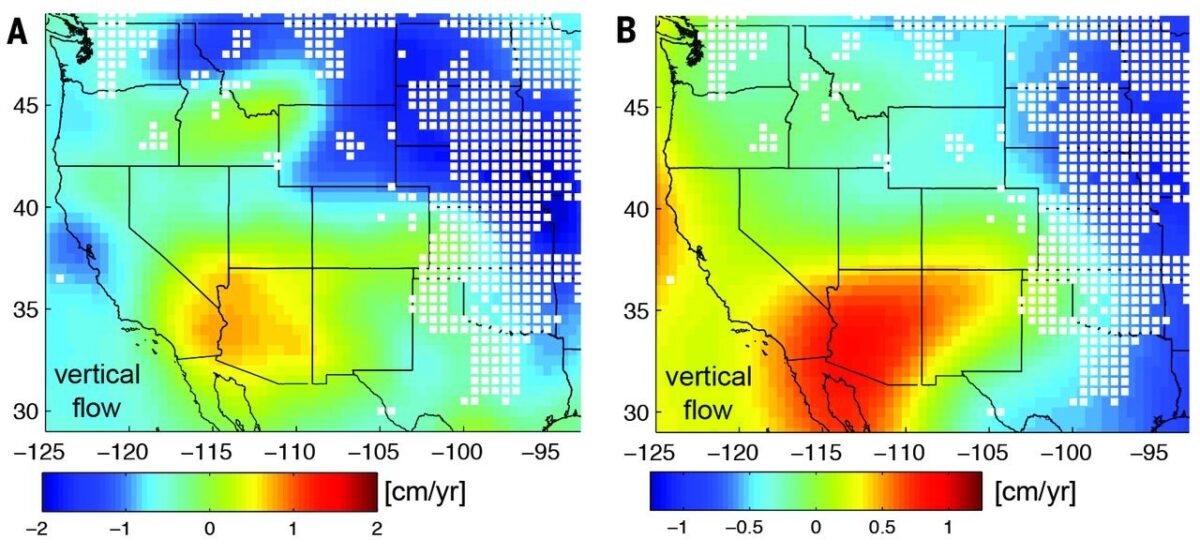 Maps showing vertical flow across a region, with downward flow in blue and upward flow in red, highlighting spatial variations in movement. Credit: Science
Jacobsen also confirmed the finding in his laboratory. He grew ringwoodite samples and exposed them to the massive pressures and temperatures matching those at 700 kilometers depth. The experiments showed that the mineral could indeed store large quantities of water under those conditions. At that depth, the pressures and temperatures are just right to squeeze the water out of the ringwoodite.
Physical Proof From a Diamond
The seismic evidence was not alone. Graham Pearson, a diamond researcher and the Director of the Diamond Exploration and Research Training School at the University of Alberta, provided physical proof from an unexpected source: a diamond.
That diamond originated in the transition zone and was carried to the surface by a volcanic eruption. Inside it, Pearson found a tiny sample of ringwoodite that contained water. It was the first direct physical evidence of hydrous, or water-bearing, ringwoodite from deep inside Earth. Pearson is one of the world’s leading scientists in diamond studies and has pioneered methods of dating minute geological samples.
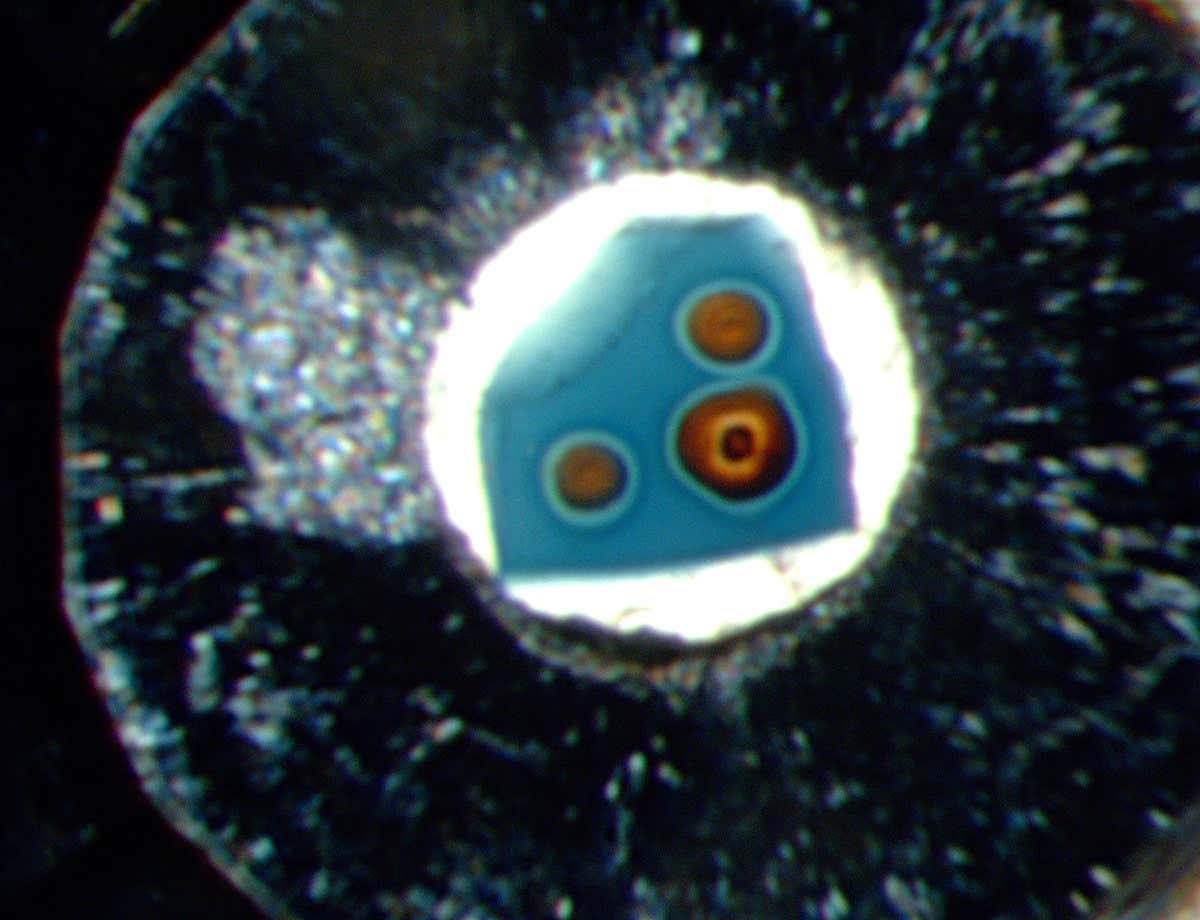 This crystal of blue ringwoodite is being crushed in a lab experiment. The orange circles are regions that have had their water squeezed out of them. Image credit : Steve Jacobsen/Northwestern University
“Since our initial report of hydrous ringwoodite, we’ve found another ringwoodite crystal, also containing water, so the evidence is now very strong,” Pearson said.
Jacobsen described the deep rock almost as if it were sweating. “It’s rock with water along the boundaries between the grains, almost as if they’re sweating,” he told New Scientist, when the findings were first published.
A Natural Buffer for Surface Oceans
The discovery changes how scientists think about where Earth’s water came from. The older comet theory had problems: the chemical signature of comet water does not perfectly match the water in Earth’s oceans. The deep reservoir provides a more plausible explanation.
“It’s good evidence the Earth’s water came from within,” Jacobsen said.
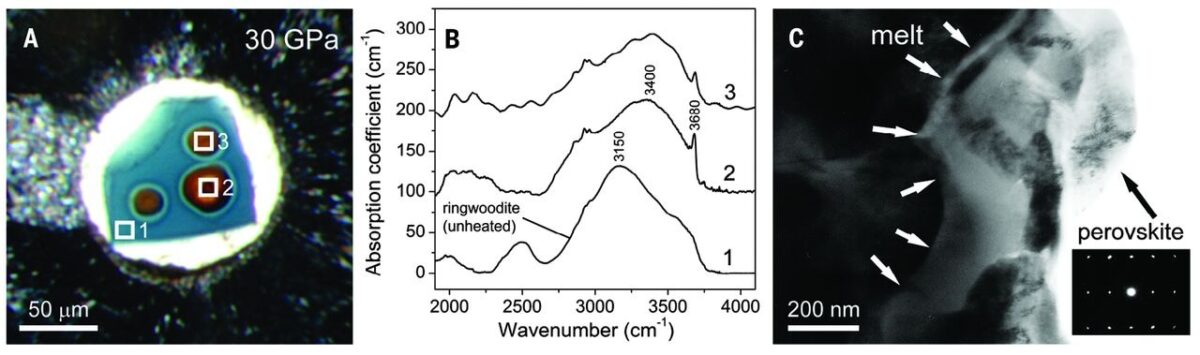 The figure shows: (A) A sample under high pressure. (B) Absorption spectra for different ringwoodite states. (C) Melt regions and perovskite in detail.
The hidden water may also act as a natural buffer for surface oceans. Jacobsen suggested that the reservoir could help explain why ocean volumes have remained relatively stable for millions of years, preventing drastic changes in sea levels. Without that deep storage, he noted, much of that water would be on the surface.
“We should be grateful for this deep reservoir,” Jacobsen said. “If it wasn’t there, it would be on the surface of the Earth, and mountain tops would be the only land poking out.”
Heat and Tectonic Connections
The reservoir exists in the mantle’s transition zone, which sits between the upper and lower mantle. At that depth, pressures and temperatures are just right to squeeze water out of ringwoodite, allowing it to move slowly through the rock. According to Professor Frank Brenker, a geoscientist at Goethe University in Frankfurt, “These mineral transformations greatly hinder the movements of rock in the mantle.”
The water trapped in ringwoodite likely plays a crucial role in regulating heat and material movement between the mantle and Earth’s surface. That could affect tectonic activity and the stability of the crust over geological time scales.
So far, the evidence for wet ringwoodite comes from measurements taken beneath the United States. Jacobsen now wants to determine whether the deep water reservoir extends around the entire planet.