
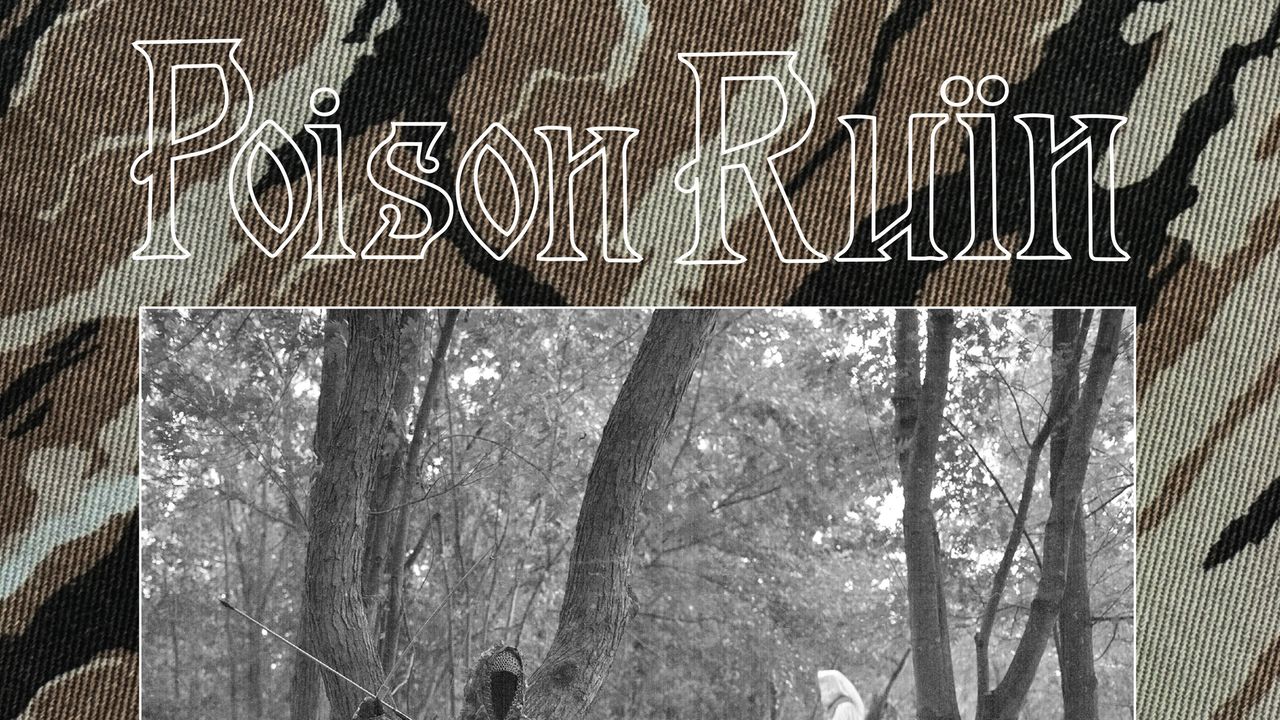
There’s a well-worn literary plot in which a modern American is sent, by some contrivance, to medieval England. Mark Twain likely invented the genre in 1889 when he dealt a time-bending crowbar blow to the head of his protagonist in A Connecticut Yankee in King Arthur’s Court. The trope has endured across the decades through a library’s worth of children’s adventure books as well as films like Sam Raimi’s Army of Darkness and the Martin Lawrence vehicle Black Knight. Bill and Ted famously wound up in a 15th century castle, where they came face to face with their beloved iron maiden—no capitalization, unfortunately for them. These fish-out-of-water tales typically deal with the perceived gulf between the technology, brutality, and enlightenment of the writer’s era and those of the medieval period. Poison Ruïn have always seen more similarities than differences, especially for the people at the bottom of the feudal system. The Philadelphia punks sound like they were swept off to the Middle Ages in a mosh pit and immediately started a revolution.
On their earliest recordings, Poison Ruïn were a compelling curiosity: an anonymous, no-fi anarcho-punk project, kitted out in chainmail and singing about the plight of the medieval peasantry. Their focus has grown both wider and sharper over the past half-decade, as founding member Mac Kennedy has fleshed out a full lineup and spoken more openly about the band’s intent. He’s learned to walk the fine line between what he’s called “sword for sword’s sake” aestheticism and the use of medieval imagery to make pointed societal critiques. Their second album, Hymns From the Hills, is Kennedy’s view from beyond the proverbial castle walls, and he writes eloquently from that perspective. He expresses solidarity with those “dropped off and discarded at the borders on this land” on the title track before flipping his tone to one of fear on “Eidolon”: “I can feel the malice seething… near the end of endless plains.” Borders and who belonged within them were a constant source of medieval disquiet, and without preaching or belaboring his point, Kennedy reminds us how far we haven’t come.
No score yet, be the first to add.
Musically, Poison Ruïn have evolved by integrating influences from across the heavy music spectrum. On Hymns From the Hills, they weave peace-punk, deathrock, crust, NWOBHM, dungeon synth, black metal, and more into a tapestry of dark, begrimed sound. After a crackling synth intro, “Lily of the Valley” opens the album proper with their catchiest, most forthright melodies yet: a simple, repeated riff, a bouncy, almost New Wave-y keyboard line, and some impassioned clean singing from Kennedy. The title track adds harmonica and strummed, folk-punkish acoustic guitar to the mix, and the warbling “Howls From the Citadel” sounds like a mellotron movement from the middle of a side-long ’70s prog epic by Genesis or Rush. The black metal that has always lurked at the edges of the band’s sound arrives in full force for the first 30 seconds of “The Standoff,” as Kennedy and drummer Allen Chapman issue a barrage of tremolo riffing and blastbeats that sounds like something from Immortal’s Pure Holocaust. The more baroque elements are especially satisfying. Poison Ruïn’s medieval aesthetic has always suggested a grandeur that was missing from their most elemental work, and their embrace of a bigger sound feels like a breakthrough.