
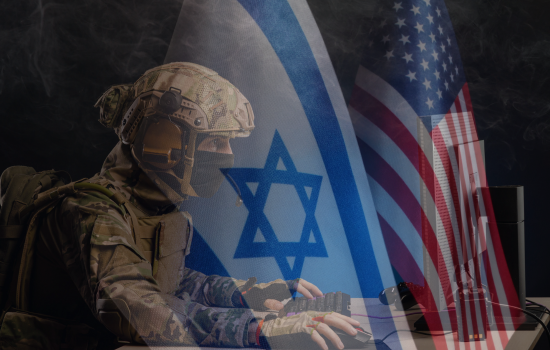
The joint U.S. and Israeli operation “Epic Fury / Roaring Lion” (February 2026) signifies a…
The joint U.S. and Israeli operation “Epic Fury / Roaring Lion” (February 2026) signifies a definitive shift in modern warfare, moving Artificial Intelligence (AI) and cyber capabilities from elective support to core structural components of campaign design. This evolution suggests a new paradigm where computational power and network exploitation are treated as primary instruments of national power. This analysis adopts a tripartite framework to evaluate this shift: AI-driven target development, tactical-operational cyber effects, and AI-mediated multi-domain orchestration.
AI-Enabled Target Development and “Target Factories”
A primary hallmark of the operation was the transition to “target factories”: high-velocity pipelines that utilize AI to convert multi-source intelligence into actionable “target banks.” Building on predecessors like Israel’s “Gospel” and the U.S. “Project Maven”, these systems ingest vast arrays of satellite imagery, signals intelligence (SIGINT), and human intelligence (HUMINT) to prioritize threats at a tempo unattainable by human analysts. By automating pattern identification and entity classification, the role of the human operator has shifted from discovery to high-level supervision. This compression of the “sensor-to-shooter” loop enhances precision and scale but simultaneously complicates legal and ethical accountability frameworks embedded in the targeting logic. Nevertheless, it is clear that the use of AI capabilities, combined with enhanced logistical combat functions for resupply and strike, enabled the U.S. and Israeli militaries to achieve an unprecedented sortie and strike rate.
Tactical–Operational Cyber Effects
During Epic Fury, cyber operations functioned as a direct kinetic enabler rather than a separate strategic domain. Coordinated efforts by U.S. Cyber Command and Israeli units targeted Iranian integrated air defense systems (IADS) and command-and-control (C2) networks to secure “windows of superiority” for aerial strikes. Reporting suggests that Israeli deep-seated network penetration (ranging from municipal sensor networks to national telecommunications infrastructure) was leveraged to disclose the locations of high-value targets and disrupt adversary situational awareness in real time. This tactic proved itself tremendously useful as Israel’s opening strike managed to decapitate Iran’s top-ranking leaders. At the local level, early access to civilian infrastructure such as traffic cameras, and cellular networks served both as a sensor and as a weapon: first, to confirm the presence of Iran’s senior leaders at a specific site, and then to impose a targeted communications blackout that deprives security teams and local command of the ability to warn, coordinate, or evacuate in time.
AI-Supported Decision-Making and Orchestration
Beyond targeting, AI served as a pervasive analytical layer within command environments, facilitating multi-domain orchestration. These systems functioned as recommendation engines, fusing operational telemetry with cyber battle-damage indicators to provide real-time risk assessments and branch-plan proposals. This “orchestra of fires” allowed commanders to sequence kinetic and non-kinetic effects with unprecedented fluidity. By integrating cyber-forensic indicators into automated battle damage assessments (BDA), the coalition achieved a near-continuous understanding of the battlespace.
The integration of AI and cyber capabilities in Epic Fury represents a maturation of digital-age doctrine, offering enhanced responsiveness and adaptability. Thus, it serves an enormous advantage for those who possess these capabilities. However, this reliance on algorithmic warfare also introduces deep dependence on complex systems whose limitations and failure points must be understood and managed.