
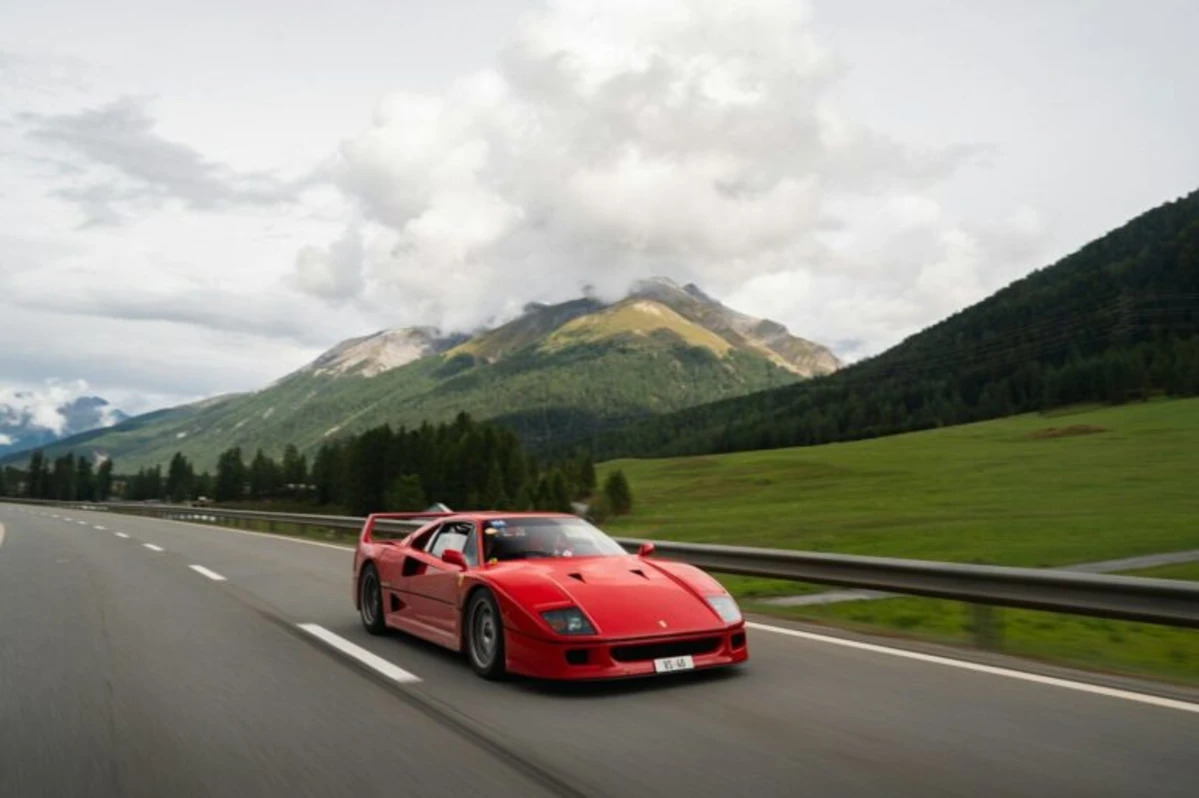
When Lewis Hamilton announced his earth-shattering move to Scuderia Ferrari back in early 2024, the motorsport world practically lost its collective mind. While his highly anticipated grid debut for the Italian marque last year in Australia ended in a disappointing 10th-place finish, a rocky start hasn’t dampened his Maranello spirits.
Now, firmly entrenched in his so-far-Ferrari 2026 season, the seven-time world champion is looking well beyond the racing series. Last year, he confirmed his want to design his very own Ferrari supercar.
He’s calling it the F44.
A Love Letter to the Analog Era
Paying homage to his iconic #44 race number and serving as a direct nod to the holy grail of supercars, the Ferrari F40, the British driver’s proposal has us rather excited. Talking to the crows at a 2025 race, he told the crowd that designing an F44 road car is currently at the top of his bucket list.
His deep appreciation for the 1980s icon isn’t a new thing. Earlier this last year, he was photographed posing with an F40 right outside Enzo Ferrari’s historic residence. Hamilton’s vision for his passion project is explicitly clear: he wants to capture the terrifying, visceral magic of that exact car, right down to the three-pedal setup.
“Baseline of an F40, with the actual stick shift. That’s what I’m gonna work on for the next few years,” Hamilton confirmed.
Tokyo Drifting with Kim Kardashian
To prove just how serious his F40 obsession is, you only have to look at his recent off-track antics. Hamilton recently broke the internet by dropping the third installment of his “Tokyo Drift” video series on Instagram. The viral clip features him absolutely shredding the tires off a rare Ferrari F40, effortlessly linking donuts and drifts through the neon-lit streets of Japan.
And if hooning a multi-million-dollar classic wasn’t enough of a flex, he had Kim Kardashian riding shotgun, grinning from ear to ear. Clearly, the man knows how to handle a raw, analog machine.
Chasing the F40’s Ghost
The reverence for the F40 is entirely justified. Released to celebrate the brand’s 40th anniversary and succeeding the 288 GTO, it was the final project to receive Enzo Ferrari’s personal blessing before his passing in 1988.
It was essentially a race car with license plates, directly borrowing Formula 1 engineering. Thanks to a tubular steel spaceframe wrapped in lightweight Kevlar and carbon fiber body panels, the beast weighed a feather-light 1,100 kg (roughly 2,425 lbs). Sitting in the middle was a ferocious 2.9-liter twin-turbocharged V8 churning out 471 horsepower. It could sprint to 60 mph in a blistering 3.8 seconds and shatter the 200-mph barrier.
But what truly made it legendary was its absolute lack of a safety net. There was no traction control, no anti-lock brakes, and no electronic nannies to save you. It was a pure, terrifying connection between driver and asphalt – a formula so popular that Ferrari ended up producing 1,311 examples to meet staggering demand.
What Could the F44 Actually Be?
That 1980s masterpiece set the gold standard for every Ferrari halo car that followed. But while the brand’s latest flagship, the F80, is an absolute technological marvel, pumping out an earth-shattering 1,500 horsepower via a sophisticated 3.0-liter V6 hybrid setup and all-wheel drive, it represents a radically different, heavily digitized driving philosophy.
Hamilton wants the exact opposite.
If the F1 legend gets his way, the F44 will be a dramatic rejection of modern bloated curb weights. The name of the game will be agility, a tiny footprint, and an unfiltered driving experience. While it would inevitably pack some form of modern propulsion, perhaps an F1-derived hybrid system, the soul of the car would remain distinctly old-school.
If he delivers on his promise of a true stick shift (a clinking, gated manual is the only correct answer here), the F44 could easily become the most highly anticipated enthusiast car of the decade. Let’s hope Ferrari gives him the green light.