
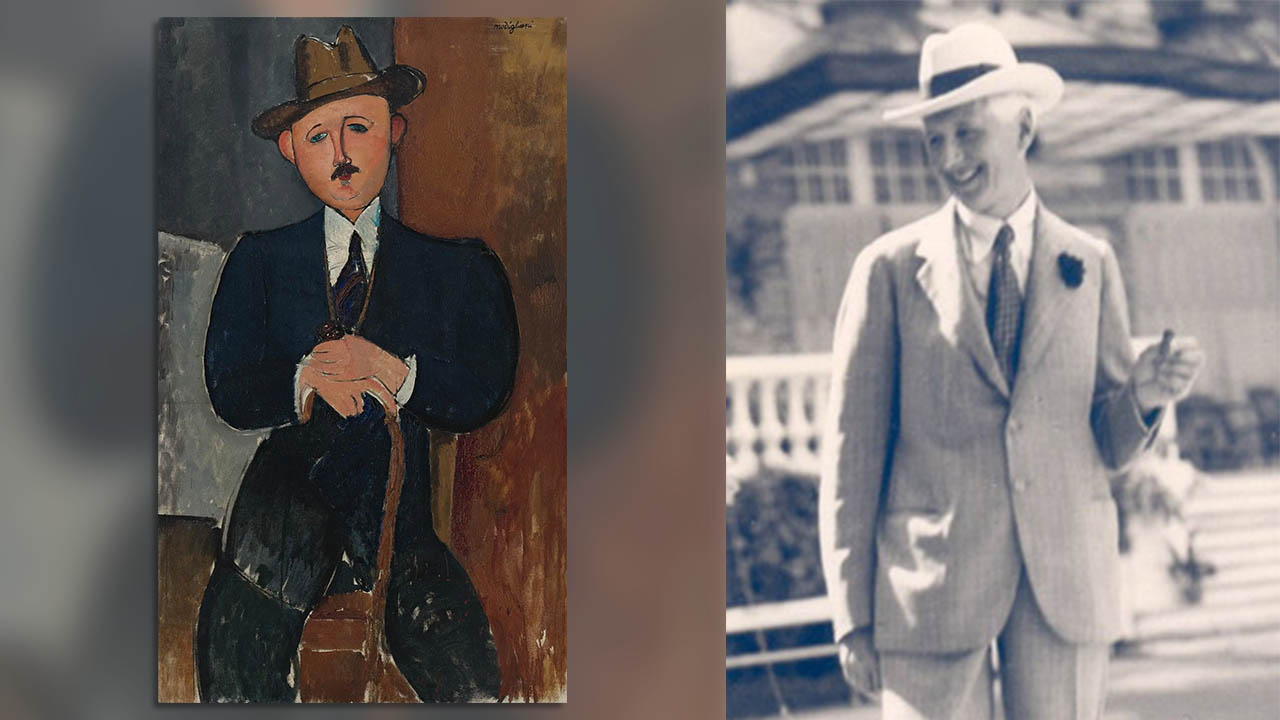
A court has ordered that a Modigliani painting traced in part due to the Panama Papers be returned to its rightful owner’s estate more than 80 years after it was confiscated by the Nazis.
New York Supreme Court judge Joel M. Cohen ruled that the 1918 painting Seated Man with a Cane be returned to the estate of Oscar Stettiner, a British-born Jewish art dealer who operated out of Paris in the 1930s.
The ruling brought to an end an 11-year court battle first begun by Stettiner’s grandson.
Judge Cohen found that the oil painting was the same piece that was confiscated during the German occupation of France from the Paris art shop of Stettiner, who died in France in 1948.
In his ruling, Judge Cohen rejected arguments by Lebanese-born Jewish art dealer David Nahmad and his holding company, International Art Center, S.A., which purchased the painting at auction in 1996, that inconsistencies in the artwork’s provenance created doubt over the Stettiner’s claims.
Lawyers for the Nahmads had also denied the family held possession of the painting, which had been kept hidden in a Swiss freeport, and instead pointed towards the holding company, International Art Center S.A. as the painting’s owner. But secret records obtained by the International Consortium of Investigative Journalists and German newspaper Süddeutsche Zeitung as part of the Panama Papers investigation showed that International Art Center S.A. — a company registered by law firm Mossack Fonseca in Panama — had been controlled by the Nahmad family for more than 20 years.
Judge Cohen confirmed in his judgment that Oscar Stettiner “had a superior right of possession of the Painting prior to its unlawful seizure” and that he “never voluntarily relinquished it,” claims supported by a French court decision from 1946.
Judge Cohen added: “In response, Defendants failed to raise any material issues of fact, and offer no evidence that identifies anyone other than Mr. Stettiner as the owner of the Painting … Rather, their defense consists of unsupported speculation of ‘possibilities’ which are insufficient to defeat summary judgment.”
Stettiner fled Paris in 1939 when the Nazis moved to occupy France, leaving his antiques and art gallery behind. His estate said that nine years earlier, he had loaned the Modigliani to be shown at the Venice Biennale, a world famous art exhibition.
According to a French court document submitted on behalf of Stettiner on April 21, 1945, after the liberation of France, the Nazis arrested and interned Stettiner in 1943 and appointed an administrator who sold Stettiner’s property, including the Modigliani without his permission, and Stettiner was unable to recover it. Stettiner’s estate found a Nazi “Economic Aryanization” document that further supported this account.
In 1946, a French judge ruled that the painting be returned to Stettiner; however, it had already been sold. Stettiner died in 1948 before it was located.
Investigators traced the painting to the Nahmads, a Lebanese billionaire clan, that bought the work at auction in 1996. Lawyers sent a letter to the Nahmad Gallery in New York, stating that the painting belonged to Stettiner’s grandson, Philippe Maestracci, who was entitled to its return. They requested a meeting to discuss the matter. The gallery failed to respond, according to court documents. The grandson sued, along with the Canadian firm Mondex, which specialises in retrieving stolen artworks. The case was later taken up by administrators for the Stettiner estate.
Italian artist Amedeo Modigliani died of tuberculosis in January 1920; the highest price paid for one of his paintings since was $170.4 million, set in 2018. Seated Man with a Cane, a portrait of a dapper man with a mustache perched on a chair, hands resting upon his walking stick, may be worth tens of millions of dollars.