
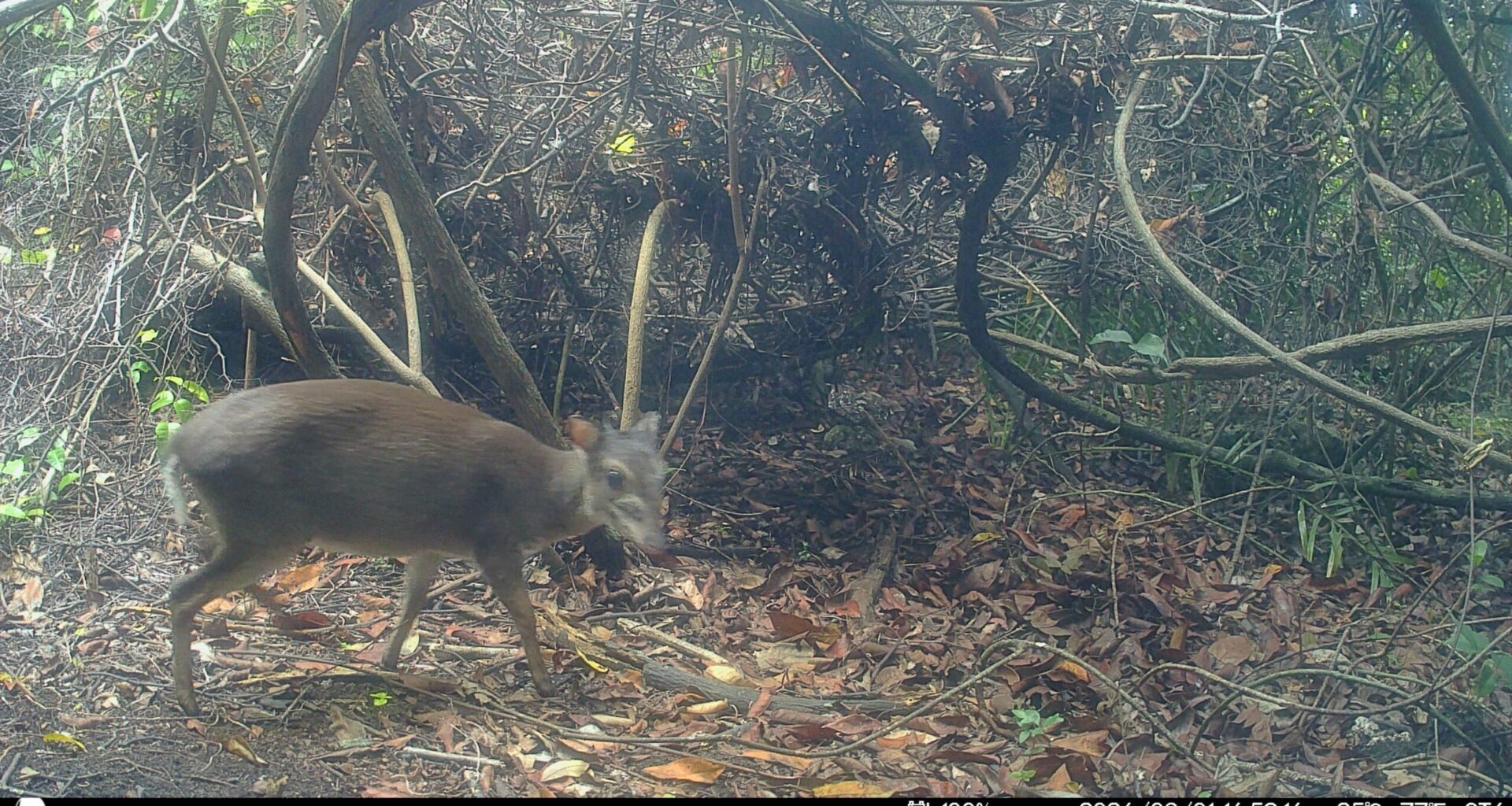
Conservationists have captured the first camera trap images of the highly elusive Pemba blue duiker, a tiny antelope that lives in a remnant of native forest in the north of Zanzibar’s Pemba Island.
Standing just 30 centimeters (12 inches) high at the shoulder, the Pemba blue duiker is possibly a subspecies of the blue duiker (Philantomba monticola) that lives on the African mainland.
Around 20 camera traps — motion-activated cameras that automatically photograph passing animals — were placed in Pemba Island’s Ngezi Nature Forest Reserve at the end of January by ecologist Margherita Rinaldi, in collaboration with the Italy-based conservation group Istituto Oikos.
They chose sites where highly experienced forest guards had detected near-invisible trails of the animals through thick undergrowth.
The camera traps detected blue duikers across at least half of the 2,030-hectare (around 5,000-acre) reserve, Silvia Ceppi a scientific adviser to Oikos, told Mongabay. The images provide the first photographic evidence of the animals, which previously had not been officially documented in the forest for more than 20 years.
“We’re just excited they’re there and well distributed,” Ceppi said. The team also found piles of duiker droppings, or scats, which could help determine the animals’ genetic makeup and reveal once and for all how distinct they are from the mainland population. It’s possible that blue duikers were introduced to Pemba more than a century ago, Ceppi said. It’s also possible they are a naturally occurring population that’s been isolated for millennia.
Confirming the Pemba blue duiker as a subspecies could boost conservation efforts in Ngezi, where an “eco-resort” is planned across a large swath of intact coastal forest. “An endemic, endangered and rare antelope, isolated on an island, would give a lot of weight and a lot of opportunities for conservation of all the rest of the species [living in Ngezi],” Ceppi said. Such species include unique birds and mammals, among them Pemba scops-owls (Otus pembaensis), Pemba flying foxes (Pteropus voeltzkowi) and around 500 different plant species.
A number of the duiker images were collected on the Tondooni Peninsula, a site within the reserve surrounded by people and villages, facing significant pressure from illegal tree cutting and animal trapping. But with recent funding from the Critical Ecosystem Partnership Fund, extra guards have been hired to protect both the duikers and their habitat, Ceppi said. The conservation work in Ngezi has also received support from Fondation Audemars-Watkins, Fondation Franklinia and the European Union.
Hanna Rosti, a conservation biologist at the University of Helsinki who has studied hyraxes in Tanzania and Zanzibar, said research highlighting small mammals persisting in the last fragments of island habitat is vital, not least because it serves as a record of their natural history “in case everything is lost.” She added, “Conservation of Ngezi is extremely important, as this only remaining patch [of native habitat] still holds undescribed species.”
Banner image: A camera trap image of a Pemba blue duiker. Image courtesy of Istituto Oikos.
