
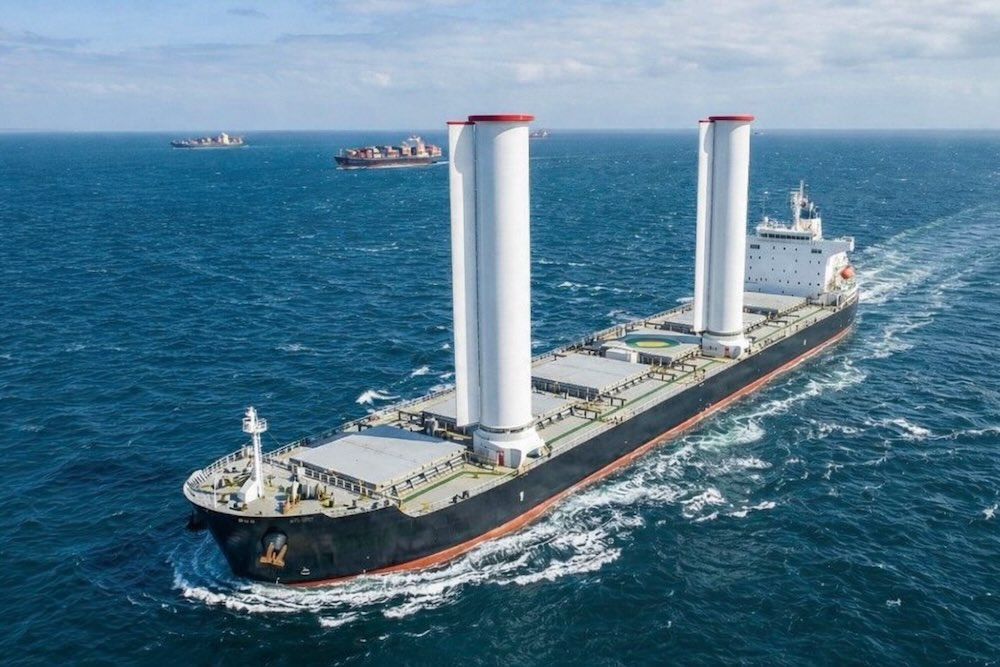
A Glasgow-based maritime technology startup is developing a next-generation Flettner rotor sail that addresses one of the technology’s most persistent commercial limitations – its dependence on favourable wind angles – through a patented tail-appendage device that reshapes airflow in the rotor’s wake to deliver higher thrust across a broader range of conditions.
EcoNavis Solutions’ Eco Rotor Sail retains the conventional rotating cylinder of a standard Flettner rotor but adds a fixed aerodynamic appendage downstream to stabilise airflow, reducing energy losses and maintaining thrust generation as wind direction changes. Initial simulations indicate a thrust increase of up to 10% alongside a 5% reduction in torque demand.
“Flettner rotors already offer one of the highest lift-to-drag ratios among wind-assisted devices, but the main drawback has been the narrow band of wind angles – typically beam and stern-quarter winds,” said EcoNavis CEO and founder Dr Batuhan Aktas. “If you can maintain performance across a wider range of conditions, you change how the technology is used. It becomes something operators can plan around, rather than something that depends on favourable weather.”
The project is backed by a £100,000 research grant from Scottish Enterprise toward a £265,000 development programme. Wind tunnel trials at Politecnico di Milano In Italy are planned for scale model validation, with a full-scale prototype potentially ready for shipboard trials this year.
Flettner rotors – first introduced a century ago – are enjoying a commercial renaissance as shipowners seek credible, proven routes to fuel savings and CII compliance. The technology’s Achilles heel has always been performance variability outside optimal wind angles, limiting its attractiveness on vessels trading diverse global routes.