
Michael Dunbar, Digital Product Manager, Matt Jones, Head of Sales UK & Ireland, and Shaun Scott, Applications Engineer at Advanced, discuss the development of smarter, integrated fire safety solutions
As fire safety challenges grow more complex, so do expectations for system performance, integration and accountability.
At The Fire Safety Event (FSE) 2026, Advanced will be demonstrating how intelligent fire, smoke control and evacuation systems are evolving to meet these demands, not as isolated components, but as part of a smarter and connected whole.
Exhibiting in Hall 4, Stand D85, at Birmingham’s NEC, from 28–30 April, Advanced will showcase how its latest technologies are supporting safer buildings today, while laying the foundations for the data‑driven, integrated systems that compliance will increasingly demand tomorrow.
Across its stand, visitors will see how fire detection, smoke control, evacuation and system intelligence can work together, simplifying compliance, improving response and reducing long‑term operational burden.
Addressing modern challenges with proven systems
The fire safety landscape has changed dramatically over the past decade.
Buildings are more complex, usage patterns more dynamic and expectations around safety, accountability and resilience far higher than ever before.
What hasn’t changed is the need for systems that are dependable, intuitive and fit for purpose.
At Advanced, we’ve spent years developing fire and life safety solutions that respond to real‑world challenges, not theoretical ones.
That experience is particularly relevant today, as the industry grapples with emerging requirements like enhanced evacuation strategies, smoke control expectations and the growing focus on lockdown and mass notification.
A good example is the conversation around Martyn’s Law.
While the legislation itself continues to evolve, the underlying principle is clear: buildings must be able to respond quickly and effectively to a wider range of threats.
What’s often misunderstood is that many of the capabilities being discussed aren’t new concepts.
In fact, Advanced systems have supported site‑wide alerts, phased responses and lockdown‑style functionality for years, using existing, proven infrastructure.
By using intelligent fire panels, networked systems and flexible cause‑and‑effect programming, it’s already possible to deliver clear alerts, control movement and support coordinated responses without introducing unnecessary complexity or standalone systems.
At FSE, we’ll be demonstrating how these features can be implemented using our existing technology, giving specifiers and end users confidence that they can adapt to future requirements without wholesale system replacement.
Another key challenge is integration.
Fire safety systems can no longer be designed in isolation.
Smoke control, evacuation alert systems, fire detection and building management all need to work together seamlessly.
This isn’t about adding layers of technology for the sake of it, it’s about creating systems that are easier to understand, easier to manage and ultimately more effective in an emergency.
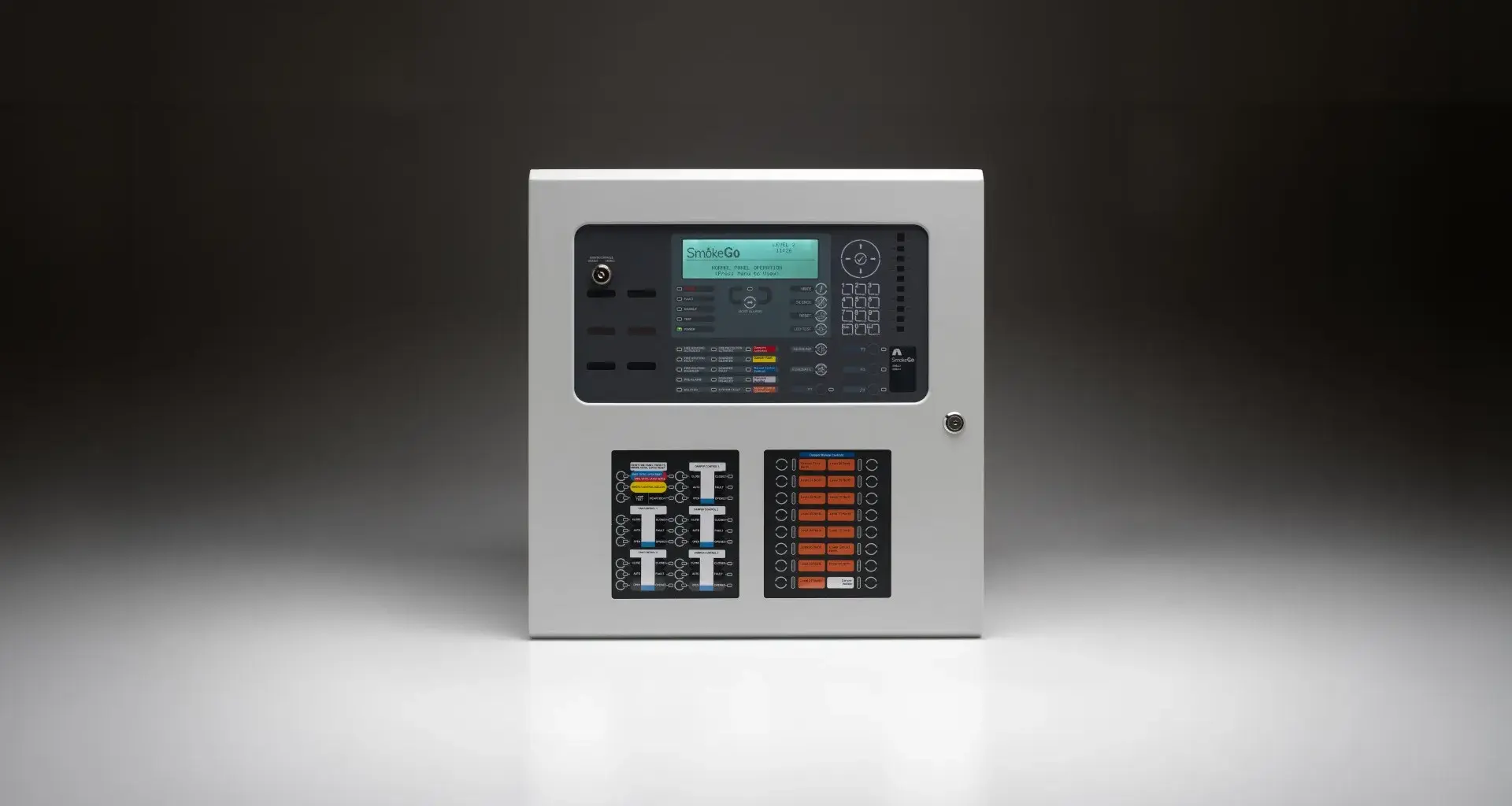
That philosophy underpins everything we’re showing at FSE, from our latest control panels to dedicated solutions like SmokeGo and EvacGo, and through to the growing role of system intelligence and connectivity.
Smoke control without complexity
Smoke control is one of the most critical, and often most misunderstood, elements of fire safety design.
It plays a vital role in protecting escape routes, supporting firefighting operations and limiting fire spread, yet it has traditionally been associated with complex programming, specialist hardware and difficult commissioning.
SmokeGo was developed to change that.
As Advanced’s dedicated smoke control solution, SmokeGo is designed to make smoke control simpler, faster and fully compliant across a wide range of applications.
Approved to EN54 Parts 2 and 4, and designed to meet the requirements of standards including BS 7346‑8 and ISO 21927‑9, it delivers reliable automatic and manual control of smoke control fans and dampers, without unnecessary complication.
One of SmokeGo’s biggest strengths is its flexibility.
It can be used in both dedicated and non‑dedicated smoke control systems, integrating seamlessly with Advanced’s next‑generation MxPro 5 fire panels.
This allows designers to achieve precise, coordinated control while maintaining a clear separation between fire detection and smoke management functions where required.
From an installer and commissioning perspective, SmokeGo’s four‑step configuration process is a game‑changer.
Complex cause‑and‑effect programming is replaced with an intuitive matrix that provides a clear, at‑a‑glance view of system behaviour.
What might once have taken days to configure can now be achieved far more quickly, with greater confidence and far less risk of error.
Operationally, SmokeGo offers the features that matter most in real buildings: automatic stairwell pressurisation, post‑alarm purge, cascade control for prioritising compartments as smoke spreads, interlocks to prevent unsafe fan operation and flexible manual overrides for fire and rescue services.
Automatic testing routines can also be programmed to run at defined intervals, helping ensure systems remain ready while minimising disruption to occupants.
Importantly, SmokeGo doesn’t exist in isolation.
When connected to AdvancedLive, users gain remote visibility of fan and damper status, adding another layer of assurance and simplifying maintenance planning.
It’s a practical example of how smart connectivity can enhance safety without overcomplicating system design.
AdvancedLive and the shift towards smarter, connected fire systems
We live in a connected world, yet many fire systems are still managed as if they exist in isolation.
Panels are installed, commissioned and then largely left alone, only interacted with during weekly tests, faults or incidents.
That approach is no longer sustainable.
Modern buildings now demand visibility.
A smart fire system isn’t about novelty or remote access for its own sake; it’s about having the right information at the right time.
Connectivity unlocks real‑time insight into system health, device status and event history, enabling faster, more accurate decision‑making when it matters most.
This is where AdvancedLive plays a critical role, not as a standalone platform, but as part of a wider smart fire system.
By connecting Advanced panels, users gain a live, unified view of what’s happening across their estate, whether that’s a single site or multiple buildings.
Fires, faults and isolations are visible as they occur, allowing teams to respond immediately rather than discovering issues after the fact.
That visibility has a direct operational impact.
Engineers can assess system status remotely before travelling to site, reducing unnecessary call‑outs.
Maintenance can be planned more effectively using device history and event data, and potential issues can be identified and addressed before they escalate into more serious and costly problems.
These benefits are already being realised in complex, real‑world environments.
At Blists Hill Victorian Town in Shropshire, multiple independent MxPro 5 panels across a large, dispersed heritage site are unified through AdvancedLive into a single, virtual network.
This provides centralised oversight without the need for additional hardware or intrusive infrastructure, allowing safety teams to monitor and manage fire system status across historic buildings, mine tunnels and standalone structures while preserving the site’s character and visitor experience.
Similarly, at Chalk Hills Academy in Luton, AdvancedLive supports the real‑time monitoring and management of a networked MxPro 5 system protecting multiple school buildings.
The platform enables authorised users to respond quickly to incidents, integrate fire safety with wider site systems such as lockdown and gas shut‑off and maintain reassurance that the system is operating as intended, even when staff are off site.
At FSE 2026, our focus is very much on making testing smarter.
Routine fire system testing remains essential, but it is often time‑consuming and disruptive.
Connected systems allow organisations to streamline testing, improve record‑keeping and reduce impact on building occupants, while still maintaining full compliance.
Looking ahead, the industry’s direction of travel is clear.
The future of fire safety is data‑driven and integration‑led.
Concepts such as the golden thread underline the growing expectation that accurate, accessible information will support building safety throughout a building’s lifecycle.
Fire systems will need to contribute to that data ecosystem, not sit outside it.
AdvancedLive is evolving with that future in mind, supporting secure access, clear audit trails and accountability.
The result is a smarter fire system where compliance isn’t just achieved at installation, but maintained, evidenced and understood over time.
A smarter, safer future
Across fire detection, smoke control, evacuation and system intelligence, Advanced’s message at FSE is simple: smarter systems don’t have to be more complicated.
By building on proven technology, embracing connectivity where it adds real value and focusing on usability, it’s possible to create fire safety solutions that are robust, adaptable and ready for the challenges ahead.
This was originally published in the April 2026 Edition of International Fire & Safety Journal. To read your FREE copy, click here.