
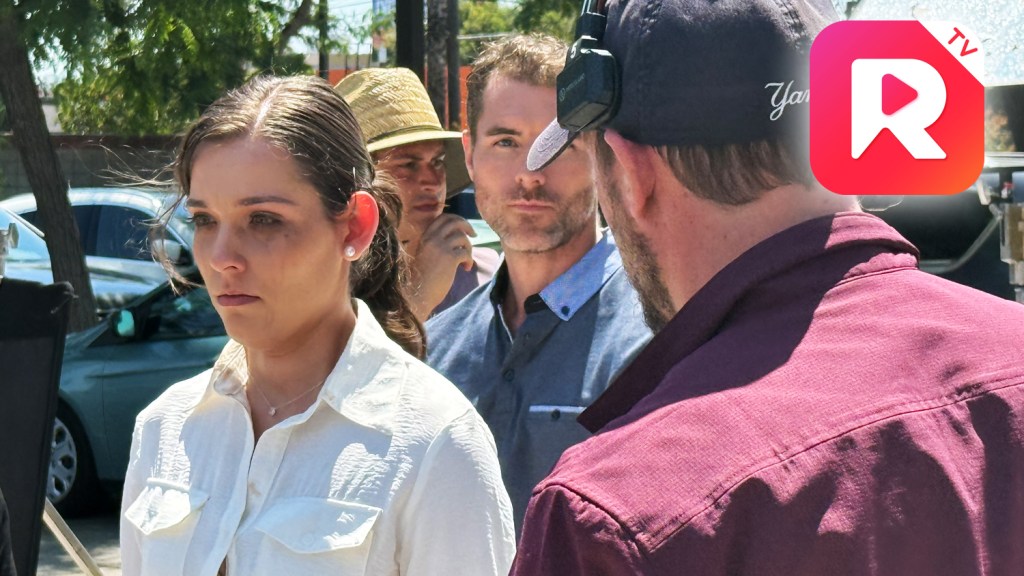
The camera hasn’t even started rolling and actress Samantha Drews is already shedding charcoal-tinted tears for her latest micro-drama.
It’s a sweltering afternoon in central Los Angeles and Drews, who’s playing a distraught mama, is preparing to reunite with her child who was inadvertently locked in the hot car of her husband’s mistress. Drews’ character has been searching for days for her lost daughter and the time has finally come to shoot the requisite happy ending.
The crocodile tears come easy for Drews, as these kinds of scenes are practically old hat by now. With her list of micro-drama credits quickly stacking up — her most recent ones include “Mommy Don’t Cry, Daddy is Sorry” and “Accidental Triplets with a Billionaire” — Drews can’t imagine doing anything else in Hollywood right now.
“On the very first short I did, I remember saying that if I did this every day for the rest of my life, I would be happy,” says Drews, who’s about to wrap her third year of doing verticals for the ReelShort app. “And I had no idea what it would become, not a clue. It has just been an absolute blessing for me.”
Cheap, kind of, and janky, sure, but these undeniably addictive shorts — bite-sized episodes that are meant for mobile, vertical viewing — have become a veritable lifeline for actors, writers, producers and directors who are desperate to break into an ever-exclusive industry. Apps like the Crazy Maple Studios-owned ReelShort are providing a constant stream of opportunities right here in Los Angeles for folks who don’t mind working on non-union projects with titles like “Sleep with Me Mortal!” and “Ruthless Mafia Daddy.”
On any given day, a majority of the casting calls on Breakdown Services are for short-form dramas that can be accessed by consumers via free (until its time to subscribe) apps.
“They’ve exploded,” explains Skyfire Artists manager Ryan Luevano of micro-dramas. “Here’s the thing, they’re profitable, right? And these companies that are making them have a system and they make them quick. They shoot quickly and shoot efficiently. When I’m looking for work for clients daily, I would say verticals make up 60% of the work that is currently out there. Without them, there would be 60% less opportunities.”
And the pay isn’t shabby. Leuvano said he recently booked a client on a feature for $150 a day when most verticals for supporting characters start at $300 a day. Leads can earn upwards of $1,000 a day. And if you are someone like Drews, you can earn a steady stream of cash by working exclusively for ReelShort.
“I’ve met a lot of wonderful people. We make a lot of wonderful connections,” says Drews, who is SAG eligible because of a previous film role. “Yes, I would love to do SAG work, but there isn’t anything right now.”
For director Anthony Fanelli, who helmed the ReelShort vertical that stars Drews, making micro-dramas offers a “collaborative atmosphere” that is rarely mired in delays, especially on the post side. And since the scripts are “very meticulous from a marketing standpoint in terms of what is going to hook the audience,” Fanelli knows exactly what is expected of him.
“They’ve been keeping me pretty busy and the goal, and as of right now, is that this is what I’m doing for the foreseeable future, unless fans such don’t like me anymore,” says Fanelli, who’s already done several minis for ReelShort.

Director Anthony Fanelli, left in baseball cap, directing a ReelShort micro-drama.
Lynette Rice/Deadline
Besides the upside of decent pay and working in Los Angeles, micro-dramas operate in relative anonymity, meaning a lead role in a cheesy vertical with themes of forbidden love, murder or betrayal aren’t likely to be on the radar of film and TV producers. In fact, when Deadline assembled a recent roundtable of Emmy-nominated casting directors, none of the participants had even heard of verticals.
“No one [in the industry] is watching these things,” observes one longtime acting coach, who encourages her junior clients to consider doing them as a way to get their feet wet. “Actors can do any many as they want. It won’t impact their careers unless they’re doing something super smutty and it becomes a problem later on if they get a job with Disney.”
The downside, of course, is the quality the scripts, many of which are written by younger writers straight out of film school. (ReelShort also maintains an in-house stable of writers, a plus for newbies looking for full-time gigs).
“The stories are outrageous, and the dialogue is very two-dimensional,” admits Luevano. “This isn’t Shakespeare, but it’s also not what it’s about. It’s the modern-day soap opera. They’re written for Gen Z, and they’re consuming them on TikTok and Instagram and all these other platforms. Actors forget that we only have the film and television industry because of commercials. That’s how television started. It was a means to get commercials to people. It’s all commodity.”
And it’s an industry that shows no signs of slowing down. Outside of China — where the soapy shorts got their start during the pandemic — the U.S. is the most lucrative market for micro-dramas. Deadline reported last month that revenues in the U.S. reached $819M in 2024, and are projected to rise to $3.8B by 2030. It’s not surprise, then, that in August, Cineverse CEO Chris McGurk and Lloyd Braun’s Banyan Ventures announced plans to launch a short-form content platform called MicroCo. Their hope is to release their first set of micro-series on a yet-to-be-named app by the first quarter of next year.
For now, SAG is remaining neutral about the burgeoning industry but is open to collaborating with vertical producers, should they want to hire union actors. “Vertical content products are most assuredly SAG-AFTRA covered work that should always be covered by an appropriate SAG-AFTRA agreement,” according to a spokesperson. “Any producer of vertical content wishing to engage SAG-AFTRA members is encouraged to contact the union for assistance in getting their project covered.”
In the meantime, Drews is encouraging other young actors like herself to consider a career (temporary or otherwise) in shorts. “I mean, there’s not a lot of work right now, as you know,” she says to Deadline. “This has definitely kept me afloat.”