

 2 min read
The crew of Artemis II named a newly discovered moon crater after a colleague’s late wife on Monday, pausing their historic mission for a moment of grief and remembrance while 252,756 miles from Earth. In a video shared to the lunar mission’s Instagram page, Canadian Space Agency Mission Specialist Jeremy Hansen said that there were some “relatively fresh craters on the moon that have not been named yet,” and that the crew wanted to propose a few for them.
“We lost a loved one, her name was Carroll, the spouse of Reid, the mother of Katey and Ellie…(The crater is) a bright spot on the moon and we would like to call it Carroll,” Hansen says.
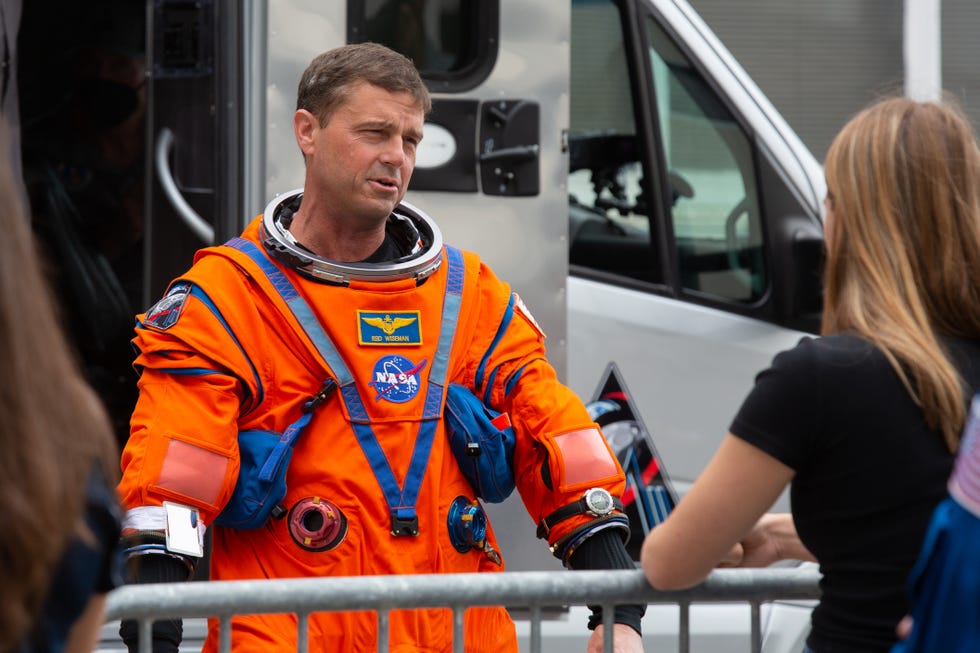
Carroll Wiseman was the wife of Commander Reid Wiseman, who is currently leading the first crewed flight around the Moon since Apollo 17 in 1972. She was a pediatric nurse practitioner and mother of two daughters with Reid, Ellie and Katherine. She died of cancer at age 46 in 2020. A 27-year Navy veteran and a NASA astronaut since 2009, Reid wrote in his NASA bio that he “considers his time as an only parent as his greatest challenge and the most rewarding phase of his life.”
The proposed “Carroll Crater” straddles the boundary between the moon’s near and far sides and can at times be seen from Earth. “After this mission is complete, the crater name proposals will be formally submitted to the International Astronomical Union, the organization that governs the naming of celestial bodies and their surface features,” NASA wrote on the blog with ongoing updates for the Artemis II.
 NurPhoto//Getty Images
NASA Mission Commander Reid Wiseman with his daughters before the launch on April 1.
 Chip Somodevilla//Getty Images
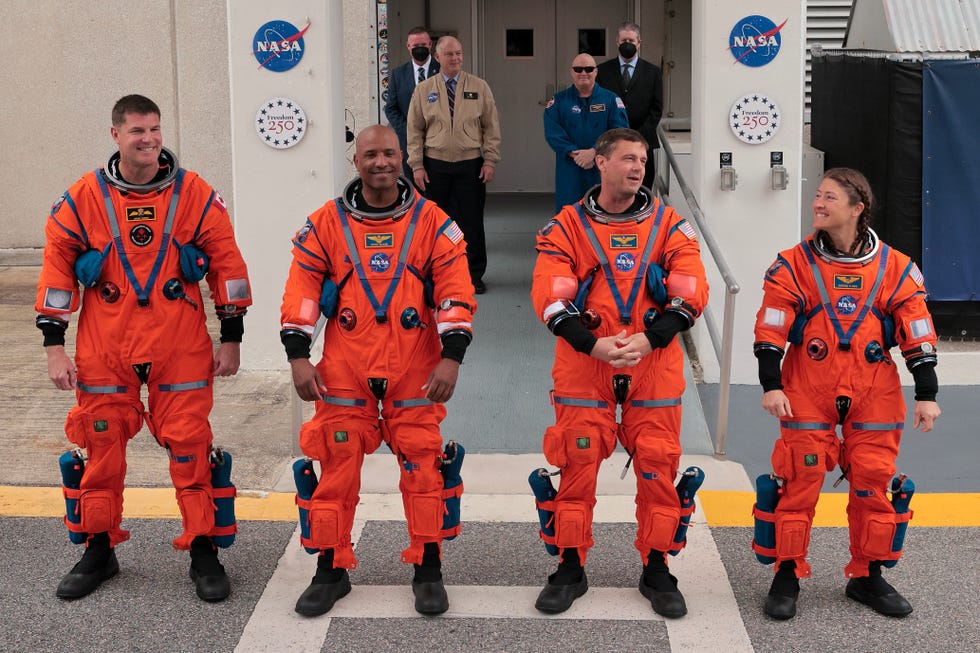
The Artemis II crew, before departure, from left to right: CSA Mission Specialist Jeremy Hansen, NASA Pilot Victor Glover, Wiseman, and NASA Mission Specialist Christina Koch.
The dedication came on the sixth day of the Artemis II flight. The crew, which also includes NASA Mission Specialist Christina Hammock Koch and NASA Pilot Victor Glover, is now making its return to Earth, with the Orion capsule exiting the lunar sphere of influence on Tuesday. It is scheduled to return to Earth on Friday, April 10, where it will splash down in the Pacific Ocean off the coast of California, near San Diego.

Rachel King (she/her) is a news writer at Town & Country. Before joining T&C, she spent nearly a decade as an editor at Fortune. Her work covering travel and lifestyle has appeared in Forbes, Observer, Robb Report, Cruise Critic, and Cool Hunting, among others. Originally from San Francisco, she lives in New York with her wife, their daughter, and a precocious labradoodle. Follow her on Instagram at @rk.passport.