
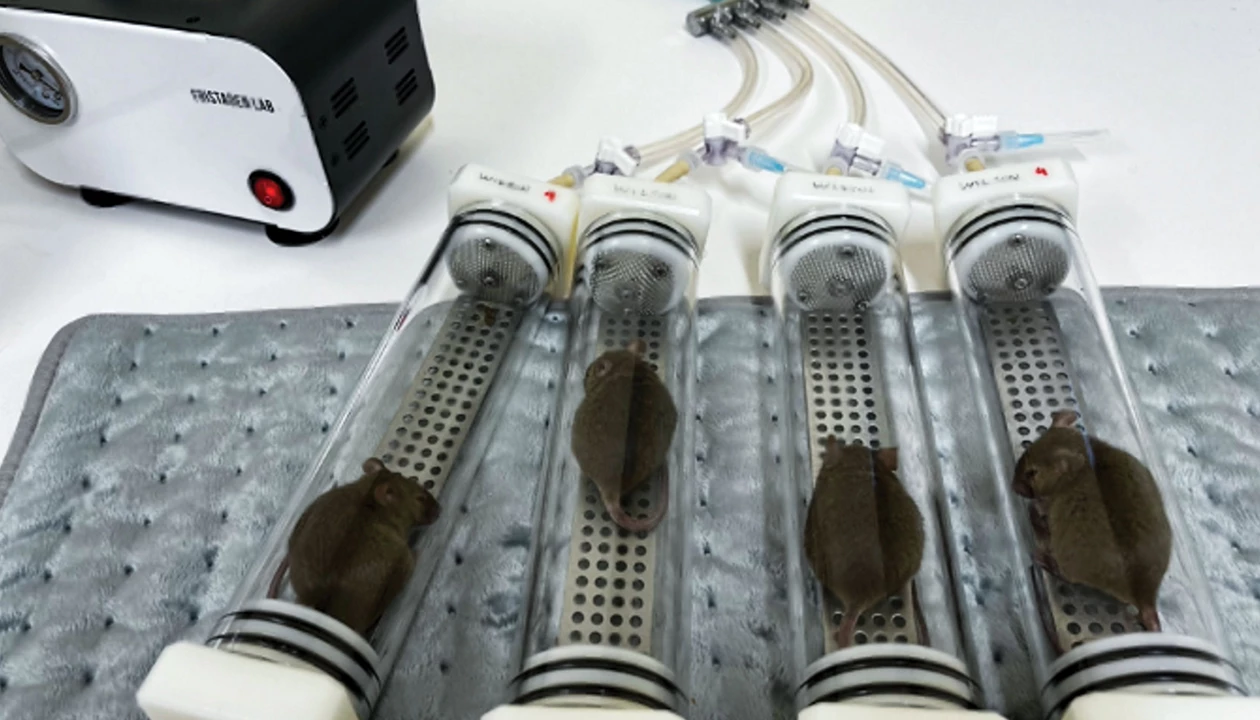
Diagnosing bacterial infections deep inside your tissues can be highly invasive, requiring procedures such as tissue biopsies or blood cultures. Now researchers have made strides toward solving this issue. They report a method that can detect bacterial infections on the breath of mice, even when the bacteria are deep inside their bodies (ACS Cent. Sci. 2026, DOI: 10.1021/acscentsci.5c01995).
Doctors already use breath tests to detect certain stomach infections. Their patients simply swallow urea labeled with carbon-13, and if an infection is present, the bacteria break down the urea into labeled carbon dioxide. Doctors then measure the 13CO2 in patients’ exhalations.
But because the urea is delivered orally, this approach is limited to the stomach. Once the labeled molecules move farther into the digestive tract, gut microbes break them down, and they cannot reveal infections elsewhere in the body.
“The eureka moment came when we heard that 13C-enriched metabolites were being used to study cancer,” says David Wilson, an imaging scientist and radiologist at the University of California, San Francisco. “Applying the same idea to bacteria seemed pretty straightforward.” Wilson’s team figured they could inject sugars labeled with carbon-13 into the bloodstream; the sugars would eventually find their way to the infection site deep inside tissues and turn into detectable 13CO2.
To identify suitable probes, the researchers first screened a panel of 13C-labeled sugars in bacterial cultures, finding that compounds such as maltose and mannitol were metabolized to produce 13CO2. The team then moved to mouse models of muscle, bloodstream, bone, and lung infection.
The researchers placed the mice in tiny breathing chambers that could collect and analyze the gases that the rodents exhaled. Using nondispersive infrared spectroscopy, the scientists were able to detect clear 13CO2 signals on the infected animals’ breath within minutes. Healthy controls showed little to no 13CO2.
The signal also tracked the mice’s response to antibiotics. In mice with muscle infections, exhaled 13CO2 levels dropped after 24 h of treatment as bacterial levels fell about 100,000-fold.
“The study addresses a genuinely important diagnostic gap,” says Mathias W. Pletz, an infectious disease specialist at Jena University Hospital who was not involved in the study. He says the most compelling aspect is its potential specificity for active bacterial metabolism. In pneumonia, doctors often start antibiotics without knowing whether bacteria or viruses are responsible. “A negative breath test could be a meaningful step forward.”
Willem van Schaik, a microbiologist at the University of Birmingham who was not involved in the study either, calls the work “an exciting innovation with strong proof-of-principle data” but says several hurdles remain before clinical translation. “Bacterial levels in human infections are often lower than those in animal models, leaving the sensitivity of this approach in patients an open question,” van Schaik notes, adding that 13C-labeled sugars are currently expensive.
Though, Wilson says, a more refined version could complement imaging in acute care settings, such as positron emission tomography (PET), which is costly in its own right and logistically cumbersome. The breath test seemed to mirror PET signals when Wilson’s team compared the two methods.
“However, it’s greatest strength might lie in quickly determining whether a patient has a bacterial infection,” Wilson says. The team is working to identify probes that can target a broader range of pathogens and to test the method in more clinically relevant models before moving to patients, he adds.
Chemical & Engineering News
ISSN 0009-2347
Copyright ©
2026 American Chemical Society