
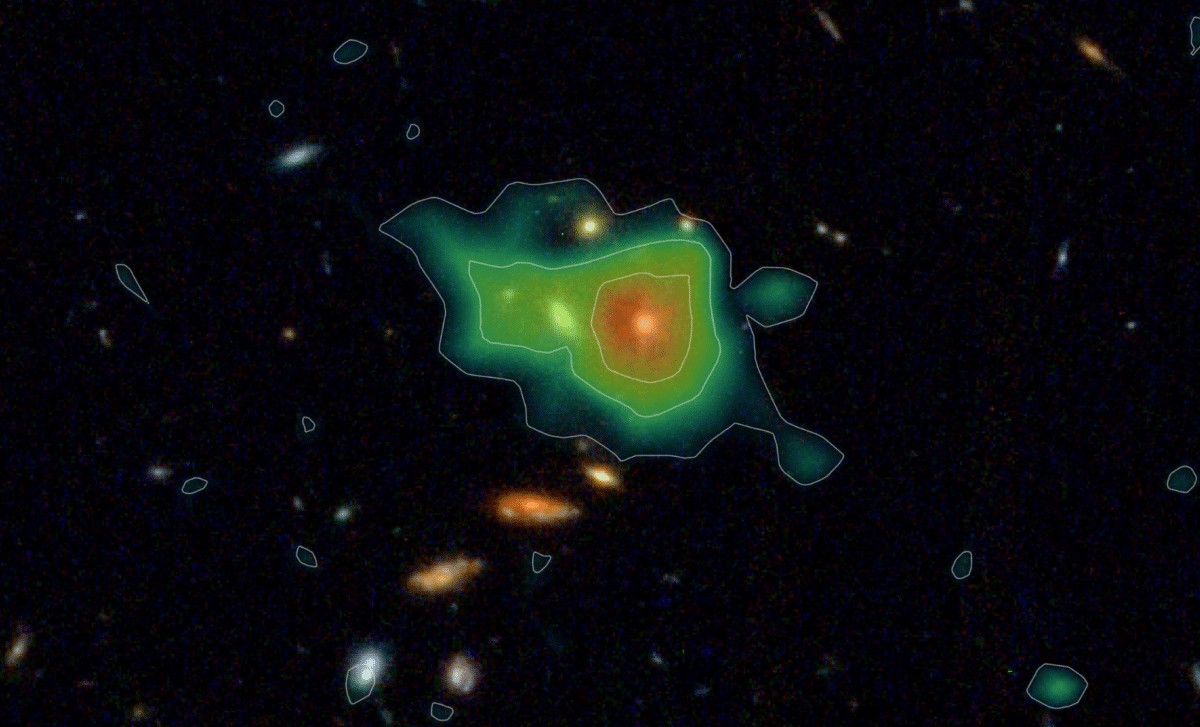
stronomers have identified tens of thousands of massive hydrogen gas halos surrounding ancient galaxies, some as far back as 11.3 billion years ago. These halos, crucial to understanding galaxy formation, were largely unknown until the Hobby-Eberly Telescope Dark Energy Experiment (HETDEX) expanded their discovery by more than tenfold. Published in The Astrophysical Journal, this discovery could transform our understanding of the early universe, shedding light on the essential role hydrogen played in the rapid growth of galaxies during the Cosmic Noon period.
A Tenfold Jump in Discoveries
The universe’s early days are still shrouded in mystery, but new findings from the HETDEX team are providing unprecedented insights into the cosmic landscape. What were once thought to be rare and extreme examples of hydrogen gas halos are now known to be much more common than previously thought. According to a recent study published in The Astrophysical Journal, the number of these colossal hydrogen clouds has increased dramatically, from roughly 3,000 to over 33,000.
“We’ve been analyzing the same handful of objects for the past 20 or so years,” said Erin Mentuch Cooper, HETDEX data manager and lead author of the study. “HETDEX is letting us find many more of these halos and measure their shapes and sizes. It has really allowed us to create an amazing statistical catalog.”
This surge in discovery marks a new era in the study of the early universe, offering astronomers a more representative sample to work with as they explore the origins of galaxies and stars.
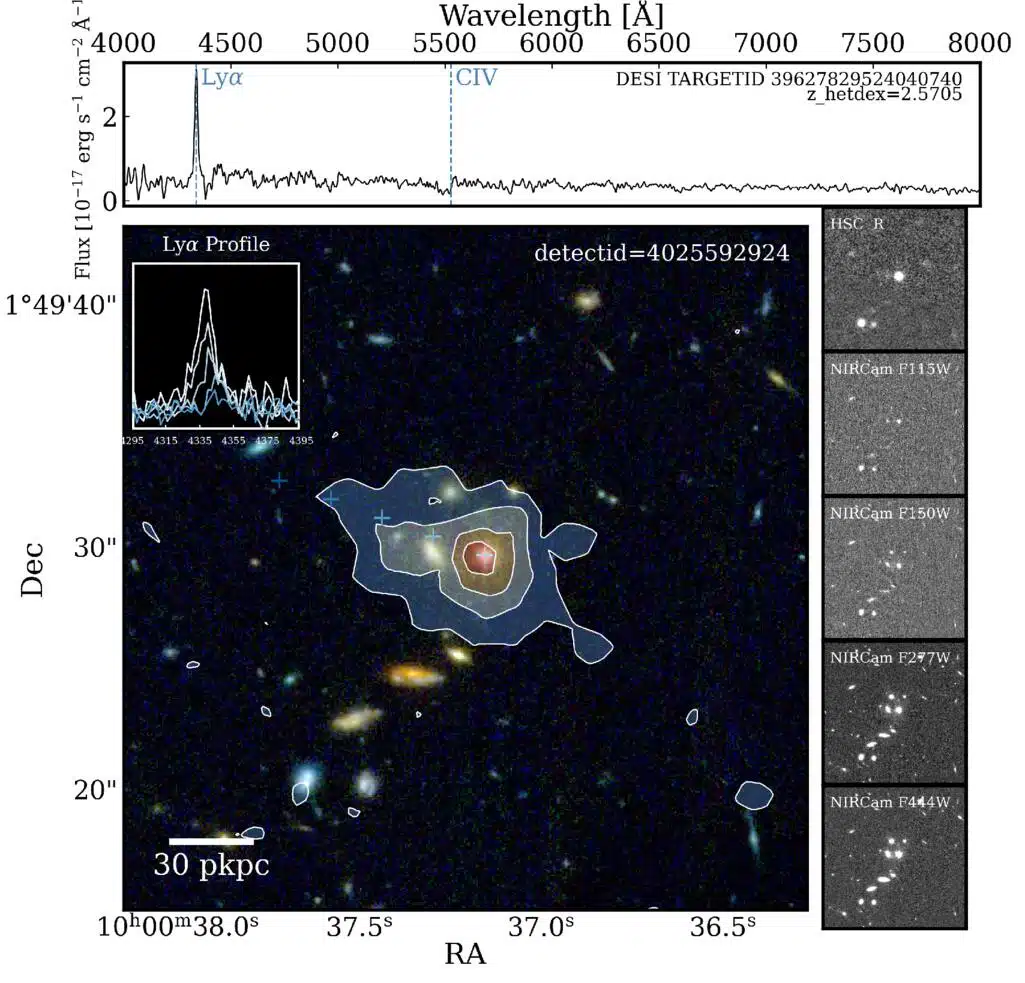 Multiwavelength view of HLAN 4025592924 at z _hetdex = 2.57. Situated in the COSMOS Deep Field, this LAN is among the largest in the HETDEX sample, with an isophotal radius of 45.9 kpc—placing it in the top 2% of the distribution. Despite its size, the structure’s Lyα luminosity is moderate at log_L_lya = 43.8 erg s−1, and it is not identified as an AGN. Top: DESI DR1 (TARGETID 39627829524040740 ; M. E. Levi et al. 2019; DESI Collaboration 2025) 1D spectrum on the central bright source (white “+” symbol). The lack of C iv suggests the source is not AGN dominated. Main: 30″ × 30″ JWST/NIRCam three-color composite (blue = (F115W + F150W), green = F277W, red = F444W) from the COSMOS-Web DR1 mosaics (M. Franco et al. 2025). The Lyα line-flux map (see Section 3) from the HETDEX data cube is overplotted as contours (levels 3–15 σ). The top-left inset shows 1D Lyα profiles extracted along the positions marked by “+” symbols in the image. A 30 kpc scale bar is indicated at lower left. Right column: 30″ × 30″ postage stamp images (top to bottom) from Subaru/HSC-r band, and JWST filters F115W, F150W, F277W, and F444W reveal that multiple low-mass galaxies accompany the LAN.
Credit: The Astrophysical Journal
The Elusive Nature of Hydrogen Halos
Hydrogen gas halos, also known as Lyman-alpha nebulae, have long been difficult to detect due to their faint glow. Unlike other cosmic objects, hydrogen doesn’t emit its own light. However, when it is near a highly energetic galaxy or a group of galaxies, ultraviolet radiation from the stars can cause the hydrogen gas to glow, making it visible to advanced instruments. Detecting these halos has historically been challenging, with astronomers only able to identify the brightest and most extreme examples.
In their study, the HETDEX team used a unique approach to scan a vast area of the sky, uncovering many more of these faint structures. With the power of the Hobby-Eberly Telescope and its ability to observe large portions of the sky, they have unveiled thousands of previously hidden hydrogen halos, offering a more complete picture of the early universe.
The Power of HETDEX: A Revolution in Astronomical Data
One of the driving forces behind this discovery is the sheer scale of data collected by HETDEX. The telescope’s unique capabilities have allowed the team to examine over one million galaxies, uncovering their surrounding hydrogen halos.
“We’ve captured nearly half a petabyte of data on not only these galaxies but the regions in between,” explained Karl Gebhardt, HETDEX principal investigator and co-author of the paper. “Our observations cover a region of the sky measuring over 2,000 full moons. The scope is enormous and unprecedented.”
HETDEX’s ability to capture 100,000 spectra in a single observation has made it a powerful tool for studying the universe at a depth never before possible. According to Dustin Davis, a postdoctoral fellow at UT Austin and a scientist involved in the project,
“The Hobby-Eberly Telescope is one of the largest in the world… and the instrument HETDEX uses produces 100,000 spectra in each observation. So, we have huge amounts of data and there are all kinds of neat, fun, weird things waiting for us to find.”
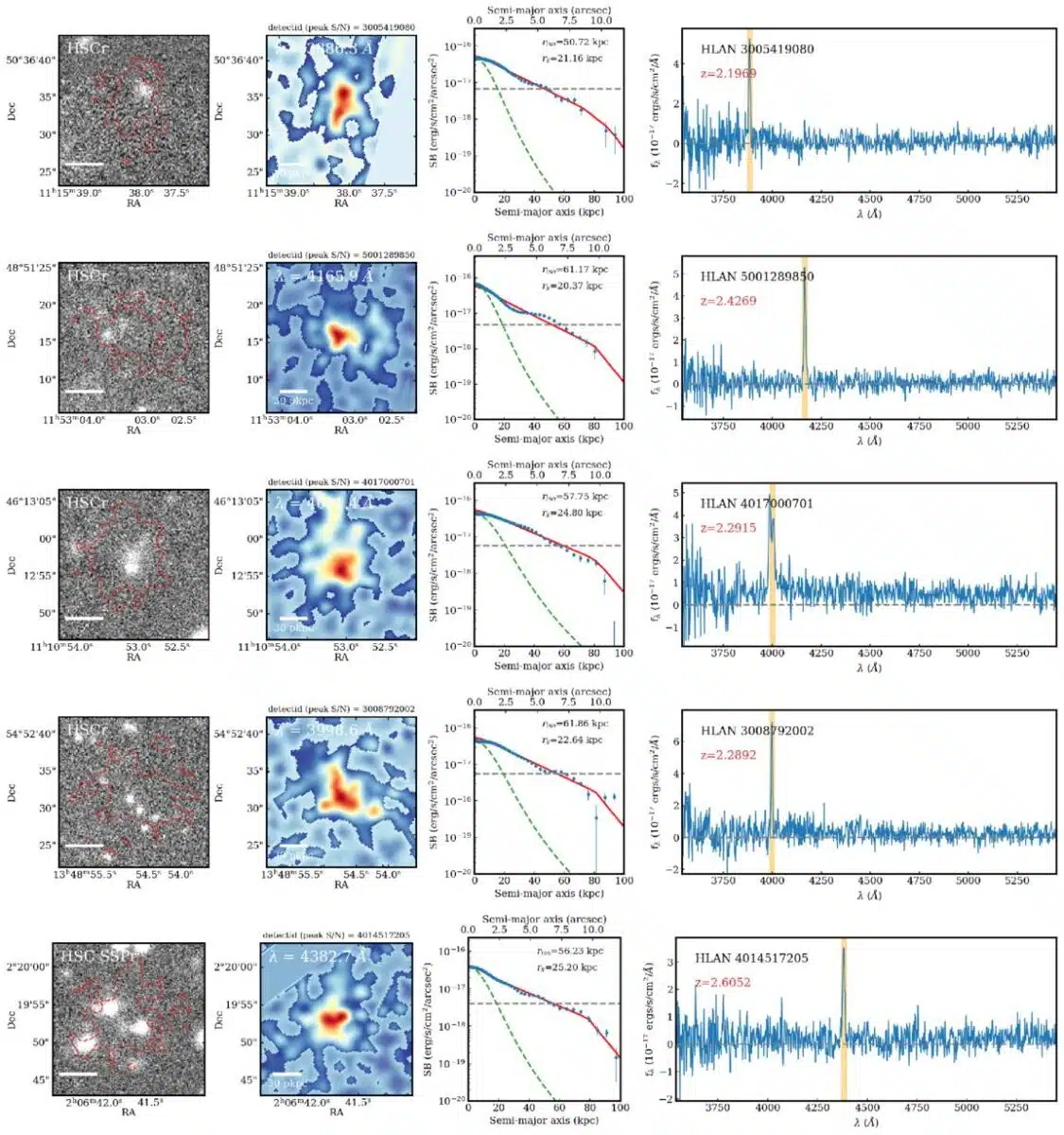 Examples of some of the largest extended Lyα-emitters. Photometric imaging from HSC-r is shown on the left, with the 2σ boundary of the Lyα emission shown as a dashed red contour. The second column displays the Lyα line-flux map centered on the wavelength listed in white text. The third column presents the radial surface-brightness profile in blue and our best-fit two-component model (PSF core + 2D exponential) in red. The dashed green line is the measured PSF from stars in the same observation as the LAN. The HETDEX/VIRUS spectrum for the central HETDEX detection is given in the rightmost panel. This spectrum is the PSF-weighted spectrum from the HETDEX pipeline. The spectral width of the line-flux map is highlighted in yellow on the spectrum. The line shapes are asymmetrical, and some appear to have multiple associated continuum counterparts in HSC-r images.
Credit: The Astrophysical Journal
Cosmic Amoebas: The Shape and Size of the Halos
As the HETDEX team delved deeper into the data, they discovered that the newly identified hydrogen halos come in a variety of shapes and sizes. Some are simple, football-shaped clouds surrounding a single galaxy, while others are sprawling, irregular blobs containing multiple galaxies. “Those are the fun ones,” said Mentuch Cooper, referring to the halos that resemble giant amoebas, with tendrils of hydrogen gas extending out into space.
These cosmic “amoebas” represent the dynamic and diverse nature of the early universe. Their irregular shapes and vast sizes, some halos spanning hundreds of thousands of light years, offer a new way to study the evolution of galaxies and their surrounding environments. By analyzing these shapes, astronomers can begin to piece together the mechanisms that drove galaxy growth during the universe’s formative years.
A New Era of Research on the Early Universe
The discovery of over 33,000 hydrogen gas halos is not just a significant leap in numbers; it also provides new opportunities for scientific exploration. With such an expansive dataset, astronomers are no longer limited by a lack of sample size when testing theories of galaxy formation and evolution. The research team is excited to move beyond the limitations of previous models and explore the fine details of individual halos.
“There are various models for galaxies in this epoch that largely work and seem to make sense, but there are gaps and holes,” said Davis. “Now we can focus in on individual halos and see at a greater detail the physics and mechanics of what’s going on. And then we can fix or throw out the models and try again.”
By studying these hydrogen halos, astronomers will be able to refine their understanding of the distribution of matter in the early universe, how galaxies formed and evolved, and the role of hydrogen in cosmic growth. With such a rich catalog of data at their disposal, scientists are poised to make new breakthroughs in the coming years.