
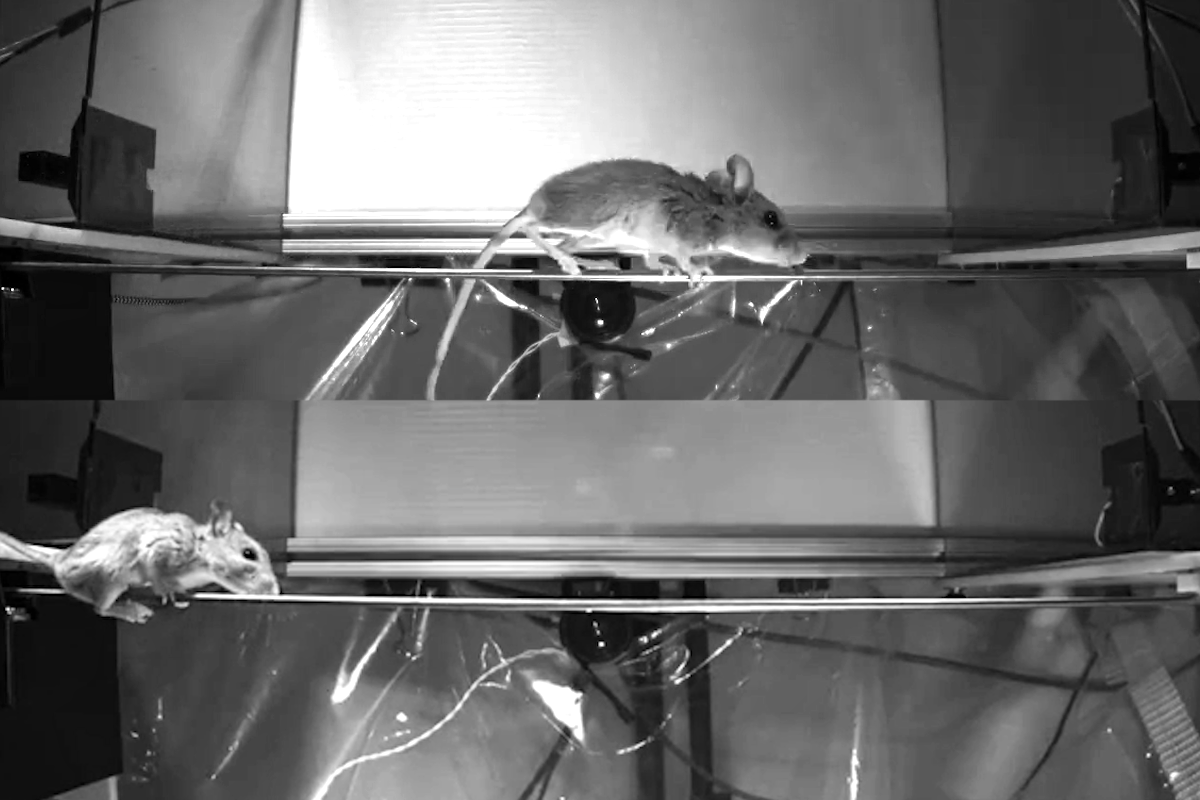
But establishing the causality between corticospinal changes and increased dexterity has been a challenge, Azim says. Enter deer mice (Peromyscus maniculatus). When open ecosystems gave way to forests at the end of the last ice age, deer mice in different parts of North America adapted to an arboreal lifestyle and independently converged on similar body morphologies—longer tails and larger hind feet—that boosted their climbing ability.
This lineage provides an opportunity to study changes in the nervous system and motor control “without breaking the complex machine of the brain,” says study investigator Adam Hantman, associate professor at the University of North Carolina at Chapel Hill.
It also turned out to be relatively easy to adapt the genetic, behavioral and electrophysiological tools used in other rodent models to both forest and prairie-dwelling subspecies of the deer mouse, says study investigator Kelsey Tyssowski, a postdoctoral researcher in Hopi Hoekstra’s lab at Harvard University.
The team used selective staining and light-sheet microscopy to reveal that forest dwellers have twice as many corticospinal axons in the cervical spinal cord, where the forelimb-innervating axons branch off into the gray matter, Tyssowski says. This increase comes from secondary motor and somatosensory cortices, retrograde labeling in the cervical spinal cord showed.
I can’t see a link between brains and behavior that doesn’t go through the biomechanics of the body.
—
—
Madineh Sedigh-Sarvestani
After six days of training, the forest mice were better able to grab food pellets and reached for the pellets in more varied ways, confirming that their axonal increase correlated with better dexterity. The prairie mice did pick up the skill, “but only if the pellets are really close to them” and by using a scooping behavior, Tyssowski says.
To disentangle whether increased corticospinal tract neurons and dexterous skill might be under independent genetic control, the researchers also tested climbing skills in second-generation hybrid deer mice, which would be expected to inherit varied prairie and forest mouse genes. The hybrids showed a correlation between climbing speed and corticospinal tract size, but not between climbing speed and weight, tail length or hind foot size, which might also affect climbing rates.
T
he researchers did not look for direct cortical-motor neuronal connections in the mice. But the findings suggest that the cortex might improve dexterity in more than one way—perhaps by exerting direct control over motor neurons, leading to new skills in primates, for example, or by using the existing systems more flexibly, which could increase capability in forest mice, Levine says.
Azim notes that the paper demonstrates only “a correlation” but says it’s a nice use of genetics to “shift the size of the corticospinal tract and show that this correlation stands.” It’s not clear how changes in corticospinal number or tract density might give rise to greater dexterity, he says, but it might result from increasing the computational capacity of the circuit.
The study deserves credit because it considers the brain, body and environment as an embedded unit, which is difficult “if you only study standard lab tasks in standard lab species,” says Madineh Sedigh-Sarvestani, assistant professor of neurobiology and behavior at Cornell University, who wasn’t involved in the study.
But she says she would like to know more about joint mechanics and flexibility, or grip strength, which might co-vary with corticospinal tract size and performance. “I can’t see a link between brains and behavior that doesn’t go through the biomechanics of the body,” she says.