
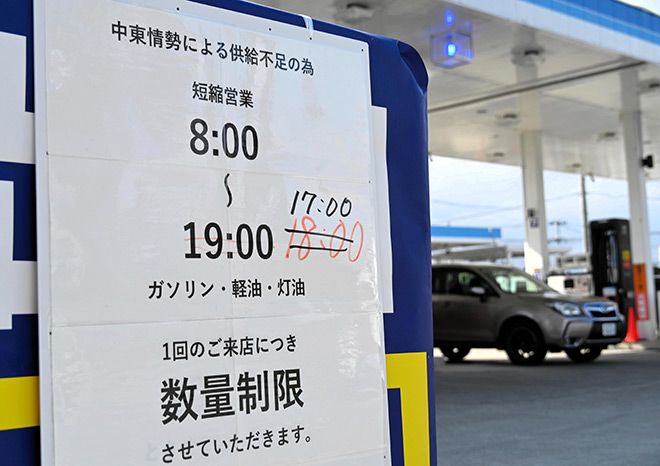
With few signs that tensions in the Middle East will be eased, moves are being seen domestically to deal with a possible shortage of petroleum and related products such as plastics.
The government should change its emphasis to restraining demand within reasonable bounds while there are still sufficient reserves to prepare for a drawn-out crisis.
The concerns of the public will not be erased if Prime Minister Sanae Takaichi only repeatedly says that the necessary volume for the entire nation has been secured.
There is first of all a need to gradually reduce the subsidy applied to restrain gasoline prices.
The subsidy began in an attempt to keep regular gasoline prices at around 170 yen ($1.10) per liter as an emergency measure to alleviate a drastic surge in price.
But individuals with high incomes and companies turning a profit also benefited from the measure.
With some estimates of a prolonged supply shortage, the program is problematic because it could conversely encourage consumption.
Gasoline prices in late March would have been about 50 yen higher without the subsidy.
To support prices, the government secured about 1 trillion yen on the initial forecast that about 300 billion yen a month would be needed.
But that fund could also quickly dry up if petroleum prices increase further.
If the subsidy program is to continue, the amount should be reduced and the price goal of 170 yen should be withdrawn. In its place, the government should consider a separate measure to support those who really need it.
We call on the government to decide before the series of national holidays from late April when more people might use their cars for leisure purposes.
Not only is there no indication of when the Strait of Hormuz will return to an opened state, but there are also no signs of when petroleum-related facilities in the Middle East destroyed by the fighting will return to normal operations.
The International Energy Agency has called on nations to take energy conservation measures because the situation represented the largest cutoff of supplies and many nations have responded.
The price of naphtha, the raw material for plastics obtained from crude oil, continues to surge. There are concerns among medical institutions that a shortage of supplies could affect the lives of patients.
Products made from petroleum-derived materials are used in various parts of daily life and corporate activities, from egg cartons to adhesives.
While Takaichi has said she is not now prepared to ask for conservation measures that might apply the brakes to economic activity, we do not feel reassured.
Now is the time for a careful explanation of her understanding of the current situation and a call for cooperation to conserve energy and be more frugal.
Specific consideration should be made as soon as possible by involving representatives from the business and medical sectors along with experts to determine which areas should be prioritized for receiving limited resources.
These efforts should also ensure that excessive self-restraint requests and measures with limited effectiveness are not made.
The oil crisis of the 1970s stimulated improved gasoline mileage among Japanese cars. International competitiveness was heightened because society as a whole thought about the efficient use of energy and energy conservation measures.
The current consideration should lead to mid- to long-term measures for a carbon-neutral future.
–The Asahi Shimbun, April 8