
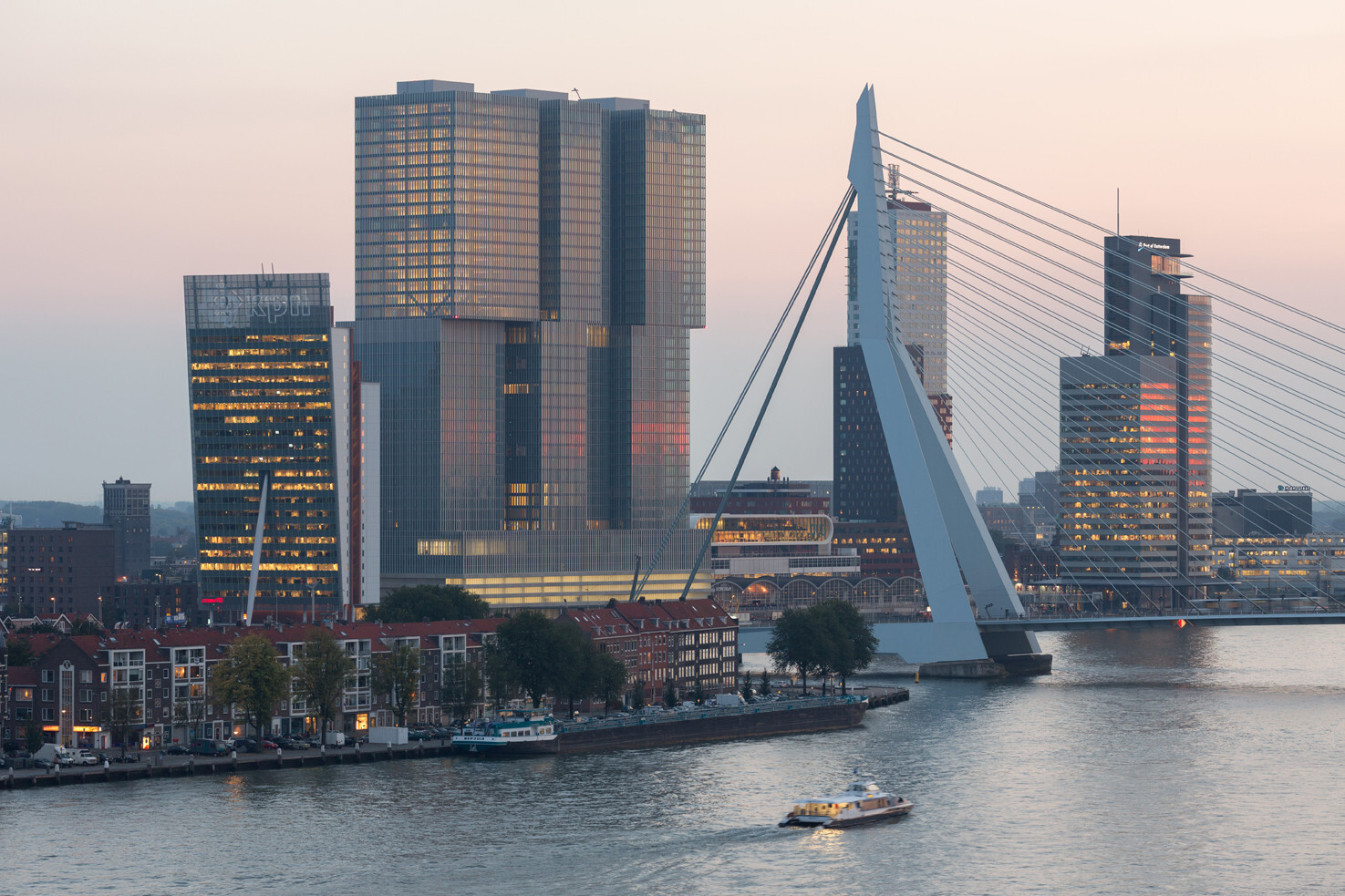
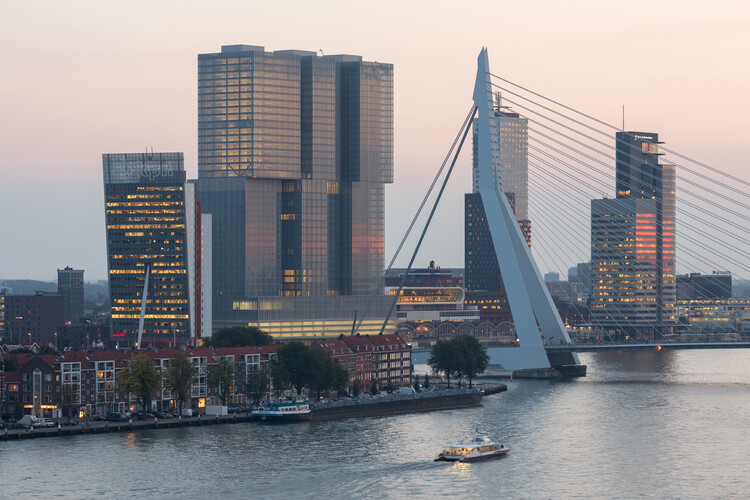
 De Rotterdam / OMA. Image © Ossip van Duivenbode
Share
Or
https://www.archdaily.com/1040325/no-solid-ground-three-approaches-to-building-below-sea-level-in-rotterdam
Architects carefully calibrate their relationship to the earth, adjusting foundations to soil, groundwater, climate, risk, and culture. Driven timber piles, rammed-earth platforms, and poured concrete slabs are each a response to a specific set of ground conditions, and each shapes the architecture that rises from it. The way a building meets the earth determines its durability and its limits because foundations are among the most consequential design choices an architect makes.
The city of Rotterdam sits approximately one meter below sea level, an organizing condition that shapes daily life in the Netherlands‘ second-largest city and is a growing preoccupation amid unstable coastal conditions. The city occupies the delta of the Rhine and Maas rivers, a landscape that was never naturally dry but has been kept functional through centuries of hydraulic intervention. The water boards in this region are among the oldest democratic institutions in the world, created in the thirteenth century to manage shared water drainage and still operating today as elected bodies with technical capacity. As sea levels rise and rainfall across Northern Europe grows less predictable and more extreme, Rotterdam faces a significantly increased risk of coastal storm surges and urban flooding driven by overwhelmed drainage infrastructure.
What emerges in response is not one unified solution but a set of distinct architectural positions. One maintains dry ground through continuous technical control, relying on infrastructure to exclude water from the built environment. Another redesigns the ground plane to absorb, store, and release water, treating wetness as a managed, visible condition. A third removes the requirement for ground altogether, developing floating architecture that operates directly with fluctuating water levels. These approaches coexist within the same city, sometimes within the same neighborhood, yet reflect different understandings of the responsibility of architecture in engaging with the ground. Together, they reframe the value of the relationship between a building and its foundation in a city below sea level.
Related Article Making Infrastructure Visible: When Systems Become Architecture 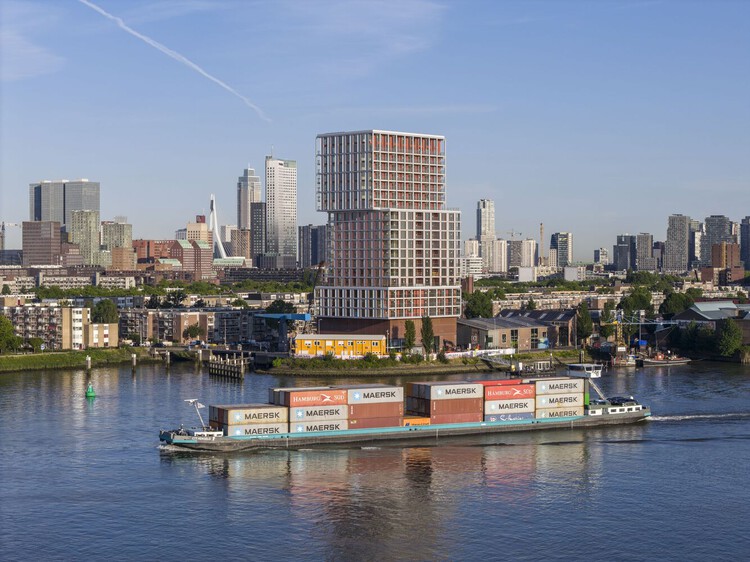 De Piek Waterfront Residential Tower / KCAP . Image © Ossip van DuivenbodeResistance: Maintaining Dry Ground through Engineering
This approach assumes that dry ground must be maintained at all times through continuous technical control. Water is managed through infrastructure that operates largely out of view. Architecture proceeds on the premise that the ground will remain stable because an extensive system is in place to ensure that it does.
The most legible expression of the first position is the Maeslantkering, the storm-surge barrier that protects Rotterdam from the North Sea. Each of its two curved steel arms is larger than the Eiffel Tower laid on its side and is designed to close automatically when storm surge threatens to overwhelm the waterway. The Maeslantkering is the most dramatic component of the Delta Works, the network of dams, sluices, locks, dikes, and barriers constructed after the North Sea flood of 1953, which inundated large portions of the country and led to national policy restructuring efforts. What this catastrophe produced is a lasting conviction that water could be controlled through sufficient force of engineering.
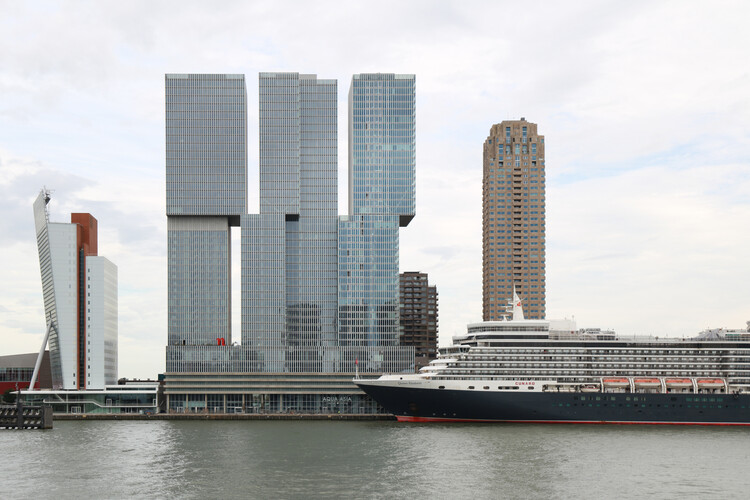 De Rotterdam / OMA. Image © Maria Gonzalez
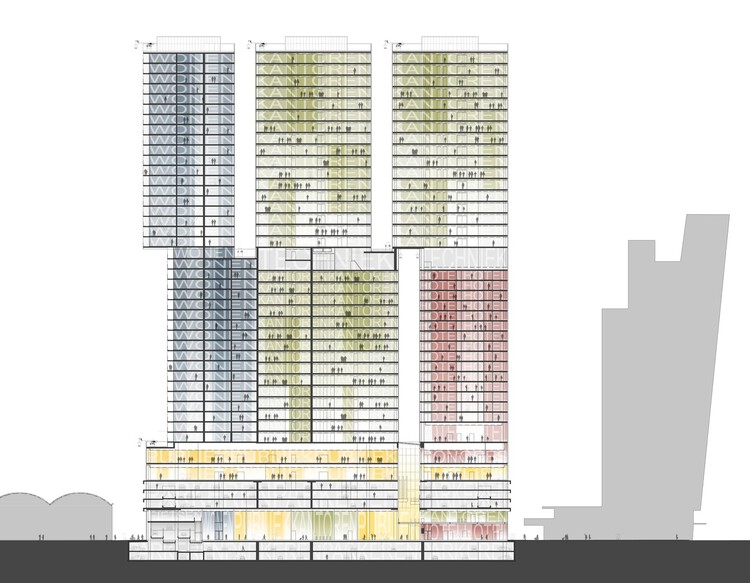 De Rotterdam / OMA. Image Courtesy of OMA
Rotterdam’s polder system depends on mechanical drainage, with pumping stations removing water that would otherwise accumulate and rise through the soil. Beneath the city, a layered network of channels, weirs, sluices, and retention basins regulates water levels with precision. Ring dikes divide the landscape into controlled zones, each managed as a discrete hydrological unit.
Foundation systems bypass unstable upper layers of peat and clay, with piles driven into stable sand strata below, while basements and underground parking are built as sealed structures engineered to resist groundwater pressure. For the residents participating in daily life on the street level, none of these systems is apparent. Architecture projects, including OMA’s De Rotterdam or the Zalmhaven complex, rely on deep foundation systems and controlled ground conditions to support large-scale, high-density construction on historically saturated land.
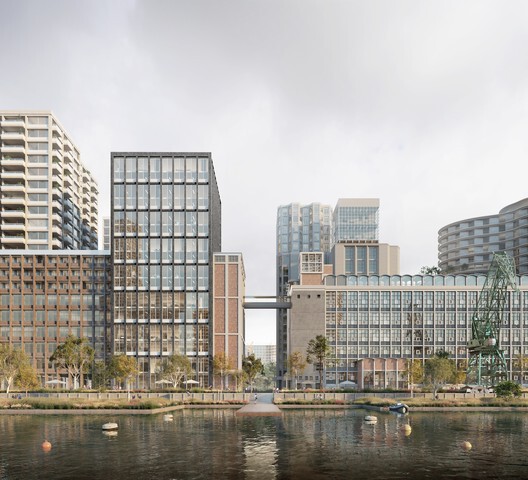 Powerhouse, Mecanoo and SHoP Join Design Team Reimagining Rotterdam’s Rijnhaven . Image © Filippo Bolognese
When water management is fully externalized to shared infrastructure, the architect is released from direct responsibility for it. The building no longer needs to negotiate with water because an extensive system has already done that work. This enables a particular kind of formal and programmatic freedom, so that buildings can be designed without continuous reference to the hydrological conditions underneath them. The architect’s work depends on a sustained reliability of systems located far from the building, maintained by institutions that will remain politically and financially functional for decades.
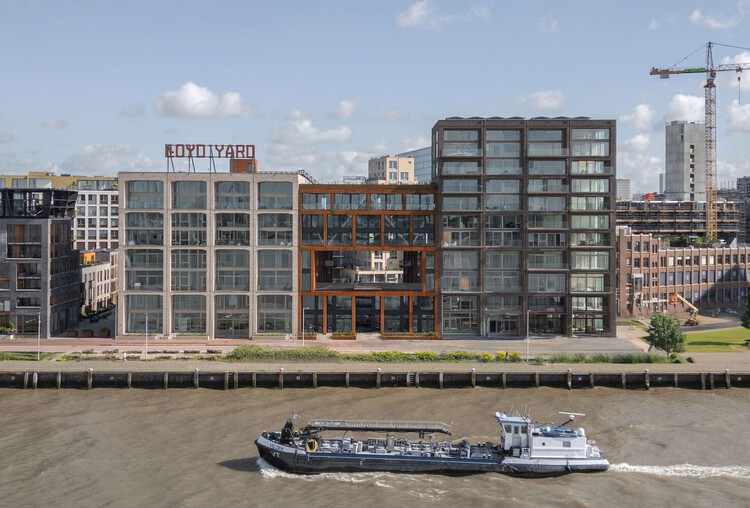 Lloyd Yard Rotterdam Block / WE architecten + Paul de Ruiter Architects + ZUS. Image © Aiste Rakauskaite
As climate conditions intensify, this dependence on external systems and the institutions that sustain them is exposed. Infrastructure can be reinforced and recalibrated, but it operates within physical and economic limits. The question facing architects that practice within this framework is less whether the model can continue and more what their buildings would be without it, and whether those buildings are being designed as if that question might one day need an answer.
Accommodation: Designing the Ground to Absorb Water
This approach treats water as a condition to be managed throughout the surface. The ground is designed to absorb, store, and release water over time, reducing pressure on centralized infrastructure. Instead of maintaining a fixed boundary between wet and dry, it accepts that this boundary can shift, and that those shifts can be made legible within the built environment.
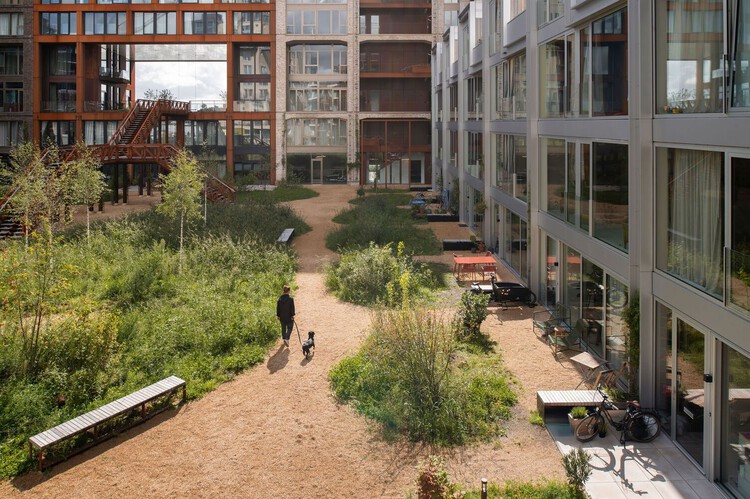 Lloyd Yard Rotterdam Block / WE architecten + Paul de Ruiter Architects + ZUS. Image © Aiste Rakauskaite
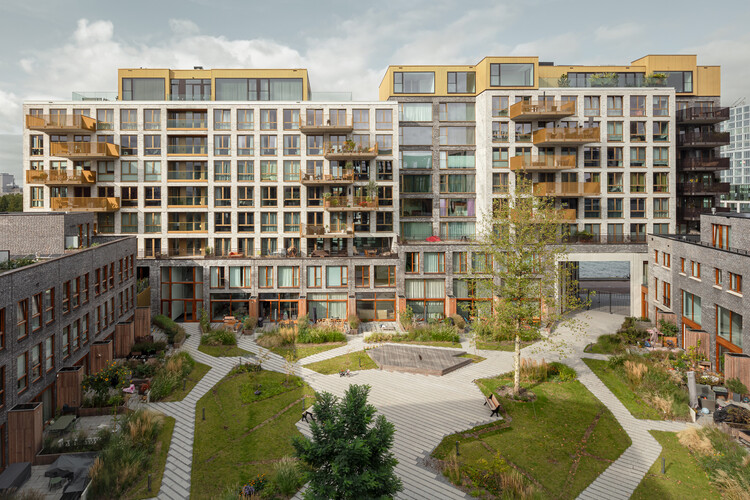 Eden District / Arons & Gelauff architecten . Image © Sebastian van Damme
On a dry afternoon, the Benthemplein water square in central Rotterdam reads as a thoughtfully designed public space with a series of terraced basins connected by ramps and lined with courts, seating, and circulation paths. Designed by De Urbanisten and completed in 2013, the square can hold 1.7 million liters of rainwater during heavy storms. When rainfall exceeds the capacity of the surrounding sewer system, water is directed into the basins, filling them in sequence and temporarily transforming the space.
Benthemplein represents a different design philosophy from the resistance model because it argues that the city does not need to be uniformly dry at all times. Across Rotterdam, a broader network of blue-green infrastructure, including retention basins, open water channels, permeable paving, bioswales, and green roofs, operates on the same logic. Each component is small in scale, but it alters how water moves through the built environment. Runoff water is slowed, distributed, and partially absorbed before it reaches the drainage systems, reducing peak loads and extending them over time, allowing the city to process the excess water.
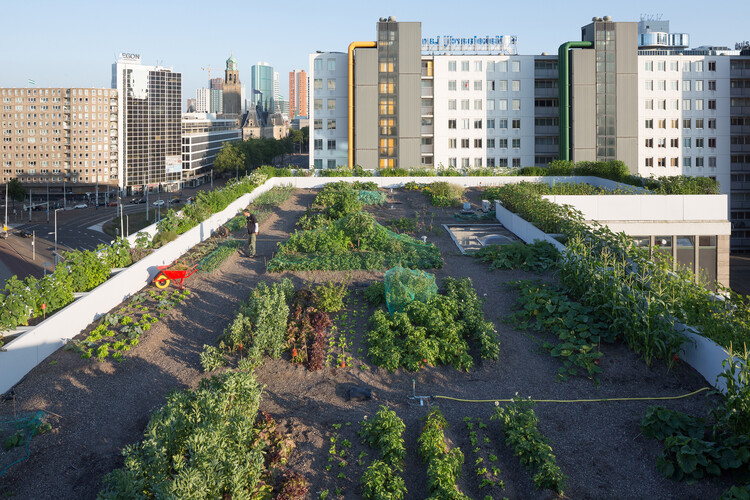 The Luchtsingel / ZUS. Image © Ossip van Duivenbode
The design consequences of this approach are less about structure than about where architectural attention is focused. Buildings in this system remain structurally conventional, while the significance is the ground plane, the edge condition, and the building’s interface with adjacent publicly managed spaces. A roof that retains rainfall, a paved surface that allows infiltration, or a threshold that redirects runoff into a planted channel are calibrated decisions about how a building participates in a larger hydrological system.
The distributed logic of the sponge city model yields measurable results only when it is aggregated across many actors and scales. A permeable landscape surrounded by impermeable surfaces cannot perform as intended, so private buildings, public space, and municipal infrastructure must operate in alignment. This raises questions about governance, maintenance, and shared responsibility that have no purely architectural answer and are not yet fully resolved in Rotterdam or elsewhere.
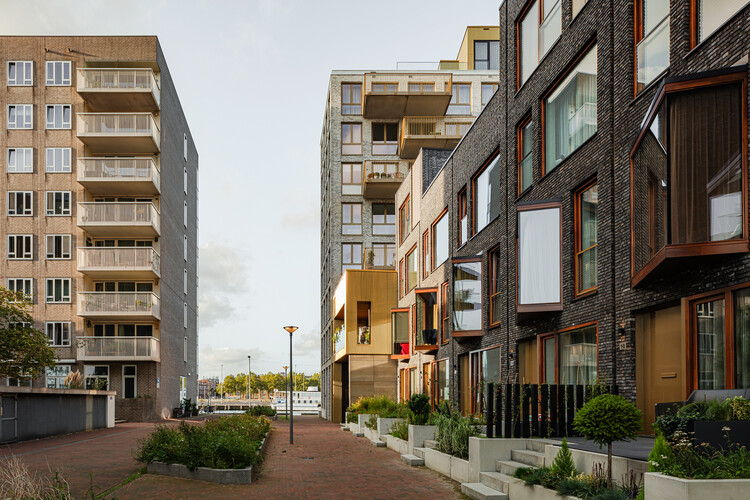 Eden District / Arons & Gelauff architecten . Image © Sebastian van Damme
What the accommodation model makes explicit, and what the resistance model tends to obscure, is that every building has a relationship to water. In this framework, that relationship is acknowledged and designed rather than deferred. For architects, this requires a shift in focus toward surfaces, edges, and transitions, where the interaction between water and the built environment is no longer hidden but actively shaped.
Acceptance: Buoyant Architecture Without a Fixed Ground
This approach removes the requirement for stable ground altogether. Rather than resisting water or redistributing it across the surface, it accepts fluctuation as a constant condition and develops buildings that operate in direct response to it. Ground becomes something to move through, rise with, and adapt to over time.
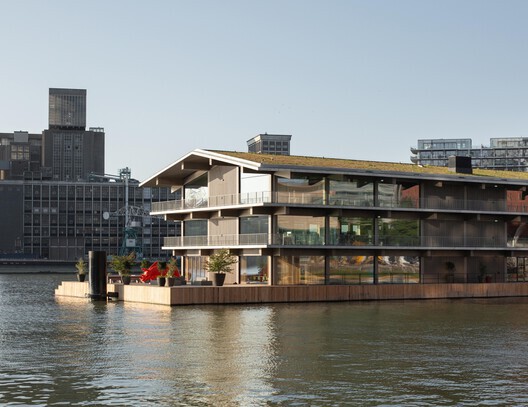 Floating Office Rotterdam / Powerhouse Company. Image © Marcel IJzerman
The Floating Office Rotterdam, completed in 2021 by Powerhouse Company in the Rijnhaven harbor, makes this position legible. The three-story timber building is supported by a series of concrete pontoons that function as a hull rather than a foundation. It rises and falls with changing water levels, draws thermal energy from the surrounding harbor, and generates power through rooftop solar panels.
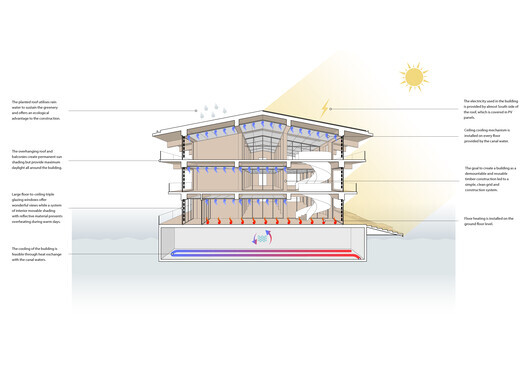 Floating Office Rotterdam / Powerhouse Company. Image © Marcel IJzerman
Less visible, but more consequential, is how this condition reorganizes the design process. On land, loads can be distributed with relative freedom within a structural system. On water, weight distribution directly determines buoyancy and stability, meaning that massing and material decisions carry hydrological consequences from the outset. Utility connections for water, power, and waste must accommodate continuous vertical movement through flexible joints and slack systems. Acoustic behavior shifts as vibration travels through a hull rather than a slab, requiring different detailing strategies. Maintenance introduces another layer of complexity, as the submerged structure must be inspected and protected against corrosion and biological growth. These constraints are manageable, but they expand the range of considerations to integrate into the earliest stages of design.
Within this category, a distinction can be made between fully floating buildings and amphibious structures. Floating buildings remain on the water at all times, while amphibious buildings rest on the ground under normal conditions and rise only when water levels increase. While both typologies reduce dependence on fixed ground, they reflect different assumptions about the frequency and severity of flooding. In the Dutch context, amphibious housing demonstrates how buildings can remain in place during periodic inundation, using buoyant foundations and adaptable service connections to accommodate vertical movement.
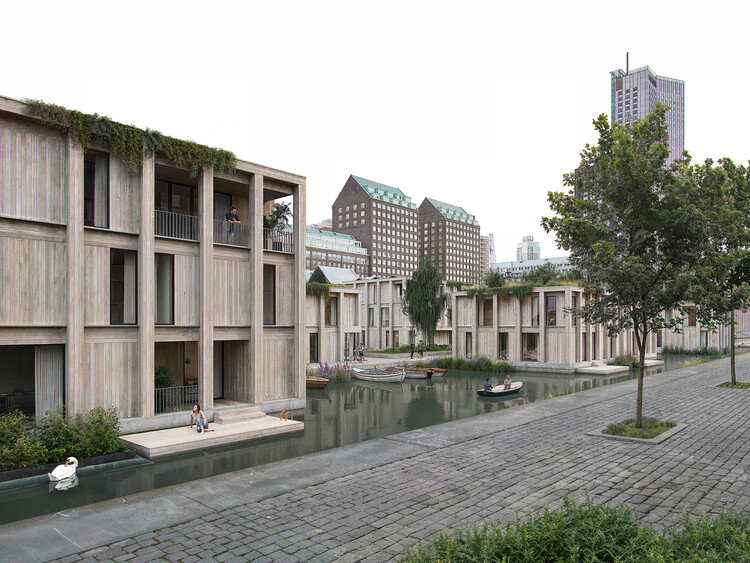 MAST and BIK bouw floating neighbourhood design for Spoorweghaven. Image © Slim Studio
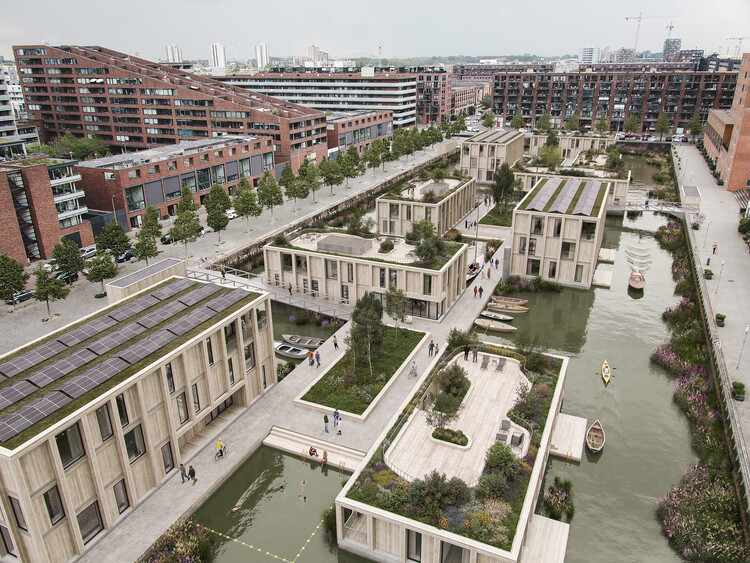 MAST and BIK bouw floating neighbourhood design for Spoorweghaven. Image © Slim Studio
At the scale of housing, floating and water-based developments propose an alternative model for inhabitation. Circulation paths shift from streets to docks, access is mediated by gangways, and the relationship between interior space and exterior environment is defined by proximity to water rather than elevation above it. Projects in Rotterdam’s harbor areas show that these are permanent arrangements organized around a fundamentally different understanding of what a site is.
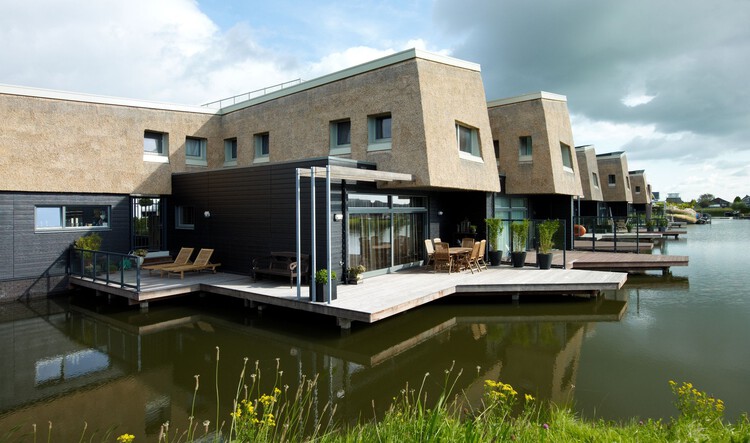 9 Houses on the Water / BLAUW architecten, FARO Architecten . Image © Jeroen Musch
Scaling this typology to the neighborhood or urban level, however, exposes the degree to which the built environment’s connective tissue was designed for solid ground. A floating building can be connected to land-based utilities through flexible tethers. However, a floating neighborhood requires a floating utility spine, a shared infrastructure layer that must itself accommodate movement, remain accessible for maintenance, and connect to land-based systems at boundaries that shift with the tide. Emergency access is complex and difficult, as the loads and turning radii required by fire and ambulance vehicles cannot simply be translated onto the logic of docks and pontoons.
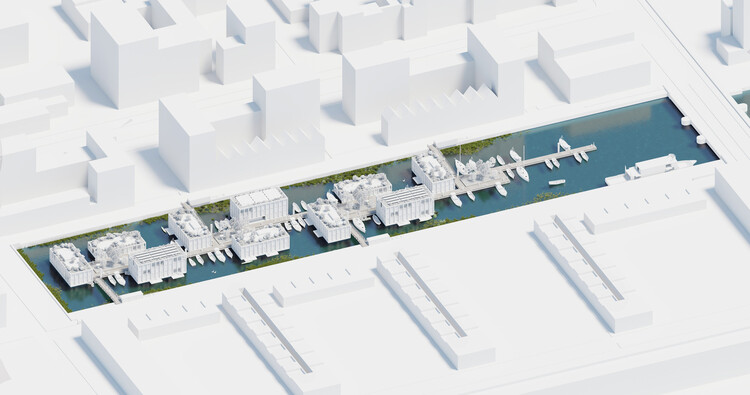 MAST and BIK bouw floating neighbourhood design for Spoorweghaven. Image © Slim Studio
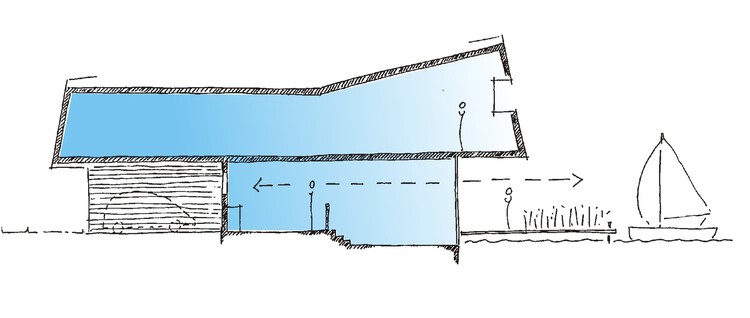 9 Houses on the Water / BLAUW architecten, FARO Architecten . Image © Jeroen Musch
Density is constrained by buoyancy in ways that have no land equivalent, since stacking mass vertically on water requires a fundamentally different structural and ballast logic than building tall on ground. Insurance and mortgage financing add pressure from another direction as floating buildings frequently fall into a regulatory gap between maritime law and building codes, making them difficult to finance through conventional instruments and expensive to insure. The Spoorweghaven proposal in Rotterdam represents an attempt to think through these problems at the neighborhood scale, but the project makes visible how much of the supporting framework, legal, financial, and infrastructural, still remains unresolved.
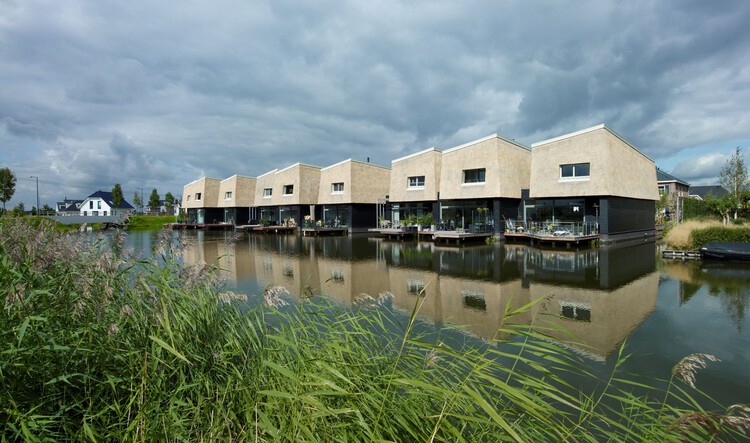 9 Houses on the Water / BLAUW architecten, FARO Architecten . Image © Jeroen Musch
The acceptance model asks the most of the architect in terms of assumptions relinquished. The certainty engineered in the resistance model and redistributed in the accommodation model is replaced by a direct engagement with change. Buildings perform by moving with their environment rather than holding it at bay. The gaps that remain are not only technical but institutional. Yet the projects already operating in Rotterdam’s harbor demonstrate that the architecture is ahead of the systems that support it. The challenge now is not to prove that it can work, but to build the regulatory, financial, and infrastructural context that allows it to scale.
Building Below Sea Level
Rotterdam has not resolved the challenges of building below sea level, and it does not claim to. Hard infrastructure is under increasing strain as conditions exceed the assumptions it was designed for. Blue-green systems show promise but depend on levels of coordination and governance that are still developing. Floating architecture remains limited by regulatory frameworks and financial uncertainty. These approaches do not focus on eliminating risk from saturated groundwater and flood risk environments, but begin to redistribute that risk, shifting how responsibility is shared across buildings, systems, and institutions.
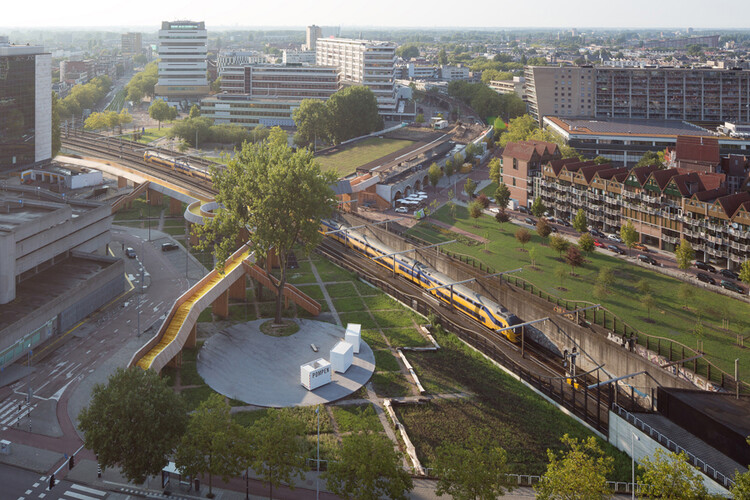 The Luchtsingel / ZUS. Image © Ossip van Duivenbode
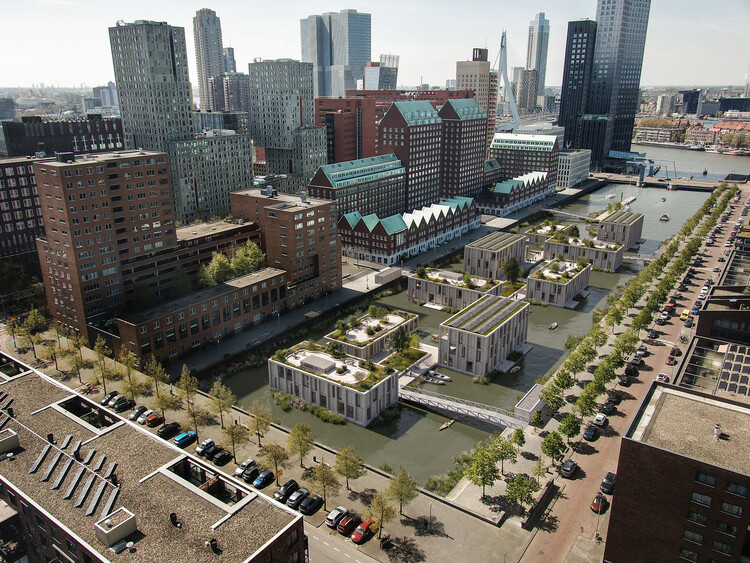 MAST and BIK bouw floating neighbourhood design for Spoorweghaven. Image © Slim Studio
For architects working in coastal regions, and the number of cities facing conditions similar to Rotterdam continues to grow, these approaches are not local anomalies. The resistance model maintains separation from water but relies on collective infrastructure that must perform without failure. The accommodation model accepts periodic wetness and asks buildings and landscapes to manage it directly, extending design responsibility beyond the footprint of a single project. The acceptance model removes the need for fixed ground, allowing buildings to adapt to fluctuating water levels while introducing new operational and technical demands. Each position carries trade-offs that must be understood rather than avoided.
What Rotterdam makes clear is that the relationship between a building and the ground is an active design decision with consequences that extend beyond the site. While the city does not offer a singular answer to this global challenge, it does provide clarity. Across its projects, architects are defining positions that acknowledge uncertainty and work within it to promote innovative, unconventional approaches. As climate conditions continue to shift and coastal environments become less predictable, this level of clarity and cooperation becomes a form of practice in itself, one that architects and planners will increasingly adopt.
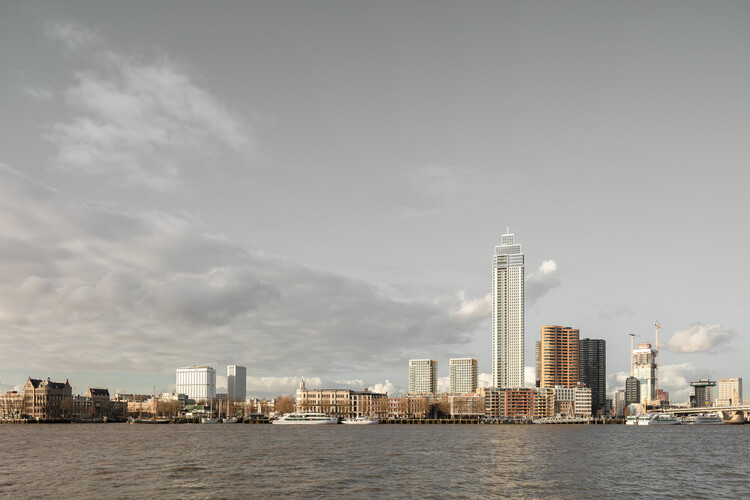 De Zalmhaven Residential Complex / KAAN Architecten + Dam & Partners Architecten. Image © Sebastian van Damme
This article is part of the ArchDaily Topic: Light, Lighter, Lightest: Redefining How Architecture Touches the Earth, proudly presented by Vitrocsa, the original minimalist windows since 1992.
Vitrocsa designed the original minimalist window systems, a unique range of solutions, dedicated to the frameless window boasting the narrowest sightline barriers in the world. Manufactured in line with the renowned Swiss Made tradition for 30 years, Vitrocsa’s systems “are the product of unrivaled expertise and a constant quest for innovation, enabling us to meet the most ambitious architectural visions.”
Every month we explore a topic in-depth through articles, interviews, news, and architecture projects. We invite you to learn more about our ArchDaily Topics. And, as always, at ArchDaily we welcome the contributions of our readers; if you want to submit an article or project, contact us.