
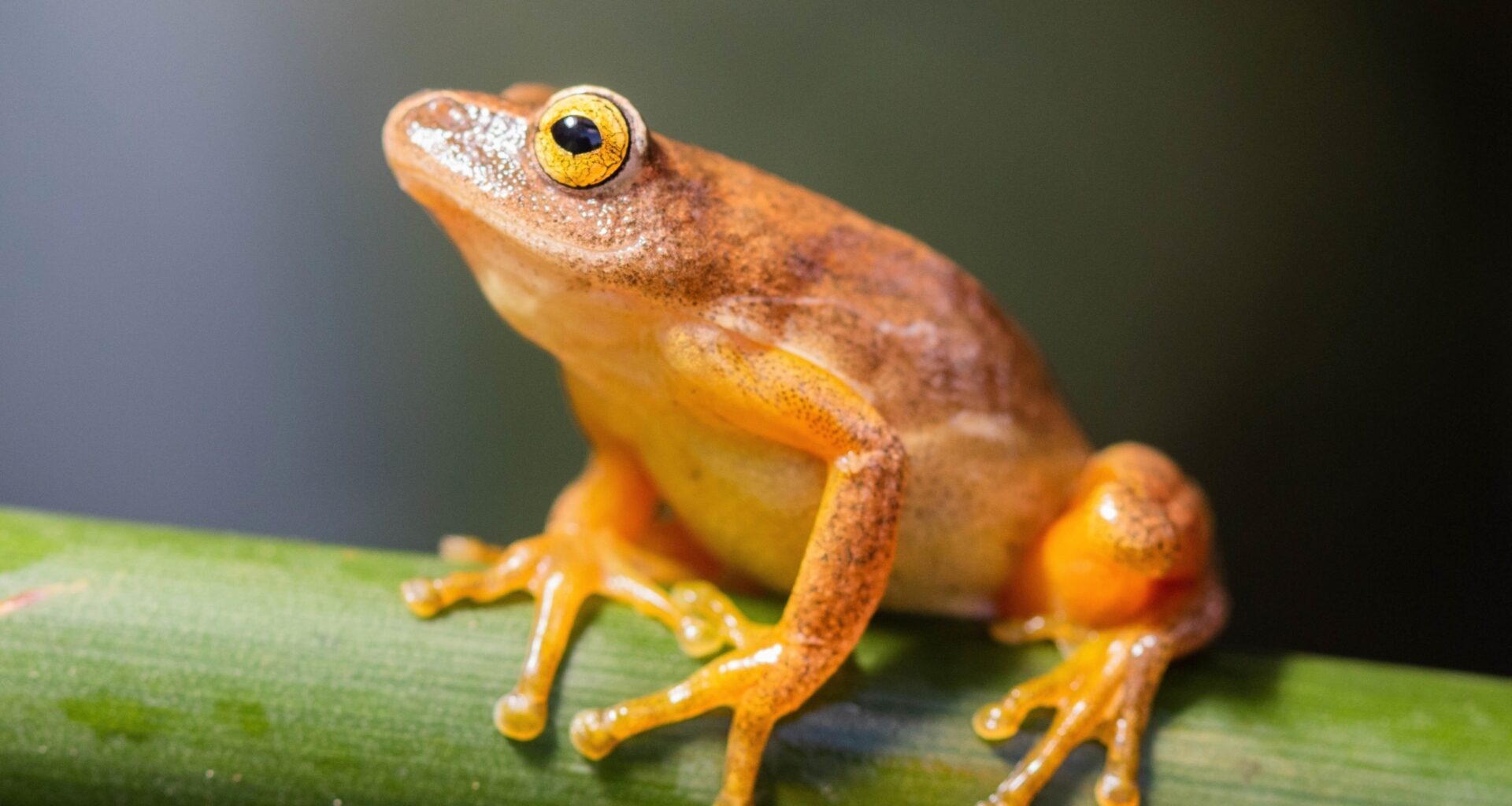
Frogs are everywhere in Central Africa’s rainforests, yet not all forests have the same mix of them.
Step into these dense green spaces and everything feels steady and timeless. Thick canopy, humid air, and the constant sound of life suggest nothing has really changed.

But that calm surface hides a long and messy history. The forests we see today are not the same ones that existed thousands of years ago.
One of the biggest surprises is that frogs still carry the mark of that past. Their diversity is uneven. Some areas are packed with species, while others, just as warm and wet, seem oddly quiet.
It turns out the answer doesn’t lie in what the forest looks like now, but in what it went through during the last ice age.
When forests broke apart
During the peak of the last ice age, global conditions were cooler and much drier. Forests that stretch continuously today didn’t always look that way.
“When the glaciers were at their maximum global extent, the earth’s climate was cooler and drier, and forests that are continuous today contracted to what were essentially islands in a sea of savannah,” said Gregory Jongsma, the acting curator of Zoology at the New Brunswick Museum.
These forest “islands,” known as refugia, served as safe havens where plants and animals could persist while surrounding landscapes became too harsh to support them.
A closer look at frog diversity
Years later, researchers began to notice a pattern that didn’t quite add up. Some lowland forests that looked perfect for frogs had surprisingly few species.
Others, not much different at first glance, were packed with them. Even more curious, certain species lived only in small, scattered pockets.
This led scientists to ask a basic question: Are frogs distributed based on today’s environment, or are they still shaped by ancient conditions?
Jongsma, working with researchers from the Florida Museum of Natural History, focused on a major group of African frogs called Afrobatrachia. This group includes more than half of all frog species on the continent and covers a wide range of lifestyles.
Some live high in the trees, others underground. Some rely on water to reproduce, while others skip the tadpole stage entirely.
That variety made them ideal for testing how environment affects diversity.
The limits of the present
At first, the team considered the obvious explanation. Areas with more rain and higher temperatures should support more species. That idea works in many parts of the world.
“There are two competing hypotheses when predicting diversity,” Jongsma said. “The ecological hypothesis says species are essentially in equilibrium with current conditions.”
“Therefore, if there’s high rainfall and temperature or productivity, you’re going to have high diversity.”
But that theory didn’t hold up here. Some areas with ideal conditions still had low diversity. It became clear that something else was at play.
Looking back millions of years
The team turned to the past. They built a climate map covering the last 2.58 million years, using data from ice cores, fossil records, and ancient sediments. These sources reveal how temperature and rainfall shifted over time.
Then the researchers added another layer. They modeled the distribution of several common frog species to understand how climate affects where frogs can live today.
With that information, the research team could estimate where suitable habitats existed in the past.
“They’re common, widespread, and largely co-distributed, so there’s enough data there to build a really robust model of their distribution,” Jongsma said.
This approach allowed them to connect ancient climate patterns with modern frog diversity.
Refugia as centers of life
The results pointed straight to the refugia. Areas that stayed relatively stable during the ice age now hold the highest diversity of frogs.
These same regions also have many species found nowhere else. Why would that be?
Part of the answer comes down to time. Even though the last ice age ended about 12,000 years ago, that’s not very long in evolutionary terms. Frogs may still be spreading out from those safe zones, and the process is far from complete.
The other reason is isolation. When forests broke into separate patches, frog populations became cut off from each other. Over time, those isolated groups evolved into new species.
“Refugia have been proposed as species pumps,” Jongsma said.
A legacy that still matters
Some frogs eventually moved back into newly expanded forests once the climate warmed. Others stayed put, which explains why certain species remain tightly confined to specific areas.
This pattern is not unique to frogs. Many plants and animals show similar distributions tied to ancient refugia. It’s a reminder that today’s ecosystems are shaped by events that happened long before humans were around.
The findings also carry weight for conservation. Protecting land based only on what looks rich in life today may miss areas that have quietly supported biodiversity for thousands of years.
“All of the countries where this study was conducted have signed on to the 30X30 goal, which is an initiative to conserve 30% of their country’s land area by 2030,” Jongsma said.
“If you’re going to expand a protected area or create a new one, considering where forests have been most stable might be an important consideration, depending on what you’re trying to conserve.”
The rainforest may look unchanged, but its past still shapes where life thrives. Frogs, in their small and scattered worlds, tell that story better than most.
The full study was published in the journal Ecology and Evolution.
—–
Like what you read? Subscribe to our newsletter for engaging articles, exclusive content, and the latest updates.
Check us out on EarthSnap, a free app brought to you by Eric Ralls and Earth.com.
—–