
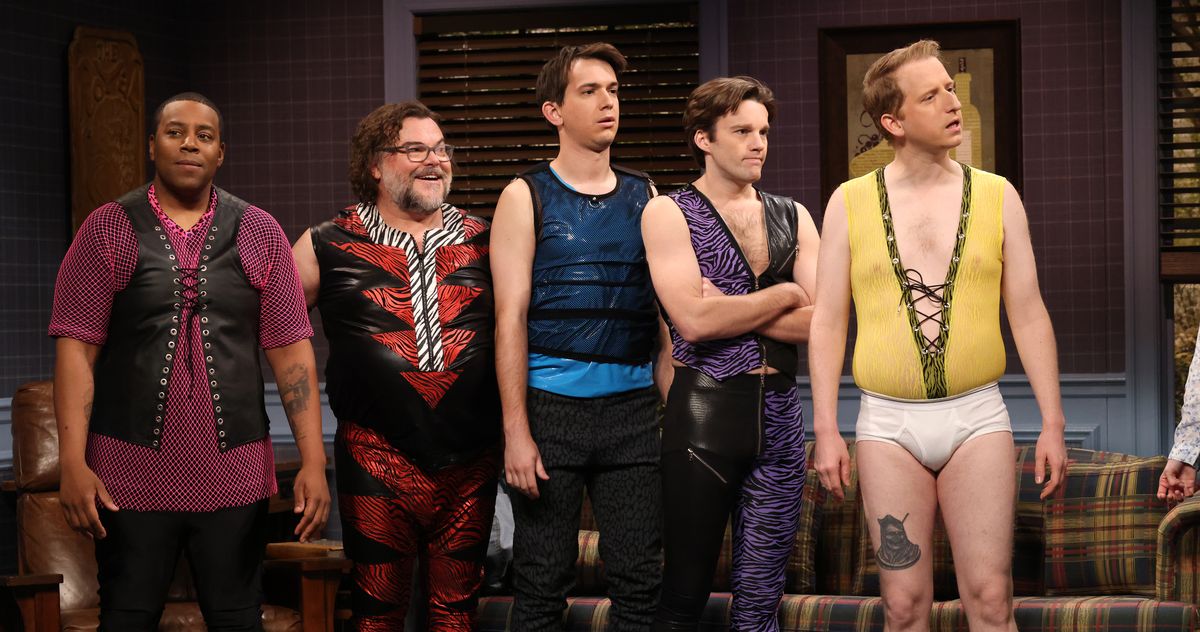
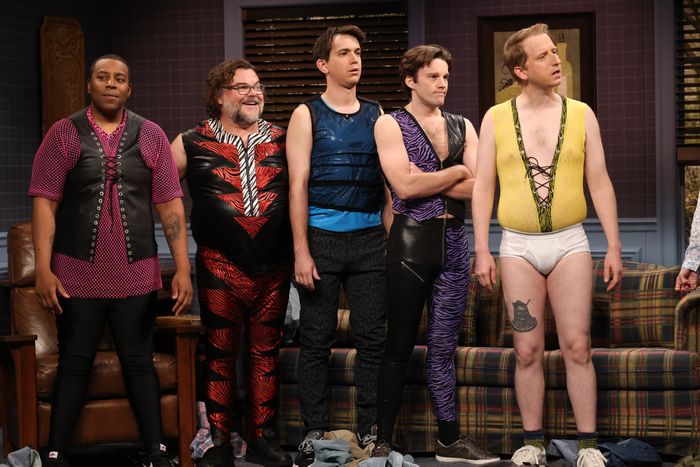
“Some of the guys peek through their fingers when they see those photos. When they made the wardrobe change in the sketch, I thought, Perfect.”
Photo: Will Heath/NBC via Getty Images
You don’t really know which direction Saturday Night Live’s “Husbands” will go until more than a minute in. In the sketch, a group of five men — forced to spend time together so their wives can socialize in the kitchen — seemingly have nothing in common and are destined for an afternoon of drinking beer in silence. Is this commentary about the male-loneliness epidemic? Will they ever find something to talk about? Actually, they do in their own special way: Encouraged by host Jack Black’s character, they all discover the bonding power of Kansas’s hit 1976 opus “Carry on Wayward Son,” progressively performing more of the verses until they strip down to their rock-and-roll jumpsuits for a grand finale. It’s crazy that they all know the song to begin with. “I actually don’t,” Kenan Thompson’s husband character admits, “but my mouth seems to.” It’s very much a love letter to one of the defining songs in the classic-rock canon and further proof that the United Nations should perhaps give air-guitar diplomacy a shot.
Rich Williams, Kansas’s guitarist and one of the band’s original members, was quickly alerted to the sketch’s existence after it aired this past weekend. “There’s always a good and bad side to things. Everybody I know is sending me the clip,” he says. “So it’s a nice problem to have, I’ll say that.” He was surprised, of course, by the sheer randomness of the premise, mostly because of the reputation Kansas has built for itself over the past five decades. “We’ve always been seen as a really serious band,” Williams explains. “As far as our career, we were serious about it, but we’re not made of stone. We laugh all the time. We have a lot of stupid inside jokes and our own language. But to be a part of something like this is just wonderful.” The sketch’s timing adds another layer of significance from Williams’s perspective, as both Kansas and SNL recently marked their respective 50th anniversaries. “It’s another feather in our cap that adds to our legacy,” he adds. “We’re still out there and working, but to be acknowledged by an institution like Saturday Night Live? Wow.”
I have to ask: Why did you drop the “my” in the title? Shouldn’t it be “Carry on My Wayward Son”?
Wow. That’s a good question, and I can’t answer that. Maybe those two letters filled up too much room on the disc.
Fair enough. Of all of the scenarios of Kansas’s music appearing on SNL, did this sketch at all align with what you were hoping for?
I’ve seen so many parodies and interpretations of our work — a capella, jug bands, all kinds of stuff. So when I first watched the sketch, it made sense to me that they would go in that direction. But still, I was like, Wow. It keeps going and going. We got a lot of air time, and that was fantastic.
It made me think back to recording our second album, Song for America, and how both Kansas and Saturday Night Live were born almost at the same time. They were about a year after our first record, so we have a lot of shared history in Americana in general. To be acknowledged in a sketch in a funny way felt nice. It wasn’t mocking us. It was very cool. And Jack Black is one of a kind. He’s very serious, but he’s very talented. He’s a jack of all trades. His role in Tropic Thunder? I don’t know too many actors that can take things so far as he can. To see him involved in that sketch gave it a lot of credibility, because he’s a musician himself.
“Dust in the Wind” and “Carry on Wayward Son” would’ve been a sick double header of songs if Kansas was a musical guest back in the ’70s. Did the band ever try to get that gig?
It’s a little fuzzy to me now, but it was talked about; it just never worked out. We never got to be on The Tonight Show with Johnny Carson, either. The Dixie Dregs got to be on with Johnny, but not us? Seriously? We instead got opportunities to do the Today show. It’s like, No, no, no, I don’t want to go on early in the morning with the morning crew and do that shit. It wasn’t the right venue for us. Don Kirshner was our manager, and he was such a New York guy, so I’m surprised Saturday Night Live never came up.
Take me back to the beginning with this one. When during the Leftoverture sessions was the song presented, and was it obvious that it had a star quality?
We were based in Topeka, Kansas, at the time, and in rehearsals working on the new album. We had more material than we needed, so we had to start culling things out. Kerry Livgren was on quite a writing streak; he was walking in almost every day with a song. We had the last day of rehearsals before loading up the truck for the recording studio down in Bogalusa, Louisiana, and we figured we’ll just start packing up equipment. But then Kerry came in and said, “I’ve actually got one more song.” Listen, we were tired of that part of the process. We felt good that we had a good record. But he insisted on explaining this new song, and he went through “Carry on Wayward Son” with a few verses with the guitar. I was like, This has some promise. This is a good song. None of the structure was there, and it was extremely bare bones.
So when we get down to the recording studio a few days later, we’re laying down each song until we realize, “Well, we’ve got that new song we haven’t really learned yet. Should we try to arrange that ‘Wayward’ one?” After four or five takes, our producer goes, “I think we’ve got the one.” That song was put together and learned by the band in the studio in a short amount of time. We rolled tape, and the version on the record is, to my estimation, the first time we ever played it correctly. I love my quirky little solo. It’s hook after hook after hook. It’s definitely a guitar and vocal song. We pretty much knew it was going to be a hit.
Were you influenced by anything in particular for your quirky little solo?
It’s kind of a weird influence, but I was a big Gentle Giant fan, and they do so much point-counterpoint where somebody will fill in a hole. It’s not playing with musicians, it’s playing around musicians. I was listening to a lot of their stuff at the time and wanted to take that theory and put it to practical use.
Who did you consider to be your peers and influences at the time? I never really considered Kansas to easily fit into either the “prog rock” or “arena rock” boxes, but you all were doing something unique that not many bands in America were replicating.
The first band I was in was with Phil Ehart, our drummer, and we played a lot of Motown and Young Rascals. But then King Crimson came out and it was like, Whoa, what in the world is this? The funny thing is, I don’t know what progressive music was called at the time. But what we now know as “prog rock” was Emerson, Lake & Palmer and Jethro Tull, who were big influences for us. Jethro Tull’s Thick as a Brick changed everything. You’re telling me you can use a flute as a main instrument? The formula of what American music was at that time was pretty simple. Nothing wrong with that. But all of a sudden, Jethro Tull threw the box away, and we started recreating it. We looked at Britain. What the early British prog movement taught us — especially early Deep Purple, when they put all these preludes to their songs — was that we didn’t have to sing about certain topics. We don’t have to play with certain time signatures. We don’t have to play under three minute songs. It opened our eyes to just be ourselves.
Did you ever have a penchant for wearing rock-and-roll jumpsuits? Did the Kansas boys enjoy some flashy looks?
I wish we stayed with what we started with, which was blue jeans and t-shirts. But as things progressed, we had pressure to have “stage clothes,” and we refused to have a wardrobe expert dress us. So a bunch of hicks from Topeka were left up to our own devices of going down to Robert Hall and finding something that might be kind of cool. I mean, I was wearing overalls back in the ‘60s, which was kind of a hippie thing to do. So the first album I was in overalls, but as it went on, suddenly I went the other way and went into a tuxedo. I wore a tux onstage all the time.
But everybody picked their own thing. Kerry was wearing these jumpsuits his wife made that looked like green silk — sleeveless v-necks, very space age, and Captain Kirk-type wear. When I look back on our wardrobe changes over the years, it’s like, Wow, we were stupid. It’s embarrassing. I’m in a tux, and while it was kind of goony, at least I could go anywhere and fit in. But some of the guys peek through their fingers when they see those photos. When they made the wardrobe change in the sketch, I thought, Perfect.
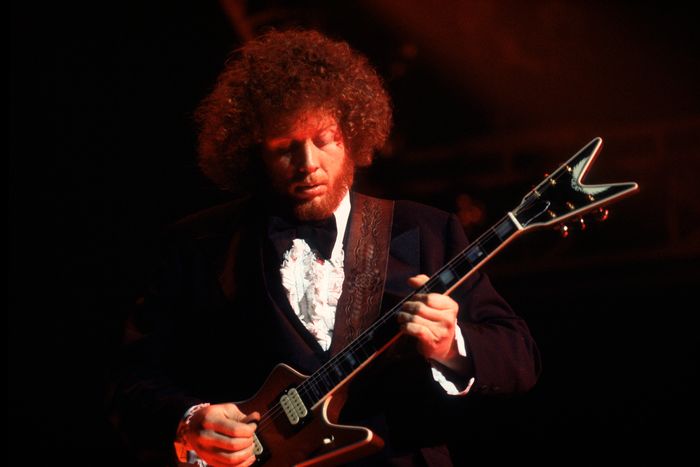
Williams in his signature tuxedo from the early ’80s.
Photo: Paul Natkin/Getty Images
I realize you all weren’t twirling ribbons around during your gigs like Jack Black’s character, but did you all have pyrotechnics or design features that you favored while touring?
We did get a little caught up in certain things. We had lasers for a while. But it was expensive and often required an inspector to come into certain venues. So we wound up paying for the laser every night, whether or not we ended up using it due to the inspector’s report.
We did pyro for a while. It was dangerous. Robby Steinhardt’s hair caught on fire once. There was a flash pot that went off right behind him, but he was too close to it. He had a haystack of hair, and it was completely on fire. I had to beat him in the back of the head with a towel. It melted into a plastic clump. Let me tell you, it doesn’t smell good when you’re burning ten pounds of hair. It’s a whole other animal.
I have to blame or thank Genesis for the pyro. We started using it because the first time I saw anything like that was when we went, as a band, to see Genesis in Kansas City. It was the Selling England By the Pound tour. A top-five concert of my life. There was one point in the set where, all of a sudden, a flash pot went off, and I had never seen one before. We were all near the back of the venue, and my first thought was somebody had just shot me in the face with a gun. Then as my eyes cleared and my heart stopped leaping, it had gone back into the theme of the song, and it was fascinating. So then pyro was part of our shtick.
Genesis had good lighting, too. It was all very theatrical. It was like going to a Broadway play — each scene, or song, was carefully crafted to create mood. When we all left the show, we were like, We should maybe lean into lighting our stage like those gentlemen from Genesis.
I remember talking to Steve Hackett a few years ago, and he had a lot of pride in saying that one particular song of theirs, “The Carpet Crawlers,” made grown men weep in the bathrooms when they heard it. Have you observed a specific reaction to “Carry on Wayward Son” when you perform it that other Kansas songs can’t replicate?
There’s a lot of crowd participation. We generally save that song for last because it’s a tough one to follow. It’s interesting, because about a decade or so ago, we realized there were a lot of young kids in our audience in the front row. Where were they coming from? It was confusing, and we didn’t understand it. So after one show, I went out and talked with them. I said, “How do you guys know all this stuff?” And they responded, “Supernatural, sir.” I never watched it but knew it existed. They used the song in every season, and it became the unofficial theme for Supernatural. That was a big thing that got us back into a crowd. It’s kind of odd to have grandparents, parents, and their children all together at a show who listen to the same music, but it’s an accolade that the music lasted all this time.
People will talk about how things just aren’t the same anymore. When we made our records, if the wheels fell off the wagon at the end, we’d have to do it again. We were under fire, the clock was ticking, and money was burning. Producers were looking at their watches and asking us, “When the fuck are you going to get this right?” It was all a very organic and intangible process, which doesn’t happen today in much of modern music. It’s all kind of homogenized. So much of it is computer generated. You don’t have to be a “musician” anymore. When machines play everything perfectly, it sucks the soul right out of everything.
An amusing coincidence is that “Carry on Wayward Son” and “(Don’t Fear) the Reaper” were released within months of each other in 1976, the latter of which, of course, was the source of one of SNL’s most defining sketches. Was there a sense of jealousy among bands of the era that Blue Oyster Cult got this renaissance?
I thought it was hilarious when I watched it, but I felt bad because it seemed like it was making fun of the band. Christopher Walken played one of the strangest and craziest characters of all time. He can read a phone book and have you mesmerized, confused, or laughing your ass off. Some of it was a little bit too true from the perspective of the band’s side. I heard early on that they weren’t really pleased with it. But it’s one of the best things that ever happened to them. One of the first bands we ever played with was Blue Oyster Cult, and we did a show together in southeastern Kansas. They blew our tweeters out of our PA system right away.
Let’s say you and the fellas are kicking back in another room while your wives are socializing. What’s the song you all will most likely start spontaneously singing and doing air guitar to?
“Funk #49,” by James Gang. Which was a song I played back in one of my early bands.
Related