
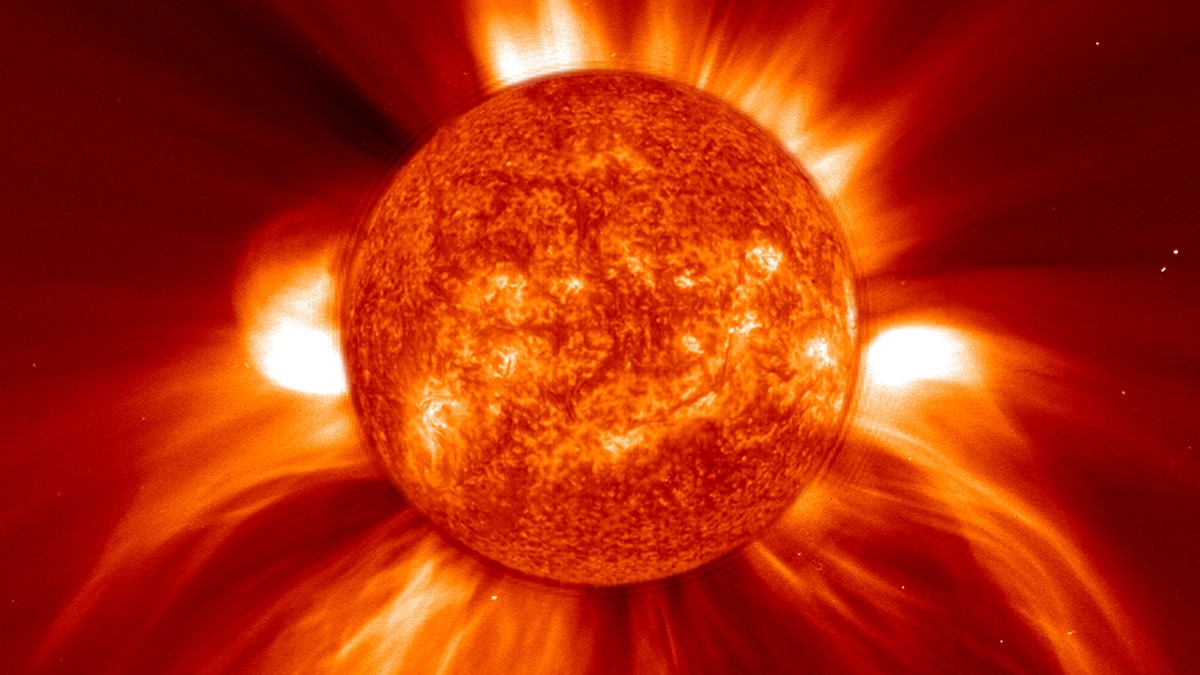
The Artemis II crew’s vessel, Orion, is the first vehicle designed explicitly to deal with risks like high-energy proton flurries. The uncrewed Artemis I mission, which flew around the moon in 2022, carried sensors that measured radiation levels all over the craft, providing potentially life-saving information during its sojourn through space. Orion was designed with both a dedicated storm shelter and special shielding to absorb radiation, and sensors onboard the spacecraft are measuring radiation levels throughout the mission.
“We gained a lot of confidence in our models and systems,” says Stuart George, a physicist at NASA’s Johnson Space Center in Houston who helps to measure and mitigate space weather effects. “It’s a really good vehicle from a radiation point of view.”
What are the dangers from space weather?
The Orion spacecraft is facing three types of space radiation as it travels from the earth to the moon and back. Such radiation acts as subatomic shrapnel, shredding human tissue and DNA and leaving behind ions that can cause molecular chaos inside the body.
Even before they left the part of space dominated by Earth’s magnetic field, the Artemis II crew passed through the Van Allen Belts, two donut-shaped regions extending between 600 to 60,000 kilometers above the planet (that’s higher than the International Space Station flies). These belts are filled with fast-moving protons and electrons trapped by the Earth’s magnetic field. While such particles can be as harmful as those encountered during a big solar storm, Orion zipped through the belts in less than an hour, limiting the crew’s exposure.
The second hazard comes from galactic cosmic rays—atomic nuclei, protons, and electrons jetting through space at significant fractions of light speed. Thought to be expelled by distant exploding stars, cosmic rays are especially dangerous because shielding against them only makes things worse. As these ultra-fast thermonuclear bullets slam into the body of a spacecraft, they cause tiny explosions and unleash a cascade of additional energetic particles, each of which can damage human tissue.