
Here’s what you’ll learn when you read this story:
A leading theory posits that life originated in prebiotic volcanic hot springs where the right mixture of elements, water, and energy drove chemical reactions to form the first protocells.
To test this hypothesis further, a new study 3D-printed an elaborate system designed to mimic hot spring fields on ancient Earth.
When testing the system, the team was able to form vesicles that encapsulated introduced RNA, essentially forming crude protocells.
Despite humanity’s ongoing quest to discover extraterrestrial life, the only organisms (microbial or otherwise) we’ve found so far are right here on Planet Earth. Detecting life beyond this Pale Blue Dot might be easier, however, if we knew exactly how and where life got started here at home—to find something, after all, you’ve got to know what you’re looking for in the first place. The search for life’s remains an unsolved puzzle for now, but several leading hypotheses have slowly but surely emerged over time.
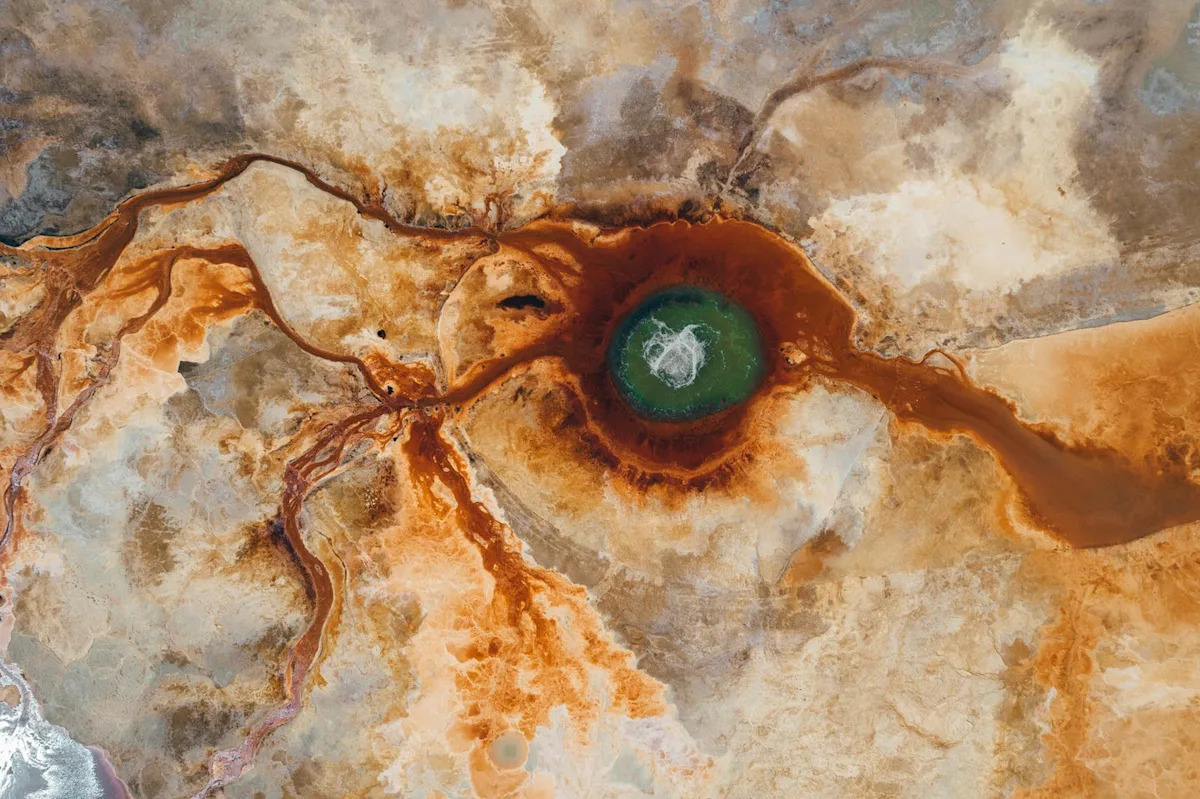
One of those, known as the “Hot Spring Hypothesis,” posits that the cradle of life as we know it was a collection of volcanic hot springs that hosted the necessary chemical elements, water, and energy to power reactions to eventually gave rise to protocells. A key piece of this theory is a process known as wet-dry (WD) cycling. Over time, scientists have found that crucial polymers (such as RNA and peptides) can be synthesized through WD cycling, as dry phases drive condensation reactions while wet phases promote molecular diffusion. In laboratories, this process has been shown to create the conditions necessary for primitive metabolic activity and a progenote system—a currently hypothetical pre-biotic stage of life that includes life’s pre-cellular Last Universal Common Ancestor, or LUCA.
Testing the Hot Spring Hypothesis, however, is tricky, as studies are often limited to simulating WD cycling within a single pool. But in a new study—published in the journal Astrobiology—a team of researchers from the University of New South Wales and Curtin University in Australia took things one step further. They meticulously 3D-printed an entire system of chemical pools to simulate the ancient hot spring fields that might’ve given rise to early life.
“Extant hot spring fields commonly comprise multitiered pool networks interconnected by natural surface channels and subsurface vein networks, with fluid flow driven by gravity, splashing geysers, and periodic evaporation–precipitation cycles,” the authors wrote. “Previous investigations have focused on mimicking WD cycles within a single pool, which precludes simulation of many hydrothermal field conditions, such as different mineralogies and variable temperature, pH, and water flow within and between multiple hot spring pools.”
The system contains an array of 3D-printed cups controlled by an Arduino Uno, which allowed researchers to independently manage temperatures in each “pool”—some pools were heated to near boiling, while other nearby pools remain lukewarm, which mimics real-life hot spring fields. To test the system, the researchers aimed to create lipid membranes known as vesicles (crucial ingredients for these early protocells) by repeatedly drying out and refilling the pools (a.k.a. WD cycling), each of which were lined with fatty acids present in meteorite samples. Not only did the system produce these vesicles, but it eventually showed evidence of enveloping introduced RNA molecules to essentially form crude protocells.
“This model hot-spring pool simulator is ideally suited for experiments focused on understanding protocell formation and polymer encapsulation studies,” the authors wrote. “The modular nature of the simulator will allow for more advanced prototypes to be designed and tested for future experiments with the aim of bridging geochemical complexity with prebiotic chemistry.”
Further confirmation of hot springs as viable candidates for the formation of life would potentially have huge consequences for the search for life beyond our planet. After all, the rules of physics are the same throughout the universe, and what happens here can technically happen anywhere—as long as you have water, chemicals, and energy, that is.
You Might Also Like