

Zuhair Rajabi is not packing.
Late last month, Rajabi, who describes himself as “the spokesperson” of the Batn al-Hawa section of the East Jerusalem neighborhood of Silwan, received an eviction notice ordering him to vacate his home. Several neighbors were also told they would need to leave.
His home, where he has lived all his life, was built by his father in the early 1960s, when the area was still part of Jordan. Eventually, he and his six brothers inherited the property.
“The whole family is 52 people,” he told The Times of Israel, sitting in his living room, which showed no sign of the pending eviction order. “Some of my brothers have found apartments — three or four — I still haven’t.”
Rajabi said he has no intention of leaving the home voluntarily. In response, authorities told him that they would arrive sometime after Passover to remove him by force.
Get The Times of Israel’s Daily Edition
by email and never miss our top stories
By signing up, you agree to the terms
Despite the attempt to project a sense of normalcy, the pending action casts a heavy shadow over Rajabi and the three children who live with him.
“They asked me, what will we do,” he related. “I told them, ‘What will we do? We’ll do what everyone in the neighborhood does — in the end they will evict us against our will.’”
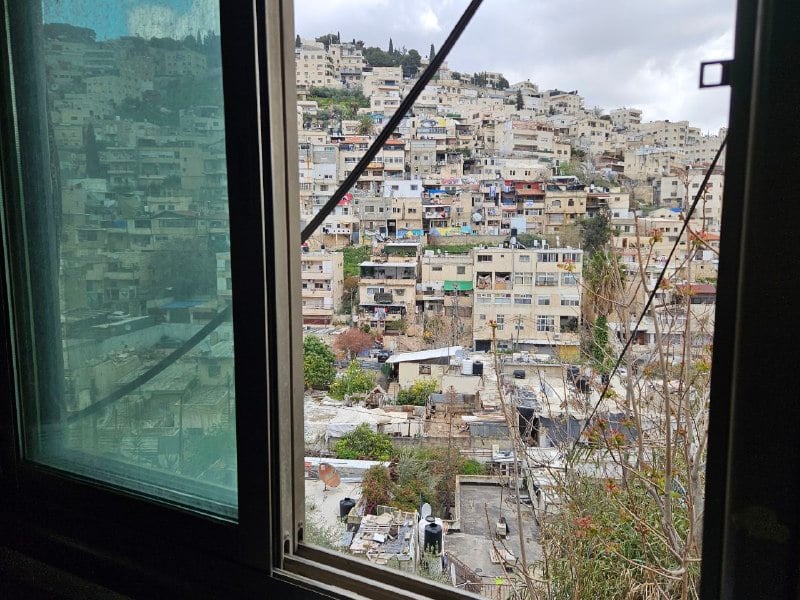
The Batn al-Hawa neighborhood in Silwan, seen from the office window of Yaqub Rajabi, who was evicted from his home. March 31, 2026. (Nurit Yohanan/Times of Israel)
For a decade, Rajabi has helped serve as the public face for the neighborhood as his family and dozens of others have fought legal battle after legal battle against claims by a far-right Israeli group that the land on which their homes sit was owned by Jews forced out a century ago.
In recent weeks, a series of rulings by the High Court of Justice in favor of the Jewish claimants have triggered one of the largest evictions of families from East Jerusalem ever. At the end of March, 15 families were evicted — 11 by force — from their homes, and seven more, including Rajabi’s, are expected to be evicted in the coming weeks.
Cases against dozens of additional families are still making their way through various levels of the courts, but are expected to mirror previous rulings forcing the Palestinians to leave.
“Today they evict your neighbor, tomorrow they evict you,” Rajabi said. “Today they remove your cousins, tomorrow they remove you. There’s nothing you can do.”
History of dispossession
The eviction proceedings were initiated by the right-wing Ateret Cohanim organization, which filed a petition in 2010 seeking ownership of the land on which the families reside. In total, according to Peace Now, a left-wing organization, 37 families, amounting to hundreds of people, have been displaced from the neighborhood since the first eviction was ordered in 2015.

Israeli authorities remove property from a Palestinian home in Silwan during the eviction of 11 families on March 25, 2026. (Peace Now)
Ateret Cohanim did not respond to multiple requests for comment from The Times of Israel.
The organization, established in 1981, works “to restore Jewish life in the heart of ancient Jerusalem,” according to its website. Much of its activities involve purchasing homes in Arab-majority parts of Jerusalem, where it then houses Jewish families, often under armed guard.
In the early 2000s, Ateret Cohanim quietly petitioned the state registrar to be named as trustee over lands in Silwan that had once belonged to a public endowment known as the Benvenisti Trust.
The Benvenisti Trust was established in the late 19th century to house poor Jews of Yemeni origin who had arrived in the country but were unable to find housing within the walls of the Old City. Instead, the trust purchased land for them in Silwan, a neighborhood just south of the Old City that slopes down toward the meeting point of the Kidron and Ben Hinnom valleys.

A view of the East Jerusalem neighborhood of Silwan on December 3, 2017. (Yonatan Sindel/Flash90)
Even then, Silwan was an Arab neighborhood, and Jews were a minority there. Jewish and Arab residents lived in relative quiet until the 1921 riots, which saw violence and looting by Arabs against the area’s growing Jewish population.
Though the rioting did not take place in Silwan, many Jews felt unsafe and began leaving the neighborhood.
In the late 1930s, British authorities told the remaining Jewish residents they must leave due to rising tensions, and the last of them departed, though the trust continued to hold the land.
Following the War of Independence, Silwan came under Jordanian control. Current residents who spoke to The Times of Israel recalled that their families purchased land in the early 1960s from Palestinian residents. One said the seller was a man apparently appointed by the trust to safeguard the land.
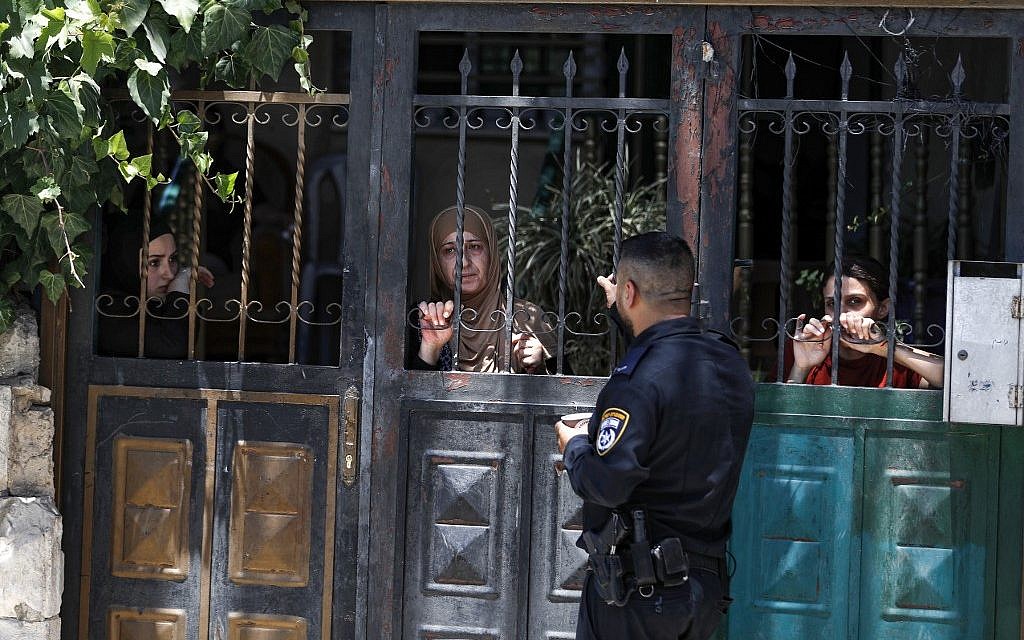
An Israeli policeman stands outside the former house of the Palestinian Siyam family as some of them look out from a gate, during their eviction in the East Jerusalem neighborhood of Silwan on July 10, 2019. (Ahmad Gharabli/AFP)
The purchases, they said, appeared to be aboveboard and they did not think their ownership could be challenged, even after Israel captured Silwan and the rest of East Jerusalem from Jordan in the 1967Six Day War.
By then, the Benvenisti Trust had ceased operating. When Ateret Cohanim applied to take control of it, it cited the fact that the bodies that had been in charge of the trust when it operated no longer existed or were no longer interested.
Painful memories
Whether or not the Silwan residents purchased the homes in what they understood to be a legal process matters little to Israeli law. That’s because of the 1970 Legal and Administrative Matters Law, which stipulates that property owned by Jews prior to 1948 can be reclaimed by its original owners, no matter what happened between 1948 and 1967.
Khalil Basbous, who was evicted from his home along with his wife, children, and grandchildren in January, tried to argue during legal proceedings that the law itself is discriminatory.
He noted that land his family was displaced from in 1948 was now part of a community near Beit Shemesh called Amatzia. Under Israel’s Absentees’ Property Law, property belonging to Palestinians who fled or were expelled in 1948 became state property.
“I told the court, ‘You want to take this land? Take it. I have documents showing I have land there,’” he recalled. “They told me ‘You’re talking politics.’”

Khalil Basbous points to the home from which he was evicted in Silwan. March 31, 2026. (Nurit Yohanan/Times of Israel)
Basbous, 68, had lived in the Silwan house most of his life, since his father purchased the land and built the family home when he was five.
After being evicted, he rented a home just 20 meters away. An Israeli flag now flies off his old home, which he said is currently unoccupied and undergoing renovations ahead of the arrival of a Jewish family.
“When I come and go, I see it,” he said, describing mixed emotions. “I don’t want to move away from the house, but I also don’t want to see it. I see people going in and out and laughing.”
Yaqub Rajabi, a cousin of Zuhair Rajabi, was thrown out of his home on March 25. Because he did not leave voluntarily, enforcement authorities came to remove the family by force, taking out first the people and then the belongings.
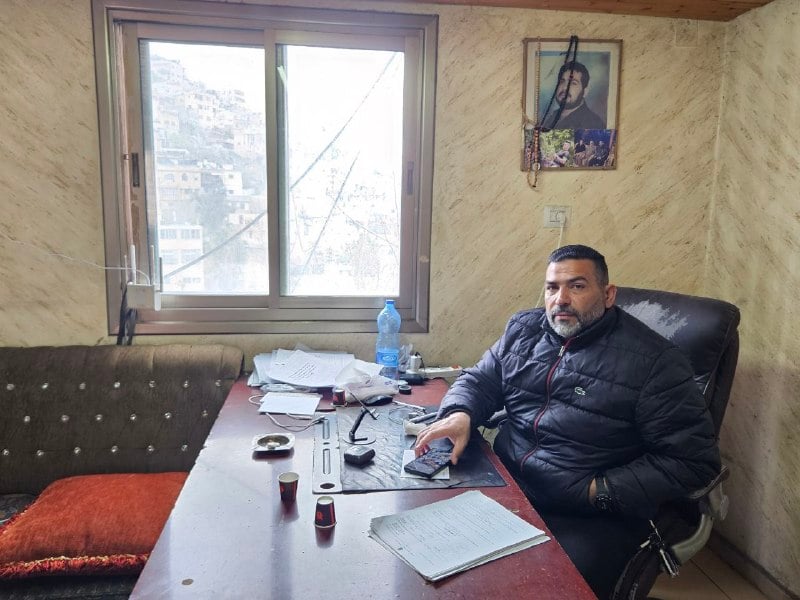
Yaqub Rajabi, who was evicted from his home, in his office in Silwan, March 31, 2026. (Nurit Yohanan/Times of Israel)
“I told them I didn’t want the enforcement authorities to take it — I wanted to collect it myself. They didn’t put it outside slowly so we could take it,” he recalled. “They started throwing it out of the windows.”
Since the “cursed day,” he and his family have lived in another family-owned home in a different part of Silwan.
He can still see the home he was evicted from out of the window of his office, a constant painful reminder of what he has lost.
“That’s the hardest thing and the biggest problem,” he said. “I still see it from here; it’s right in front of my eyes. Every time I see it, I go back [to what was].”
‘Here I don’t know anyone’
Other families have the opposite problem, being forced to move far from their neighborhood and relatives.
Nasser Rajabi, a member of the same Rajabi clan as Zuhair and Yaqub, was evicted in December, and now lives right next to the West Bank security barrier on the outskirts of Beit Hanina, an East Jerusalem neighborhood in the city’s far north.
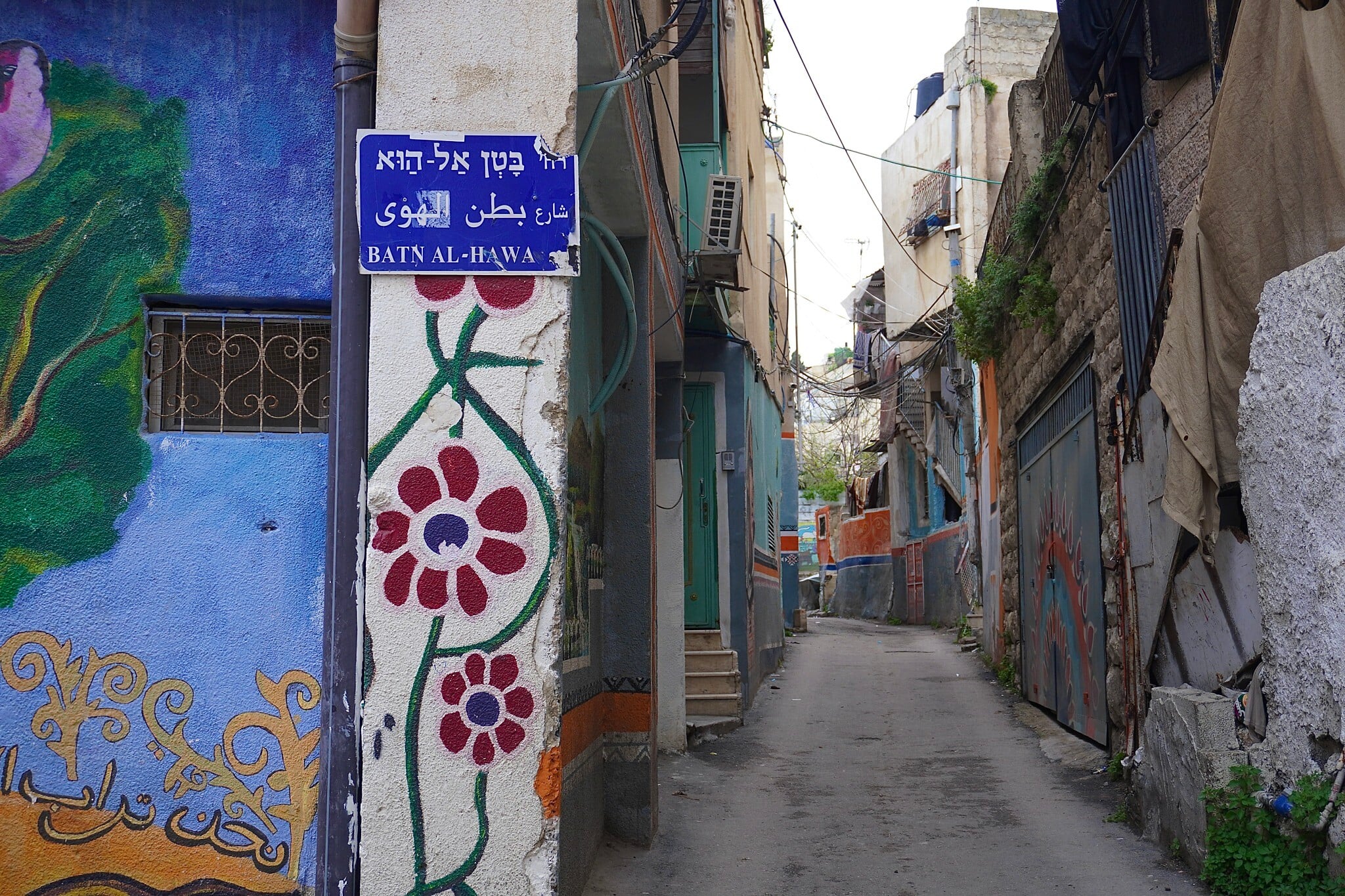
A narrow street running through the Batn al-Hawa area of Silwan, a Palestinian neighborhood in East Jerusalem, on March 30, 2026. (Charlie Summers/Times of Israel)
Born and raised in Silwan’s tight-knit environment, he now lives a completely unfamiliar life in Beit Hanina, a more upscale, modern neighborhood made up of nuclear families rather than large kinship networks.
“In Beit Hanina, nobody knows one another. There are people who have come from the north, from the south. There are many small families, but most don’t know one another in the same way,” he said.
This was especially apparent during Ramadan, which ended in late March. He recounts feeling far more isolated than in past years when breaking the daily fast each evening.
“In Silwan, it’s a different world. During the month of Ramadan, you would prepare yourself for it two months before. You’d clean, put up lights, everyone in the family would gather in one place for iftar,” he recalled.
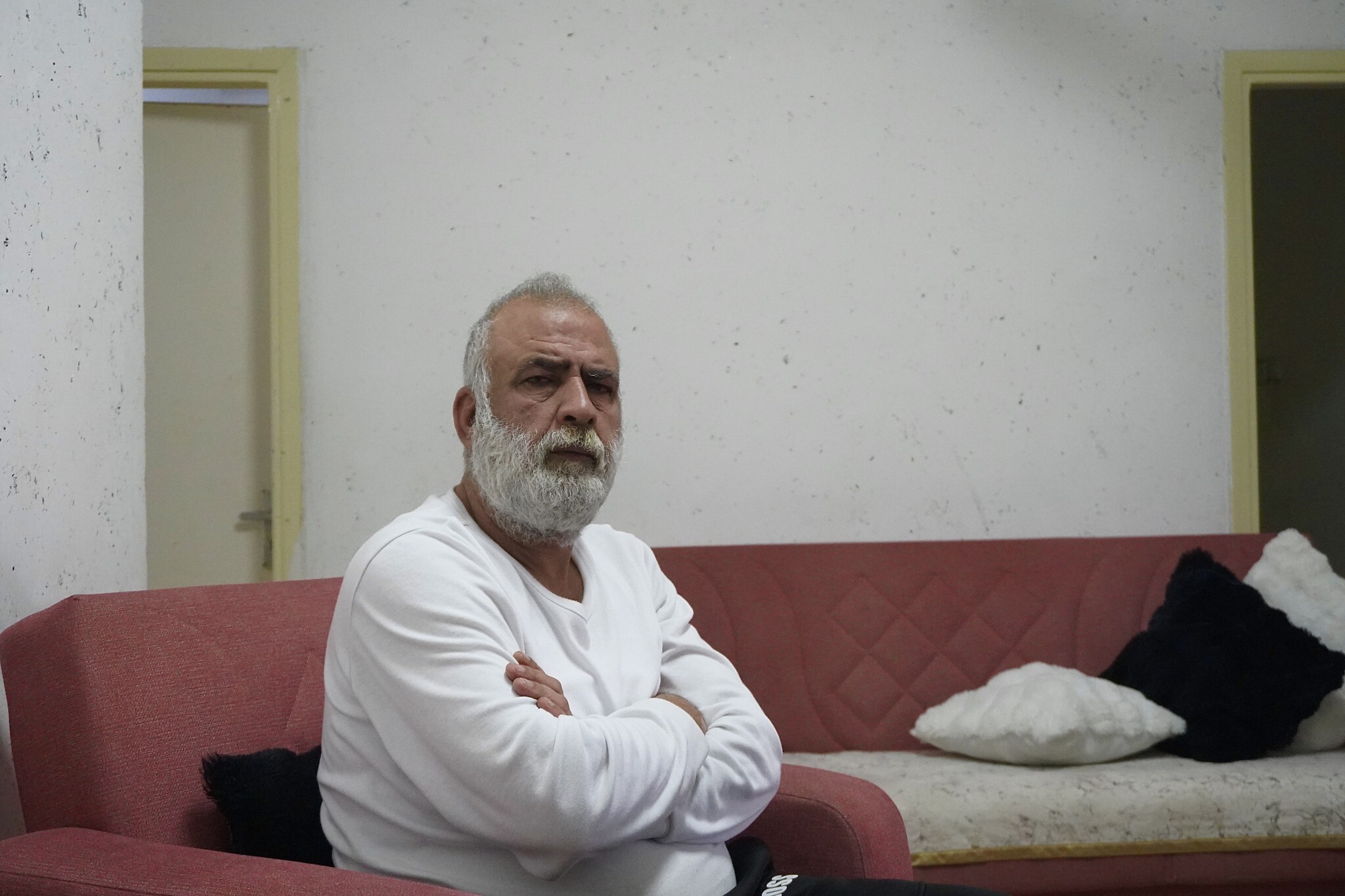
Nasser Rajabi, a Palestinian from the East Jerusalem neighborhood of Silwan, sits in his new house in Beit Hanina after being evicted from his home, on March 31, 2026. (Charlie Summers/Times of Israel)
“I grew up knowing everyone — here I don’t know anyone,” he said from his living room, smoking cigarette after cigarette as he prepared to go to work.
The home in Beit Hanina, where he lives with his own family, his mother and his brother’s family — 14 people in all — is only temporary. The landlord has given him and his family two months to find another place.
Strewn about the dimly lit house were half-emptied cardboard boxes and piles of clothes, signs of his suddenly transient existence.
“It was impossible to grasp in my mind, how could I leave this house, the house I was born in, grew up in,” he said of his Silwan home. “You’re sitting there and within an instant someone comes, a judge signs an order to kick you out,” he said.
Trust issues
Residents said that when they first received eviction notices more than a decade ago, they did not believe they would ultimately be removed from their homes.
“Throughout all these years, we didn’t break — us and the lawyers,” said Basbous. “I had hope that we would stay. First, we’ve been on this land since 1963 — for 50 years no one told us you’re on land that isn’t yours. I thought they would ask them — why didn’t you say so from the beginning? And also, if the trust is being transferred — why not to me? I’m the one living here. Or at least inform me.”
According to Ir Amim, an organization that assists Palestinians in East Jerusalem, the decision to transfer the Benvinisti Trust’s rights to Ateret Cohanim was improper. The process was not conducted publicly and only came to light after Ateret Cohanim began filing eviction lawsuits in 2010.
“When they took control of the trust, there was no one there who could present a contrary position — no one could challenge it,” said Aviv Tatarsky, a researcher with Ir Amim.

A Jewish man stands on the balcony of Ateret Cohanim yeshiva in Jerusalem’s Old City, on August 1, 2017. (Nati Shohat/Flash90)
Their control of the trust, Tatarsky argues, also contradicts its original purpose.
“This is a trust that was originally meant to house poor families. In practice, they are evicting poor families from Silwan,” he said.
He noted that though Ateret Cohanim is supposed to act as executor of the trust, it has essentially merged the trust into its organization.
“In all the petitions, they act in the name of the trust — but the trust has no bank account, nothing — it’s all Ateret Cohanim’s details,” he charged.

Private security guards funded by the state escort a Jewish family to Ateret Cohanim’s Beit Rachel in the Batan al-Hawa district of Silwan, East Jerusalem, on July 31, 2018. (Sue Surkes/Times of Israel.)
Ir Amim filed a petition in 2019 seeking to revoke Ateret Cohanim’s status as trustee due to the alleged irregularities. The case is still pending, but following an inquiry into the matter, the Registrar of Trusts recommended a series of reforms late last year.
These include a full separation between the trust and Ateret Cohanim in day-to-day operations, as well as the publication of clear criteria for what constitutes a “needy family” eligible to live on the land, which do not currently exist.
The recommendations have yet to be implemented. Ateret Cohanim did not respond to a request for comment from The Times of Israel on the matter.
‘They want to throw us out’
For Khalil Basbous, the hardest part of being evicted is not the loss of the house itself, but the sense that the legal system has branded him a trespasser in his own home.
“The story isn’t the house as a house, [it’s] stones and all that, it’s how the police tell you you’re a thief, it’s the Border Police telling you you took someone else’s home, when it’s really the opposite,” he said.
Residents said they feel the process is part of an organized effort to push them out not only of the neighborhood, but of East Jerusalem altogether.
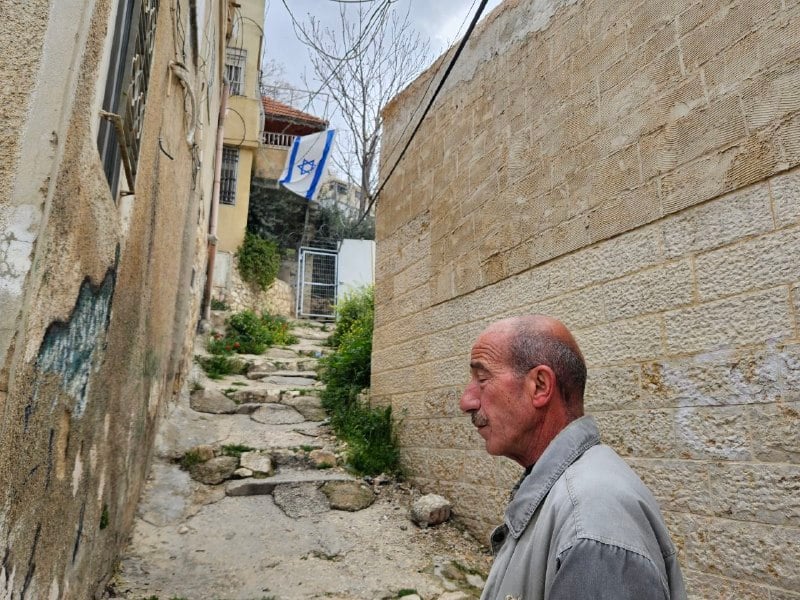
Khalil Basbous near the home from which he was evicted in Silwan. March 31, 2026. (Nurit Yohanan/Times of Israel)
“The feeling is they want to throw us out of Jerusalem — the more they can push you out of Jerusalem, behind the [West Bank security] barrier, the better,” said Zuhair Rajabi.
Though he isn’t leaving his home willingly, he is preparing for a day he knows is coming. Searching for a rental property, he has insisted on remaining in Silwan itself, so as not to be pushed out of the city.
But rentals are hard to come by in the neighborhood, and the fact that he is facing eviction makes it even harder to find housing.
“Sometimes someone says, yes, I have an apartment, come see it,” Rujabi said. “Then they hear you’re being evicted and say, ‘I don’t want it, it’s trouble and all that.’ So we go back to searching again.”