
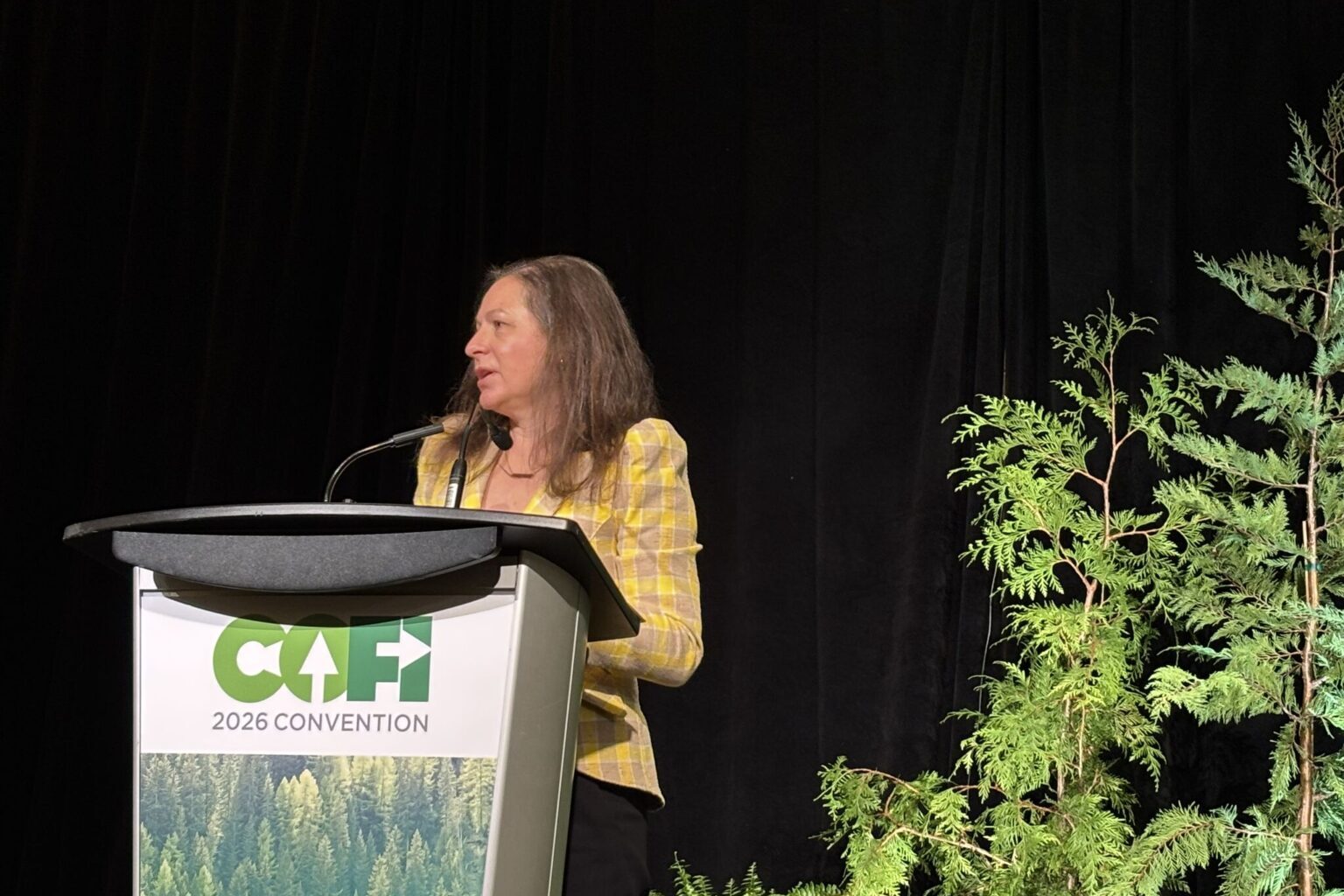
The BC Council of Forest Industries’ (COFI’s) 2026 convention kicked off today with a packed house at the JW Marriott Parq Vancouver discussing the impact and value the sector brings to the city and its surrounding region.
Day 1 of sessions began with an official welcome from Greg Stewart, chair of the COFI’s board of directors; Lisa Dominato, Vancouver city councillor; and Kim Haakstad, president and CEO of COFI; as well as an official Squamish Nation territorial welcome by forestry specialist Brian George.
Dominato discussed the importance of the forest products sector.
“The region is home to about 25% of forestry-related professionals supporting everything from innovation and engineering to finance and logistics. Vancouver alone hosts 560 forestry-related companies and suppliers, representing nearly $1 billion in annual industry spending,” she told the crowd. “That’s why it’s so important to send a clear message to the province at this time that when red tape is reduced and policy enables the forest sector to compete, our tax base grows, strengthening our ability to sustain jobs and find essential public services, like health care and education.”
She also said the forestry sector represents a key solution to solving housing challenges throughout the region.
“Metro Vancouver’s population is expected to grow to 4.1 million people by 2050, driving significant demand for new homes,” Dominato said.
Vancouver recently approved its first city-wide official development plan. Over the next 30 years, it will introduce walkable hubs with diverse housing types and essential services.
“This plan opens up roughly 800 blocks to five- and six-storey wood-frame construction and we’re already seeing progress in this area,” Dominato said. “In 2025, Vancouver approved roughly 3,200 units in wood-frame projects, representing about 25% of all of our housing approvals across the city.”
The city has also modernized its building regulations to assist in accelerating low-rise apartment construction and is continuing to scale mass timber.
“Vancouver has increased allowable heights from six to 18 storeys with density incentives to make projects viable. Mass timber shortens construction timelines and helps control costs, both for builders and for residents,” Dominato said.
She wrapped up by discussing how the forest products sector plays a role in helping the city meet its climate goals.
“Buildings are a major source of urban emissions. Vancouver is targeting a 40% reduction in building emissions by 2030 compared to 2018 levels,” Dominato said. “Wood construction helps us get better. And importantly, trees are a renewable resource, responsibly managed here in British Columbia.”
*Stay tuned for more 2026 COFI Convention coverage.