
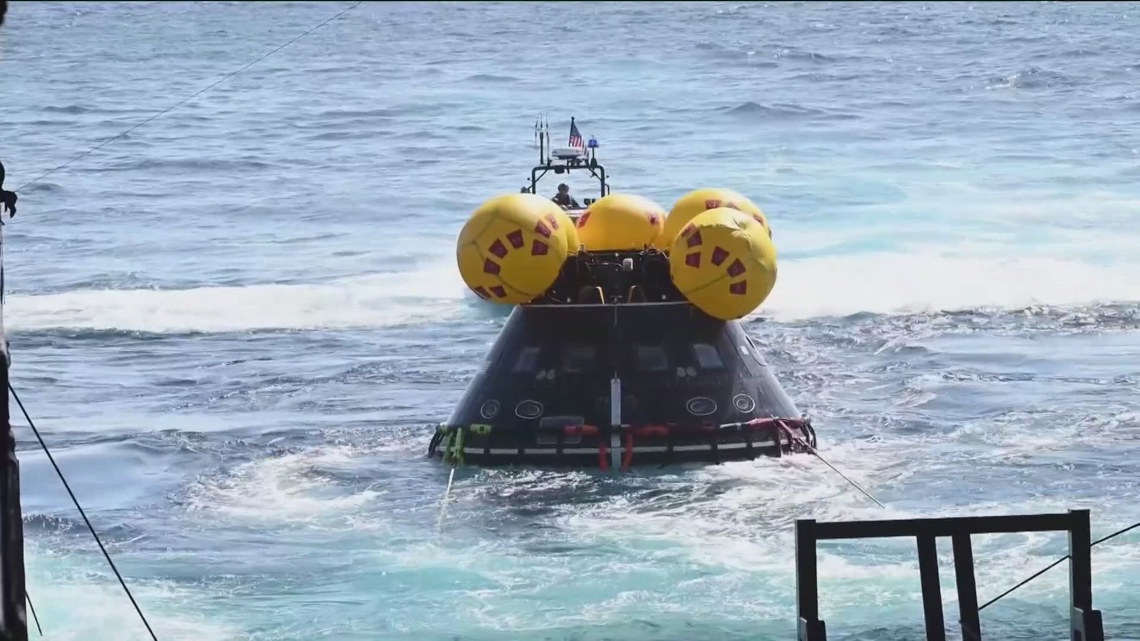
The San Diego-based USS John P. Murtha will be deployed to recover the Artemis II astronauts after their spacecraft splashes down off the coast of San Diego.
OCEANSIDE, Calif. — The San Diego-based USS John P. Murtha will be deployed to recover the Artemis II astronauts after their spacecraft splashes down off the coast of San Diego.
Sailors assigned to the amphibious transport dock ship have been undergoing training in preparation for recovering the Artemis II crew, whose space capsule is set to return just after 5 p.m. Friday, the Navy said Monday.
In a statement, the Navy said the ship has “unique advantages” that will assist NASA in the Orion space capsule’s recovery and collection of “critical data to help ensure it’s ready to recover the astronauts and capsule during future Artemis missions.”
A U.S. Navy helicopter squadron based out of Naval Air Station North Island will assist in tracking the capsule while it travels through Earth’s atmosphere, then recover the four astronauts and bring them to the ship for assessment, the Navy said.
Navy divers will also recover and transport the Orion space capsule from the water to the ship’s deck.
Can you see the splashdown from the shore?
The capsule is expected to splash down in the Pacific roughly between San Clemente Island and Catalina Island shortly after 5 p.m. PT on Friday, April 10.
Francisco Contreras, an Oceanside resident and board member for the San Diego Astronomy Association, told CBS 8 that while the planned landing location isn’t optimal, there is still some hope for those wanting to spot it from along the California coast.
“I’m going to try. I would say, head to the coast. Because it’s so high up and so far away, you should be able to see it from the coast; you don’t have to get close to San Clemente, I don’t think. As long as you can have a clear view northwest, that would be your best chances to see it.”
“And, what we’re hoping is to see, not much from here, unfortunately, because of the time of day. But about 50 miles offshore, there’ll be some rescue boats, and that’s part of the reason San Diego is so special. As a Navy town, we’ve got all of the facilities and structures in place to support these astronauts coming back home…This is a pretty good place to come back to,” Contreras said.
The mission reached a historic milestone Monday as astronauts flying around the far side of the moon traveled farther from Earth than any humans in history. They surpassed the previous distance record set by Apollo 13 in 1970 at 248,655 miles during a lunar flyby Monday morning, according to NASA.