
Fast Retailing Co., operator of Uniqlo clothing stores, reported record sales and profits but warned that its products may become more expensive down the road due to rising oil prices.
For the six months ending in February, Fast Retailing sales soared 14.8 percent year on year to 2.0552 trillion yen ($12.9 billion), while net profit surged 19.6 percent to 279.2 billion yen, both record highs, the company said April 9.
For the full business year ending in August, the company forecasts revenue of 3.9 trillion yen and net profit of 480 billion yen.
Takeshi Okazaki, a director at Fast Retailing, said the war in the Middle East will likely not have an immediate negative effect on the company’s performance.
“The current rise in oil prices has an extremely limited direct impact on this fiscal year’s performance,” he said at the company’s interim earnings briefing on April 9.
Iran’s effective blockade of the Strait of Hormuz has halted shipping traffic and pushed up crude oil prices. Oil-derived synthetic fibers are used in clothing, including those sold at Uniqlo stores.
According to Fast Retailing, the company’s preparation for Uniqlo products begins a year before launch, meaning that fibers and other materials are procured at an early stage.
“As far as what we can see through August, we have secured a clear outlook for the procurement of materials,” Okazaki said.
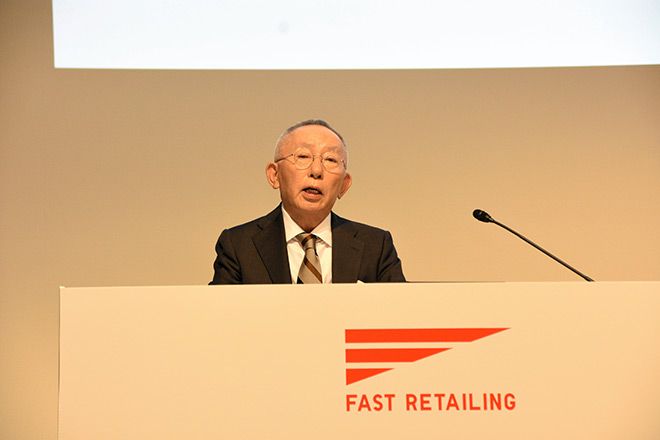
However, Tadashi Yanai, chairman and CEO of Fast Retailing, did not rule out possible price increases in for the longer term.
“In order for customers to continue buying our products, we need to endure what we can,” he said, but added, “It is not possible for only us to avoid raising prices.”
Fiber manufacturers, such as Toray Industries Inc. and subsidiaries of Teijin Ltd. have announced price hikes for synthetic fibers used in clothing.
Synthetic fibers are made from naphtha, a crude gasoline product refined from oil, and other petroleum-derived materials.
Naphtha prices have also risen since the U.S.-Israeli airstrikes against Iran opened the war on Feb. 28.
The United States and Iran agreed to a two-week cease-fire on the evening of April 7. But both sides have already accused the other of violations, and some media outlets have reported that Iran has once again sealed off the strait.
Takahiro Kazahaya, a senior analyst at UBS Securities Japan Co. who specializes in the apparel industry, said if the closure of the strait is prolonged, “it cannot be ruled out that prices for products from next spring and summer onward will be reconsidered.”