
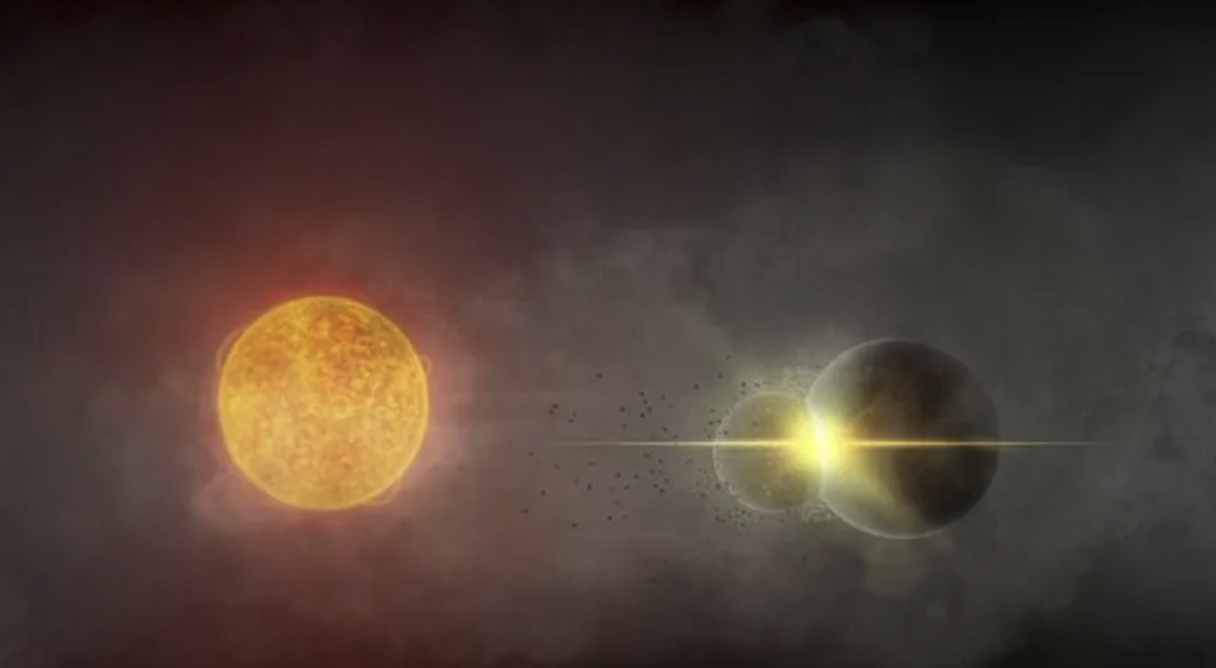
Planet formation is a dynamic process. In its final stages, many worlds often crash into each other. These events, called giant impacts, play a central role in shaping planetary systems. Astronomers may now be observing such an event in real time.
In a recent SETI Live discussion, astrophysicist Dr. Moiya McTier spoke with astrophysicist Anastasios (Andy) Tzanidakis, a final-year astronomy Ph.D. candidate at the University of Washington. They shared evidence for a system called Gaia GIC1 (also referred to as Gaia20ehk), which may represent an ongoing planetary-scale collision.
What makes it exciting is that it emerges from time-domain astronomy, enabling researchers to observe changes as they occur rather than only the aftermath.
An Unusual Signal in the Data
The discovery started with data from the Gaia space telescope, a mission by the European Space Agency that has mapped nearly two billion stars. Gaia continuously monitors stellar brightness with high precision through its alert system, which flags transient or variable phenomena.
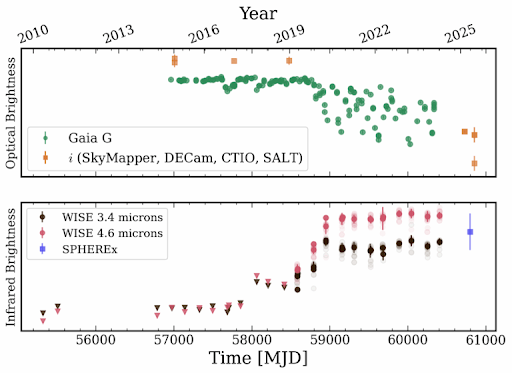
Gaia’s alert system identified Gaia GIC1 due to its unusual variability. The star’s brightness evolution, represented by a light curve, a graph of brightness as a function of time, shows three distinct phases:
Figure showing optical and infrared brightness evolution of Gaia GIC1 over time. Image credits: Andy Tzanidakis
An extended period of stable brightness
Regular dips of about 25% every 380 days
A sudden change to deeper and more irregular dimming, up to 50%
These changes are illustrated in the figure below, which shows both the optical light curve and the corresponding infrared evolution.
This behavior is atypical. When planets pass in front of stars, they usually block only a tiny fraction of the light, indicating that a substantially larger structure is responsible for the observed dimming.
Dust And Heat Explain The Situation
To figure out what was happening, scientists looked back at data taken by the NEOWISE infrared telescope. Infrared observations are particularly sensitive to heat emitted by dust.
They found that as the star’s optical brightness decreased, its infrared emission increased. This is a visible sign of infrared excess, an observed surplus of infrared radiation relative to expectations, typically caused by warm dust absorbing and re-emitting stellar energy. This fits well with the idea of a recent collision.
The persistence of both strong infrared emission and continued optical dimming suggests that the debris cloud remains present and thermally active. In this case, the data suggest a thick cloud of debris spreading outwards.
Could It Be Something Else?
Given the complexity of astrophysical systems, alternative scenarios were considered.
One possibility involved evolved stars, such as red supergiant stars, which can eject large amounts of dust. However, spectroscopic data showed that Gaia GIC1 is not an aging star.
Another idea involved a planet breaking apart near the Roche limit, the distance within which a celestial body is torn apart by tidal forces due to a larger body’s gravity. This process can also produce dust clouds. But those events usually happen very close to the star and change quickly. That does not match what we see here.
The best explanation so far is a giant impact happening about 1 astronomical unit (AU) from the star. That is roughly the same distance as the one between Earth and the Sun, a region commonly associated with terrestrial planet formation.
A Young System In Formation
Age is a critical factor in interpreting the data. Giant impacts are most frequent in young planetary systems, generally within the first 100 million years.
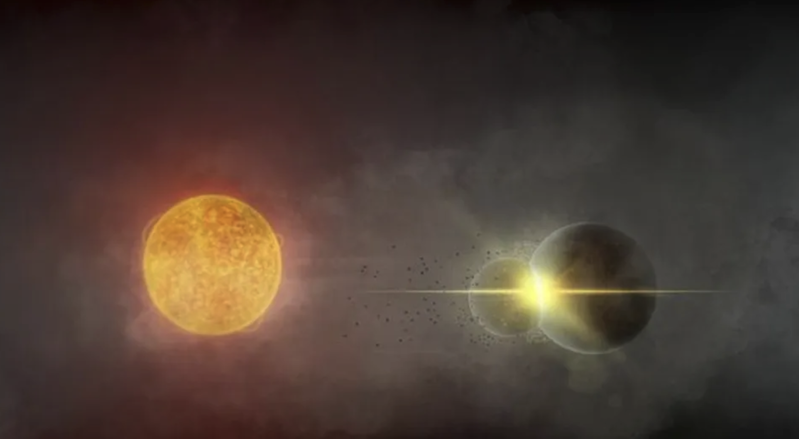
An illustration of two planets colliding near the star Gaia20ehk in 2021. (Image credit: Andy Tzanidakis)
Evidence suggests Gaia GIC1 is young. It sits near clusters of stars that likely formed together and are less than 40 million years old.
It’s hard to measure a star’s age directly, but being part of a cluster gives a good estimate. If Gaia GIC1 belongs to one of these groups, it supports the collision idea.
Why Giant Impacts Matter
Giant impacts are a big part of how planets evolve. For example, the most widely accepted theory of how the Moon formed involves a Mars-sized object colliding with early Earth.
These collisions affect:
Planetary composition
Atmospheric development
Orbital configuration
Potential habitability
Understanding their frequency is essential. Current observations suggest a mismatch between theoretical predictions and detected events. Gaia GIC1 may help resolve this, since it represents one of the few detections enabled by time-domain astronomy.
What Happens Next?
Unlike other candidate systems, Gaia GIC1 has not returned to its original brightness. The optical signal remains dimmed, while the infrared emission persists, indicating that the dust cloud is still present and evolving.
Future observations may involve the James Webb Space Telescope, which can analyze the dust’s spectroscopy and how it interacts with light. This could reveal its composition, if it contains silicates, metals, or even traces of planetary atmospheres.
That would give us a much clearer picture of what happens after planets collide.
A New Era Of Discovery
This discovery highlights the power of modern astronomical surveys. By constantly watching billions of stars, astronomers can now catch rare events as they happen.
As next-generation observatories such as the Vera C. Rubin Observatory come online, the volume of data will increase dramatically. Identifying rare phenomena like giant impacts will require advanced computational methods, including machine learning.
Moreover, Gaia GIC1 represents more than a single system. It is a proof of concept, showing that planetary collisions can be observed in real time. Expanding the sample of such systems will be essential for understanding how frequently these events occur and how planetary systems form and evolve.
Watch the full SETI Live conversation here. Read the press release and the published paper.
Final questions
1. Can scientists really observe planet formation in real time?
Yes. Scientists can observe planet formation in real time using Time-domain astronomy. Systems like Gaia GIC1 exhibit unusual brightness patterns that may indicate ongoing planetary collisions, offering direct observational insight into planet formation.
2. What is a giant impact, and why is it important for planet formation?
A giant impact is a collision between large planetary bodies during the late stages of formation. These events shape planetary structure, composition, and orbital dynamics. The Giant Impact Hypothesis suggests Earth’s Moon formed from debris after a Mars-sized object collided with early Earth.
3. What is infrared excess, and what does it reveal?
Infrared excess is when a star emits more infrared radiation than expected due to warm dust. It indicates debris that absorbs and re-emits energy, often from planetary collisions.