
Animal behavior is becoming easier to understand, thanks to science.
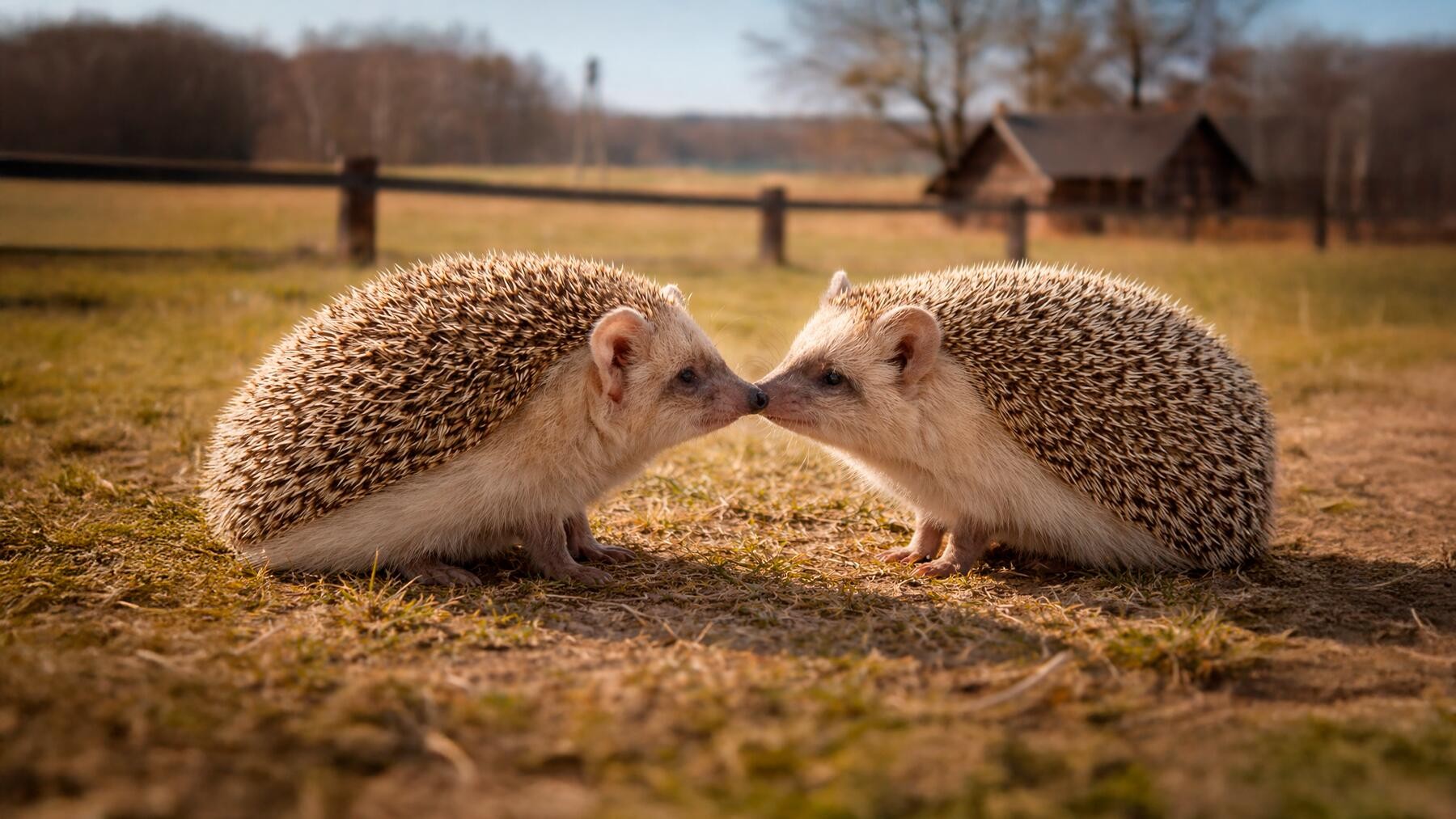
Biologists have spent decades studying animal life on our planet to better understand the evolutionary process. And one researcher recently found a ‘secret language’ being used by several species, like hedgehogs and chimpanzees, that has largely been overlooked by the scientific community for years.
Why has this hidden form of communication been overlooked by science for decades?
How animals communicate has influenced our own species over time
This fascinating subsector of science has been a major advancement in human understanding of animal communication.
We have learnt that several linguistic experts have stated that our ability to verbally communicate may have come from the “musical” calls of primates that existed many moons ago.
Animals have even played a part in some of the most important developments made by mankind over the last century.
Sonar was directly influenced by the echolocation abilities of bats and dolphins. The phenomenon uses the same concept to map the world and enable us to navigate the treacherous regions of the planet with ease.
How many more technological advancements are going to be influenced by studying animal life on our planet?
Biology has taught the world how animals mimic us as humans in several ways
We have no doubt that many of our most emblematic behaviours are deep-rooted instincts that evolved over time from our animal kin.
Such as the recent discovery that chimpanzees have a serious proclivity for shiny crystals as opposed to normal rocks. They feverously hold on to these crystals and refuse to let go like a child clasping onto their favorite plush toy.
A significant portion of humans’ love for dancing and music most likely comes from studying animal courtship in the wild.
We know that life, even on the molecular level, is capable of complexities that previously were only attributed to those forms of life with a brain. This has been proven recently as a single-cell organism was able to complete a complex learning test, even without a brain or a single neuron.
Understanding that life on our planet can come in various shapes and forms has enabled science to study the world around us with a renewed sense of curiosity and amazement.
A recent study, “Exploring nose-to-nose contact in mammals,” published in Evolution and Human Behavior, has detailed a remarkably similar behavior among several animals.
Nose-to-nose communication in animals explained by study
The aforementioned study has found that nose-to-nose communication exists among several different species of animal life.
We know that some species of animals, such as monkeys, display complex behavior that we used to think only existed in humans. Such as monkeys having a social hierarchy that affects their appetite for risk-taking.
We have wondered where the act of kissing emerged from for us as humans.
The recent study analyzes how nose-to-nose communication in mammals works. They found that several species exhibit the same nose-on-nose behavior in complex social bonding and communication.
Several species of animals are “kissing” to communicate
The study details how nose-to-nose interactions across multiple species of mammals have mostly been overlooked by science and biology for decades. We know understand that such behaviors in hedgehogs and even chimpanzees may have been an evolutionary precursor, if you will, for kissing among humans.
So while some humans prefer a solitary existence away from others, this study finds that other mammals may also “kiss” each other to communicate.
The study provides the basis for further examination as hedgehogs, which are normally solitary animals, and chimpanzees use nose-to-nose contact and interactions to express themselves to one another.
Is there more evidence of this behavior in other animals? Time and, more importantly, science will tell.