
Breathing with your ribs feels so normal that it’s easy to forget it’s an invention. The chest expands, the lungs inflate, and oxygen flows in – no gulping, no throat pumping, and no reliance on damp skin to trade gases with the air. But that rib-driven style of breathing had to start somewhere.
A new study in Nature points to a surprisingly tiny creature as one of the earliest pioneers: Captorhinus aguti, a small, lizard-like amniote that lived about 289 million years ago.

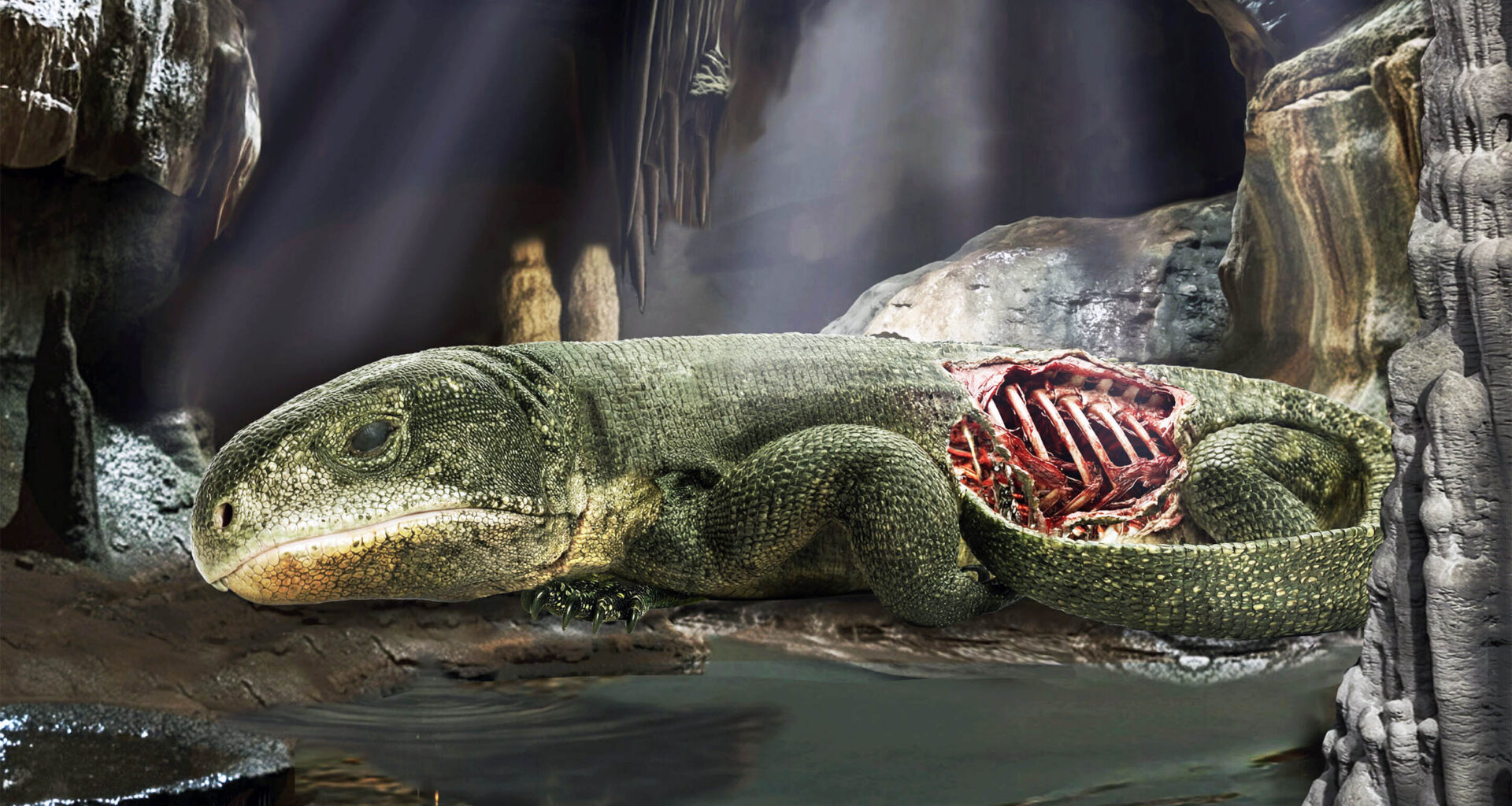
The fossil was found mummified in an Oklahoma cave system, and it preserves something paleontologists almost never get to see from this era: not just bones, but also skin, cartilage, and even traces of ancient proteins.
Together, these tissues reveal the oldest known example of costal respiration in amniotes, the group that includes reptiles, birds, mammals, and their shared ancestors, showing how they breathe.
Mummified Captorhinus aguti fossil
Captorhinus aguti came from Richards Spur, a site in Oklahoma famous among paleontologists for its dense record of late Paleozoic land animals. The cave system has yielded an unusually diverse snapshot of life from that time.
What made this particular discovery stand out is how the environment preserved the body: conditions such as oxygen-poor mud and hydrocarbons helped keep the tissues from collapsing and rotting away.
So instead of a flattened imprint, researchers found something closer to a natural “mummy” – a small animal frozen in a lifelike pose, with one arm tucked under its body.
To study it without damaging it, the team used neutron computed tomography (nCT) at a facility in Australia, which let them look through the surrounding rock as if they were performing a medical scan.
Accordion-like skin pattern
When teams began working through the scan data, researchers realized there was far more than bone present.
“I started to see all these structures wrapped around the bones. They were very thin and textured. And, lo and behold, there was a nice wrapping of skin around the torso of this animal,” said Ethan Mooney, who co-led the study while working in Professor Robert R. Reisz’s lab at the University of Toronto.
“The scaly skin has this wonderful accordion-like texture, with these concentric bands covering much of the body from the torso up to the neck.”
That “accordion” pattern is especially interesting because it resembles the flexible, ringed scales seen in modern burrowing reptiles like worm lizards.
This kind of body design lets an animal bend and twist without tearing its skin, but the skin wasn’t the main prize.
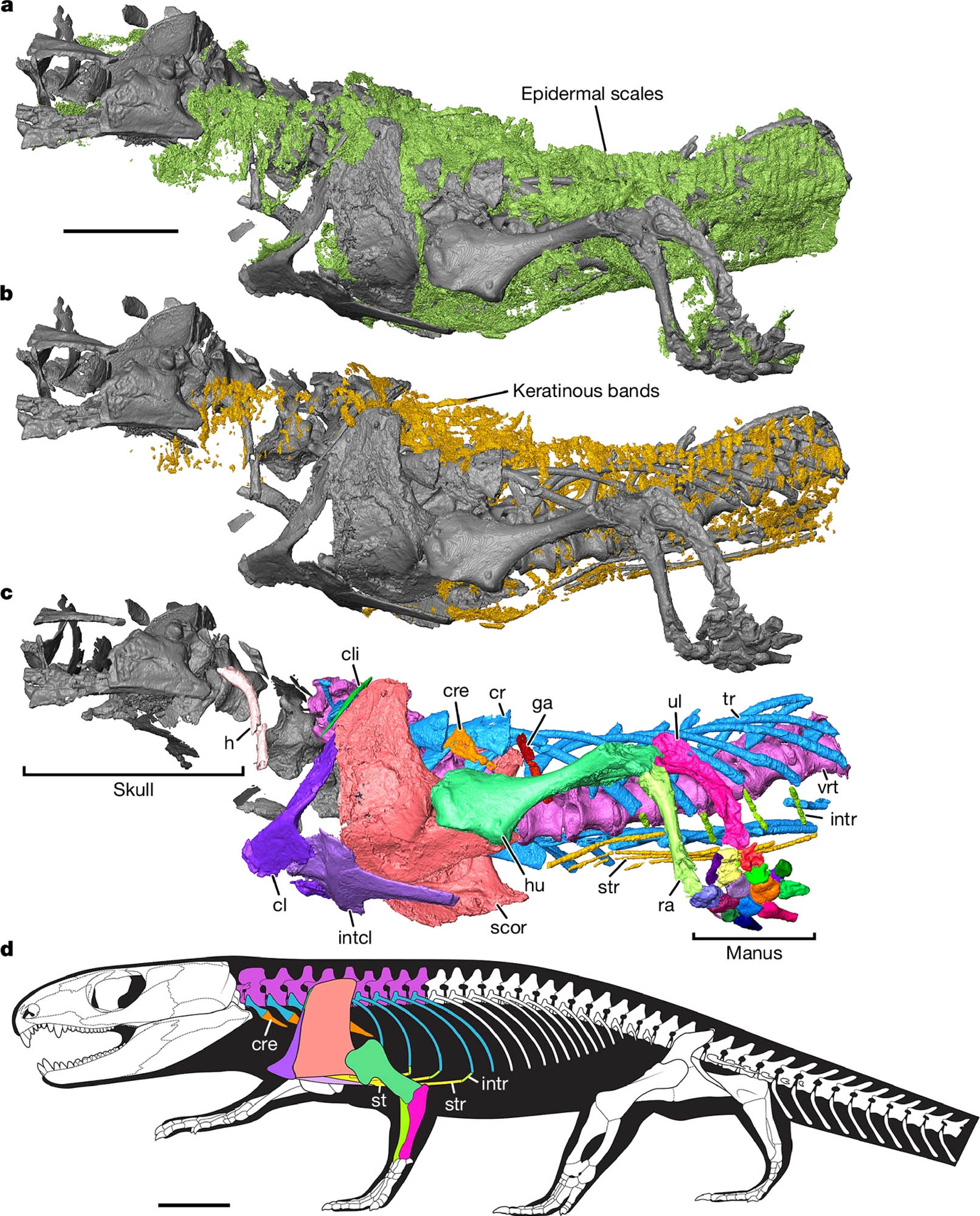 Digital recreation of mummified Captorhinus aguti fossil from 289 million years ago showing nCT renderings and skeletal reconstruction in left lateral views. Credit: Nature. Click image to enlarge.Human link to Captorhinus aguti
The researchers examined three Captorhinus aguti specimens, and together they preserved a set of chest structures that are rarely visible in fossils this old.
In one specimen, the team identified a segmented cartilaginous sternum, ribs associated with the sternum, intermediate ribs, and connecting structures that link the rib cage to the shoulder region.
That combination matters because it allows scientists to reconstruct something that’s usually lost to time: how the entire breathing apparatus was assembled in an early amniote.
“We propose that the system found in Captorhinus represents the ancestral condition for the kind of rib-assisted respiration present in living reptiles, birds, and mammals,” Reisz said.
Thus, this little Permian reptile may show the basic layout that was later refined into the breathing mechanics that power everything from a running lizard to a flying bird to a human sprint.
Breathing changed life on land
Before amniotes, the dominant land vertebrates were reptile-like animals that could breathe partly through their skin and used a mouth-and-throat pumping method to move air into their lungs.
That system can work, but it is not well suited for animals that need to be highly active on land.
Costal breathing – the system in which muscles between the ribs expand and compress the chest cavity – is more efficient. It can pull in more air, exchange gases more effectively, and support higher activity levels.
“It was a game changer that allowed these animals to adopt a much more active lifestyle,” Mooney said.
That extra oxygen capacity may help explain a broader historical pattern. Once amniotes – including early reptile ancestors – had the tools to live and breathe more powerfully on land, they diversified rapidly and eventually became the dominant land vertebrates.
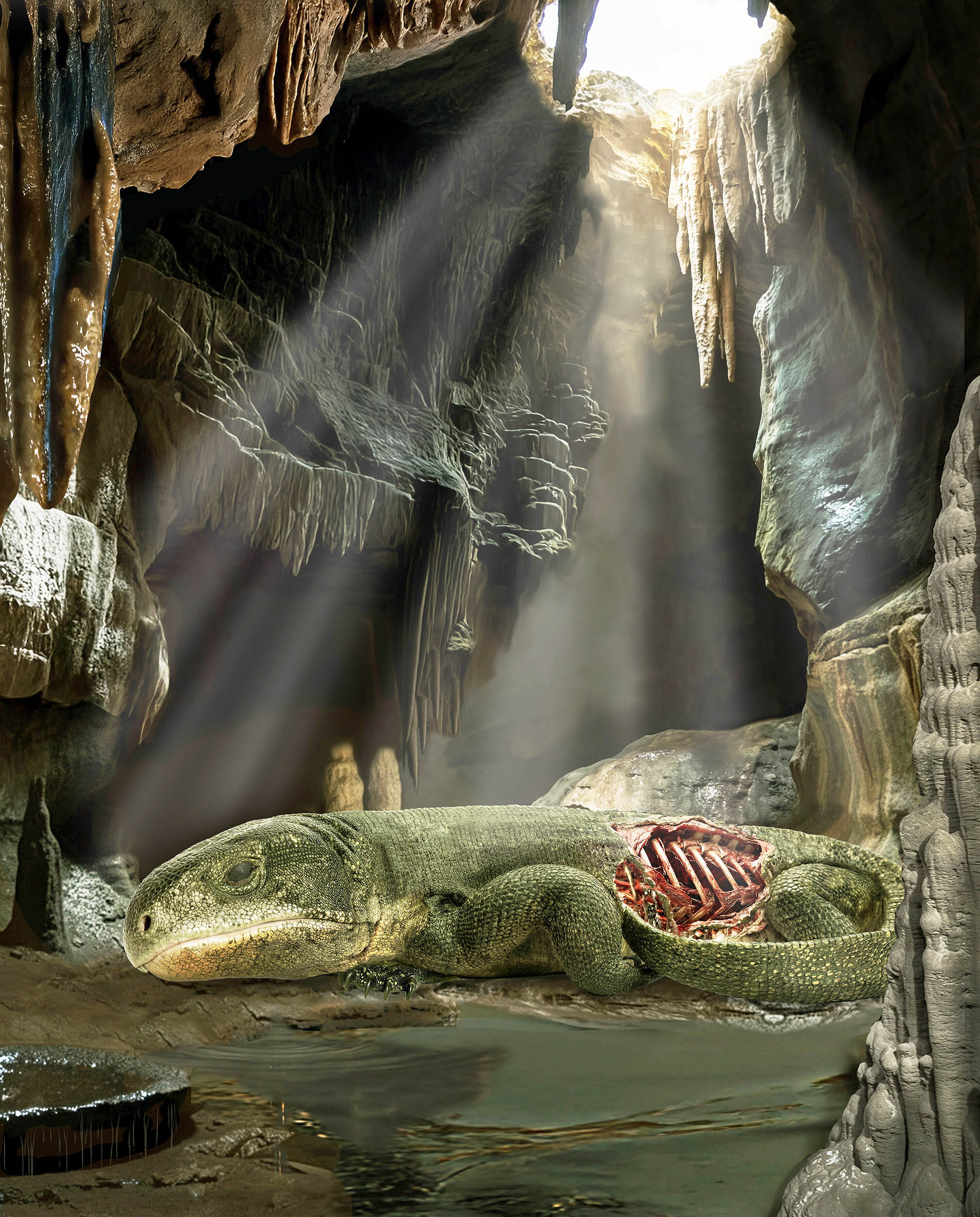 289-million-year-old reptile Captorhinus aguti, first human ancestor to rib breathe, in its death pose in a cave system. Credit: Dr. Michael DeBraga. Click image to enlarge.Ancient proteins still remain
The fossil didn’t just preserve anatomy. Using synchrotron-based infrared spectroscopy, the researchers also detected remnants of original proteins in the fossil’s bone, cartilage, and skin.
“The protein remnant finding is exceptional, and it dramatically pushes our understanding of what is possible in terms of soft tissue preservation in the fossil record,” Mooney said.
That is a significant finding because Paleozoic fossils are usually far too old to retain anything like original organic molecules.
The study suggests that, under the right conditions, the fossil record may be holding onto biochemical clues from much deeper time than scientists previously assumed.
Lessons from Captorhinus aguti
Captorhinus wasn’t a dinosaur-sized giant or some dramatic “missing link” skeleton. It was small, common, and probably the kind of animal that once scurried through the undergrowth without much fuss.
But thanks to extraordinary preservation, it is now helping explain something fundamental. It shows how early amniotes turned breathing into a powerful engine for life on land – and how that same basic design still drives the rise and fall of our own ribs every day.
The full study was published in the journal Nature.
—–
Like what you read? Subscribe to our newsletter for engaging articles, exclusive content, and the latest updates.
Check us out on EarthSnap, a free app brought to you by Eric Ralls and Earth.com.
—–